Video Interview Bias Examples and How to Avoid Them
Five video interview bias examples with simple fixes for each. Plus, scoring criteria, a scorecard you can copy, and how to check AI scores.

By Ekrama Taimuri
October 21, 2026
13 min read
TL;DR – Key Takeaways!
- Reduce video interview bias by scoring job skills, not first impressions.
- Set questions and scoring criteria before reviewing candidates.
- Compare independent ratings and investigate unexplained gaps.
- Check AI scores against recorded answers before deciding who advances.
When you open a video, the lighting, the speaker’s confidence, and the choice of words can shape your first impression before you assess the answers. Video interview bias can emerge beneath the surface. Subconscious judgments can form around the speaker’s gender, religious clothing, skin color, or a name unfamiliar to the reviewer.
Regardless of how well candidates answer, impressions of accent or appearance can influence candidate ratings.
Furthermore, when the brain is under cognitive load, mental shortcuts (heuristics) can influence fast decisions. Across a long queue of candidates, repeated reliance on first impressions could lead reviewers to overlook qualified people.
That's a video interview bias. It's when a candidate's score is shaped by something other than their ability to do the job. It happens in live interviews and one-way interviews alike, and from the inside it just feels like having an opinion.
It's also hard to switch off by trying harder.
Research covered by Harvard Business Review shows similar patterns in broader hiring. One study linked women’s selection chances to the gender makeup of the finalist pool. Another found fewer callbacks for equally qualified applicants with Turkish names and headscarves in Germany. These studies concern hiring generally, rather than video interviews specifically, but highlight why impressions deserve scrutiny before they become hiring decisions.
In another study, published in Cognitive Research: Principles and Implications, people watching simulated video interviews rated candidates higher when the video and sound were better, even after researchers told them to ignore recording quality. Awareness alone did not remove the effect.
This article focuses on video interview bias and how you can reduce the risk during hiring. You’ll see five common examples, learn why two reviewers can score the same answer differently, and use a scorecard to support decisions with evidence. We’ll also look at where AI scoring helps and where human review still matters. Let’s hop in.
5 Common Video Interview Bias Examples
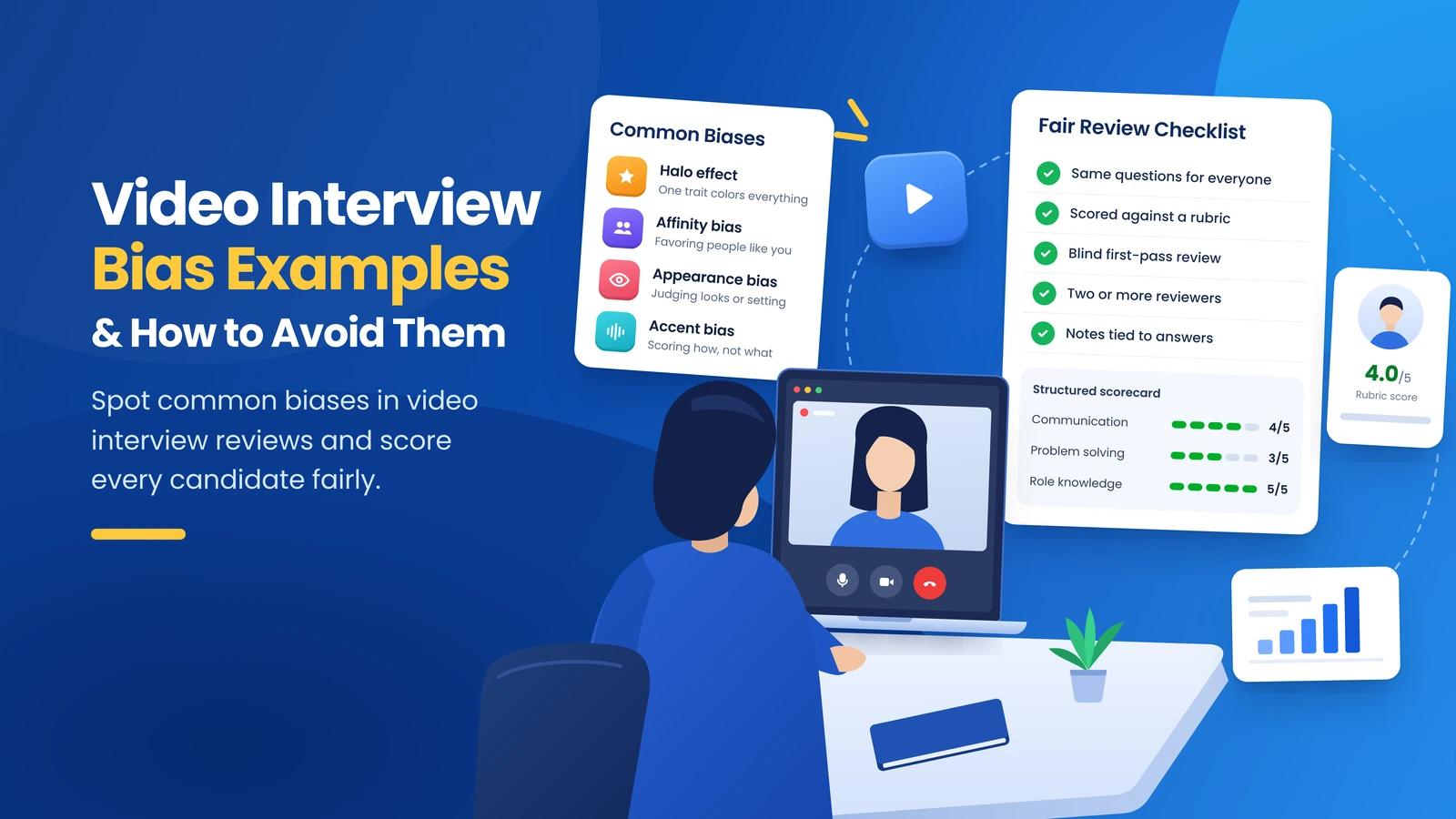
These five video interview bias examples show how judgments can drift away from job skills. For each one, here’s what the problem looks like and what to do instead.
1. The Halo Effect (First Impressions that Stick)
One good moment makes everything else look good. One bad moment is the opposite.
It's 4:45 pm, and you're on candidate number 31. Priya opens with a smooth intro, a great voice, and a quick joke. You relax. By question three you've stopped really listening and started nodding along. Daniel, who comes next, stumbles on question one. He recovers, though, and by question four he's describing exactly how he rescued a project that was six weeks late, including the awkward call with an angry client. If Priya still wins, you scored polish, not project management.
What to do: Score answers, not people. Watch question one for every candidate and score it. Then move on to question two. This way, a shaky start can't drag down the whole interview, and a great start can't carry it.
2. Affinity Bias (Liking People Who Feel Like You)
Affinity bias is the tendency to favor people who seem familiar: the same school, the same city, or mutual friends. In candidate evaluation, familiarity can become a substitute for evidence of job ability.
Marcus, a hiring manager, spots that a candidate went to his old university. Within seconds, he's thinking, "I like this person."
Two videos later, Aisha, who freelanced for years and then joined a small agency, gives an answer that's just as strong.
But Marcus still has his mind on the first candidate. Why? He sees a good fit without pointing to anything job-related.
What to do: If you use remarks like “a good fit,” add “why” and name a quality relevant to the job. If you struggle to find one, think twice. A clear reason helps you challenge biased judgments.
3. Accent and Communication-style Bias
How fast someone talks, how they pause, and how they sound can change how smart they seem. It tells you very little about how smart they are. This shows up a lot when you are hiring all around the world.
Similarly, two candidates can approach questions differently. One emphasizes formal wording while the other explains how to do the task, step by step.
What to do: Decide what communication the job needs, and score that. For customer support, a criterion could be “explains the next step clearly and checks the customer understands.” You can observe and measure that skill.
Avoid vague goals like “sounds polished.” Some jobs need strong spoken communication, but write the requirement into the criteria before watching. Clear criteria help limit subjective ratings.
4. Appearance and Video Quality Bias
Imagine watching an interview video with bad lighting, a quiet voice, and a messy background. Those details can nudge your opinion, even when they have nothing to do with the job.
Research on video interview bias found that poor audio and video quality lowered candidates’ hiring ratings; the study did not specifically test messy backgrounds.
The next candidate has a ring light, a tidy desk, and a decent microphone. Nobody decides "Candidate A is less capable." You just find the second video easier to watch, and that comfort quietly becomes a score.
What to do: Allow candidates to retake where appropriate and read any note explaining recording issues before scoring. If technical problems prevent a fair review, offer another way to answer. Retakes alone cannot resolve every source of unfair scoring.
TestTrick’s pre-recorded video interviewing tool lets recruiters add text or recorded questions, set answer times, and enable retakes in the assessment settings.
5. Confirmation and Anchoring Bias
Anchoring bias means getting stuck on your first impression. Confirmation bias means noticing details that support that impression while dismissing details that challenge it.
You decide something early, then spend the rest of the interview looking for proof. For example, you decide in the first minute that a candidate lacks confidence because they struggle with the first answer.
During the next question, the candidate pauses. You think, “That proves it.” When they give a sharp answer to question three, you think, “Lucky.” You’ve stopped weighing the evidence and started defending your first guess, another form of video interview bias.
What to do: Take notes on what you heard (“explained how they solved the customer’s problem and checked the solution worked”) instead of a vague judgment (“seemed unsure”). If you’re unsure about who should advance, ask a second person to score independently before comparing results. Sharing opinions too early can influence the second reviewer.
Why Two Reviewers Score the Same Answer Differently
Even when two recruiters watch the same answer, they can disagree on the score because each give more or less weight to different parts of the response. Without shared criteria, bias becomes harder to spot.
Picture two recruiters, Sana and Ben. Sana gives the answer 4 out of 5: “The candidate explained how she reduced customer waiting time from 10 minutes to 6.”
Ben gives the answer 2 out of 5: “The candidate’s answer was too long, and she rambled.” Sana is scoring evidence, and Ben is scoring delivery. The agreed scoring guide should determine how much each factor matters.
Neither reviewer intends to be unfair. Each uses a private idea of “good.” One loves detail; another prefers short, sharp answers.
One hears confidence and thinks “capable.” Another barely notices it. When criteria live in personal opinions rather than clear rules, subjective judgments can turn your shortlist into a guessing game.
A few things help:
If two people can’t point to the same criterion, they’re scoring different things. A line like “includes a specific example with a result” would help Sana and Ben explain their scores. Averaging scores alone will not resolve a disagreement about what matters.
Score on your own first, then talk
Otherwise, the loudest or most senior person sets the number.
Use a two-point rule
On a five-point scale, if two reviewers differ by two or more points on one answer, stop and talk it through. Ask, “What in the answer led to your score?” Use the gap as a review trigger, not proof of video interview bias.
Practice together
Before watching real applicant videos, your team should grade three practice videos on their own. Then, compare your scores. You do not need the exact same score. Instead, talk about why you gave different scores using real proof from the video answers.
How to Reduce Video Interview Bias: Seven Practical Steps
Video interview bias can occur in both one-way and live interviews. These practices give recruiters a shared process for judging job skills and checking questionable results.
1. Write your Scoring Guide Before you Watch Anything
Start with a scoring rubric. Describe what a weak, average, or strong answer looks like before you watch candidates. If you write the guide after a favorite appears, you risk writing it around that person. A guide helps keep reviewer preferences in check.
For example, ask: “How would you handle an unhappy customer?”
| Score | What it looks like |
|---|---|
| 1 | No clear plan; blames the customer or brushes it off |
| 2 | Offers a fix but doesn't acknowledge the problem or find the cause |
| 3 | Acknowledges the problem, finds the cause, gives a clear solution |
| 4 | Resolves the issue completely, identifies why it happened, implements a permanent fix to stop it, and contacts the customer later to confirm satisfaction |
These descriptions focus on job-related actions rather than appearance or accent. They give reviewers a shared reference for checking questionable ratings.
One-way video interviews help you keep questions consistent. Develop a set for each role and use the same set for candidates applying for that job. Consistency supports comparison, but it does not eliminate video interview bias.
Prepare different question sets for each field, such as IT, finance, supply chain, or marketing. Behavioral interview questions can help candidates describe relevant actions and results.
3. Keep a Standard Process for all
Use the same preparation time, answer limits, and retake settings for candidates applying for the same role. Give everyone clear instructions. Consistent conditions help reduce avoidable differences that can feed unfair comparisons.
Provide appropriate accessibility adjustments when needed, and document any changes. Fair treatment does not always require identical conditions.
4. Use video interview software with clear scoring controls
Choose one-way video interview software with controls for questions, recording limits, and evaluation. At TestTrick, built-in features support a shared review process, while your team remains responsible for checking video interview bias.
- Set up questions: Add written or recorded video questions relevant to the role. Set the answer time and enable retakes where needed, using consistent settings for candidates applying for the same job.
- Define the scoring criteria: For written questions answered on video, generate AI scoring criteria, then review and edit the suggestions to match the skills you need to evaluate, such as explaining a solution clearly. AI scoring isn’t available when the question itself is a recorded video.
- Review scores by question: Check individual question scores alongside overall results, so one strong or weak answer doesn’t dominate your assessment.
- Watch the answers yourself: Compare the recorded response with your scoring guide before deciding who advances. Look for evidence of job skills and question any score the answer doesn’t support. Human review also needs safeguards against bias.
- Share results with your team: Use candidate assessment reports to review overall scores, test results, and performance by skill. Export PDF or Excel reports to give reviewers a common reference for discussion.
5. Score Skills Separately
One overall score cannot tell you whether a candidate fits the job. If the role needs technical depth and clear communication, score both separately. Separate ratings make video interview bias easier to question.
6. Think About Accessibility
Tell candidates how to request adjustments, and offer another suitable way to take part when needed. A clear, accessible process supports candidate experience and interview completion while helping you address video interview bias.
7. Check your Results Every Few Months
A hiring process can seem fair and still produce unequal results. To check for video interview bias, compare how many candidates advance at each stage, by reviewer and, where legally permitted, by groups such as gender, race, or ethnicity.
The pass rate is the percentage of candidates who move to the next stage. If 3 out of 10 women advance, their pass rate is 30%. If 5 out of 10 men advance, their pass rate is 50%.
In the US, the four-fifths rule is a screening guide: divide the lower pass rate by the higher one. Here, 30% ÷ 50% = 60%, below the 80% threshold. Investigate the difference, but do not treat a small sample or the threshold alone as proof of discrimination. The rule can flag a concern; it cannot establish the cause of video interview bias.
How to Write Video Interview Scoring Criteria: A Scorecard You Can Copy
Good video interview scoring criteria don’t need to be fancy. Define the skills the role needs, describe strong answers, and record evidence before assigning scores. A clear scorecard helps reviewers check video interview bias.
| Skill | What a strong answer show | Score guide | Evidence from the answer | Score |
|---|---|---|---|---|
| Problem-solving | Explains the problem, action, and outcome | 1 = no evidence; 2 = partial; 3 = clear; 4 = clear, with tests or results | A relevant example from the recording | 1–4 |
Three habits make it work.
- Fill in the evidence column before you pick a number.
- Score each skill separately, such as communication and technical knowledge.
- Record any overall impression last, after scoring the evidence.
Remember: support every rating with useful notes. Suppose you’re hiring a Python developer. Instead of “good communicator,” write what the candidate explained, such as how the script worked and how they tested it. Specific notes help another reviewer check for video interview bias.
For a Python developer, use this illustrative question:
“Describe a Python tool you built, the problem you faced, and how you checked the solution worked.”
Use a 1–4 scale for each skill: 1 = no relevant evidence; 2 = partial evidence; 3 = clear evidence; 4 = clear evidence supported by tests or measurable results. Define the expected evidence for each skill before the interview. The sample below illustrates basic scoring safeguards; it is not a validated assessment.
| Skill | What a strong answer shows | Evidence from the answer | Score |
|---|---|---|---|
| Problem-solving | Explains the problem, solution, and result | “I built a script that checked stock levels and flagged products needing a reorder, reducing manual checks from 30 minutes to 5.” | 4/4 |
| Python knowledge | Explains relevant coding choices and testing | “I used dictionaries to store product details and tested cases where stock was below, equal to, or above the reorder point.” | 4/4 |
| Communication | Explains the work in a clear sequence | Described the problem, code, and outcome clearly, but didn’t explain what “reorder point” meant. | 3/4 |
Write observations before choosing scores. “Good communicator” gives another reviewer little to assess; specific notes explain why the candidate earned each rating. Keep the score and the evidence together when reviewing video interview bias.
Does AI Scoring Remove Video Interview Bias?
AI now supports several hiring stages, including resume screening and recorded answer evaluation. AI video interview scoring can speed up review and apply a rubric consistently, but consistency alone does not remove video interview bias.
Some AI tools can reduce variation between human reviewers by applying the same scoring criteria. Results still depend on the inputs, criteria, and model. Check what the system measures before assuming it ignores appearance, accent, or other possible sources of video interview bias.
A 2015 SHRM article reported that Novartis conducted 2,700 video interviews, avoided $475,000 in costs, and reduced manager travel by 220 trips. Those results describe efficiency savings, not evidence that AI reduces video interview bias.
Facial expressions or tone of voice should not become default scoring criteria without evidence of relevance to the job. A person needs to stay in the loop. Human oversight means checking questionable scores against recorded answers and correcting decisions when the evidence supports a change.
Explore TestTrick’s video interview features to see how questions, scoring criteria, and recorded answers fit your review process.
When to Double-Check an AI Score
Don't wait for a complaint. Take a second look when:
- The score doesn’t match the evidence in the answer.
- The score is very high or very low, and you can’t see why.
- The recording has poor sound or video quality.
- The system appears to misinterpret an accent, speech difference, or disability-related communication pattern.
- You’re unsure whether the candidate should advance, and the score could decide the outcome.
- The tool cannot provide a useful explanation of the score.
Keep Video Interview Bias in Check
Reducing video interview bias takes more than good intentions or consistent AI scores. Set clear criteria, record evidence, and compare independent ratings before making decisions.
When an answer and a score do not match, investigate the gap. A fairer review process gives candidates a chance to show the skills the job needs.
Frequently Asked Questions of Video Interview Bias
What are examples of video interview bias?
Common video interview bias examples include the halo effect, affinity bias, accent bias, appearance or recording-quality bias, and anchoring. Each can lead reviewers to give weight to something unrelated to job ability.
How can recruiters reduce bias in one-way video interviews?
To reduce video interview bias, write a scoring guide first, ask candidates for the same job-related questions, and use consistent timings with appropriate accessibility adjustments. Score independently before discussing differences, and check who advances at each stage.
How should a hiring team score recorded answers?
Use written criteria for each question and describe weak, average, and strong answers. Note the evidence before giving a number. Score each skill separately and save any overall impression for last.
Does AI scoring remove video interview bias?
No. AI can make scoring more consistent, but it can repeat biased patterns or measure factors unrelated to the job. Check scores against the answer, ask vendors for relevant bias audits, and keep a person responsible for the final decision.
Should I mark a candidate down for a poor-quality recording?
Treat poor audio or video as a technical issue. If you cannot judge the answer fairly, offer a retake or another suitable format. Assess job-relevant communication through clear criteria rather than production quality.
Build a Hiring-Ready Assessment
Create role-specific, anti-cheat assessments and shortlist candidates on evidence, not guesswork.
Start for freeBy Ekrama Taimuri
October 21, 2026
13 min read
Build a Hiring-Ready Assessment
Create role-specific, anti-cheat assessments and shortlist candidates on evidence, not guesswork.
Start for free