AI Video Interview Scoring vs. Human Evaluation: A Guide for Recruiters
Learn how AI video interview scoring compares with human reviews, where scores fall short, and how hiring teams can check results
By Ekrama Taimuri
October 9, 2026
13 min read
Human interviewers and AI have a relationship that has continued to evolve over the years. In the realm of recruitment, the two have evolved into rivals. I mean, both are strong in their own way of doing the job.
AI can be trained to evaluate a candidate’s job-related alignment using a blend of data parsing and response analysis. They use the same rubric and the same question set yet can score answers differently.
It felt like magic back then when AI was a myth: yet, today, in a short time, while you are having a cup of tea, you can have a pile of answers with AI video interview scoring right in front of you.
Of course, humans are the core pillars when deciding whom to approve and take the interview further, but AI is a pretty good choice.
To be precise, for high-volume ranking, you just add the questions and, after a couple of weeks, a mound of AI video interview analytics for candidates in bulk is right in your face. Your judgement is no less vital thereafter.
The article is more than a guide. It is a research-powered piece drawing on I-O psychology research and third-party platform benchmarks.
In this research, we have discussed some important points; we talked about structured prediction and found some surprisingly remarkable data.
Balancing AI Structure with Human Ownership in Video Interviews
As per Schmidt and Hunter’s meta-analysis, structured human interviews are more predictive of job performance than unstructured interviews.
Fabric reports 60% to 90% alignment between AI and human scoring once teams calibrate a structured rubric, a common guide for evaluating candidates (the vendor’s comparison concerns adaptive AI interviews, not validation of every one-way video platform).
This raises a question and diverts the mind: the truthful battle isn’t about AI vs. humans; it is all about which part of AI video interview scoring you should take ownership of while keeping both well-structured.
AI video interview scoring compares recorded answers with job-related criteria and assigns ratings. Human review checks those ratings against the answer evidence; a live human interview adds a separate conversation.
If you need the format basics first, you can read our blog: An ultimate guide to one-way video interviews.
| Area | AI video interview scoring | Human interview |
|---|---|---|
| Scoring | Applies set criteria across many answers. Poor criteria might be repeated too. | Can use the same rubric, but ratings can vary. |
| Bias | Scores might have flaws in the system or its rules. | First impressions can affect ratings (or halo effect) do occurs. |
| Candidate experience | The recorded format can remove scheduling for the first screen. The format and setup affect completion. | Let's candidates ask questions but require a shared time slot. |
| Best stage | First-round screening with clear job criteria. | Later rounds need follow-up questions and cultural discussion. |
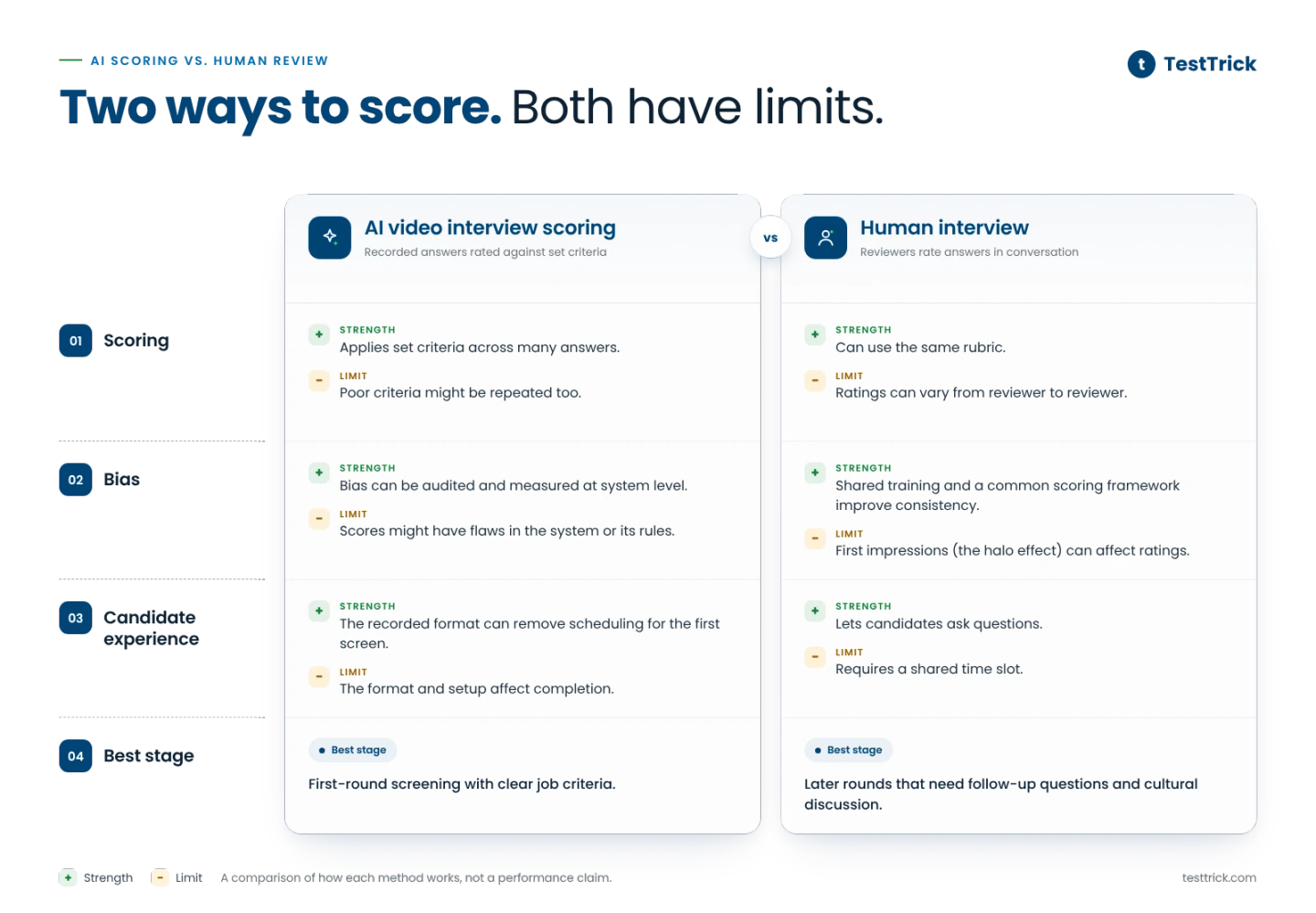
Simple AI scoring versus Human Review Graphic
AI Video Interview Scoring and Human Interview Performance Evaluation - Research Has Some Powerful Insights
Determining the Usefulness of Video Interview AI Assessment
To resolve the issue, you must track structured human judgment very closely at scale. Research involving 1,073 mock video interviews found stronger evidence of validity for AI personality assessments trained on interviewer ratings than on self-reports. Although reliability findings remained mixed. These findings concern personality assessment, not proof of hiring accuracy, or later job performance.
AI video interview scoring accuracy isn’t defined only by an AI algorithm's power, but also by how the rubric structure is designed.
High-quality rubrics with specific behavioral anchors open a wide, clear evaluation range. Vague rubric compresses and weakens it. The real question is no longer, should we trust human intuition versus AI algorithms? Instead, we must ask if the rubric both are scoring against is robust enough to make either option reliable.
The U.S. Office of Personnel Management recommends shared interviewer training and a common scoring framework. Teams do not invest in calibration risk inconsistent human ratings. Before deploying AI scoring, check how both reviewers and the system apply the agreed rubric.
You can learn more about setting criteria in our blog on building a talent assessment framework.
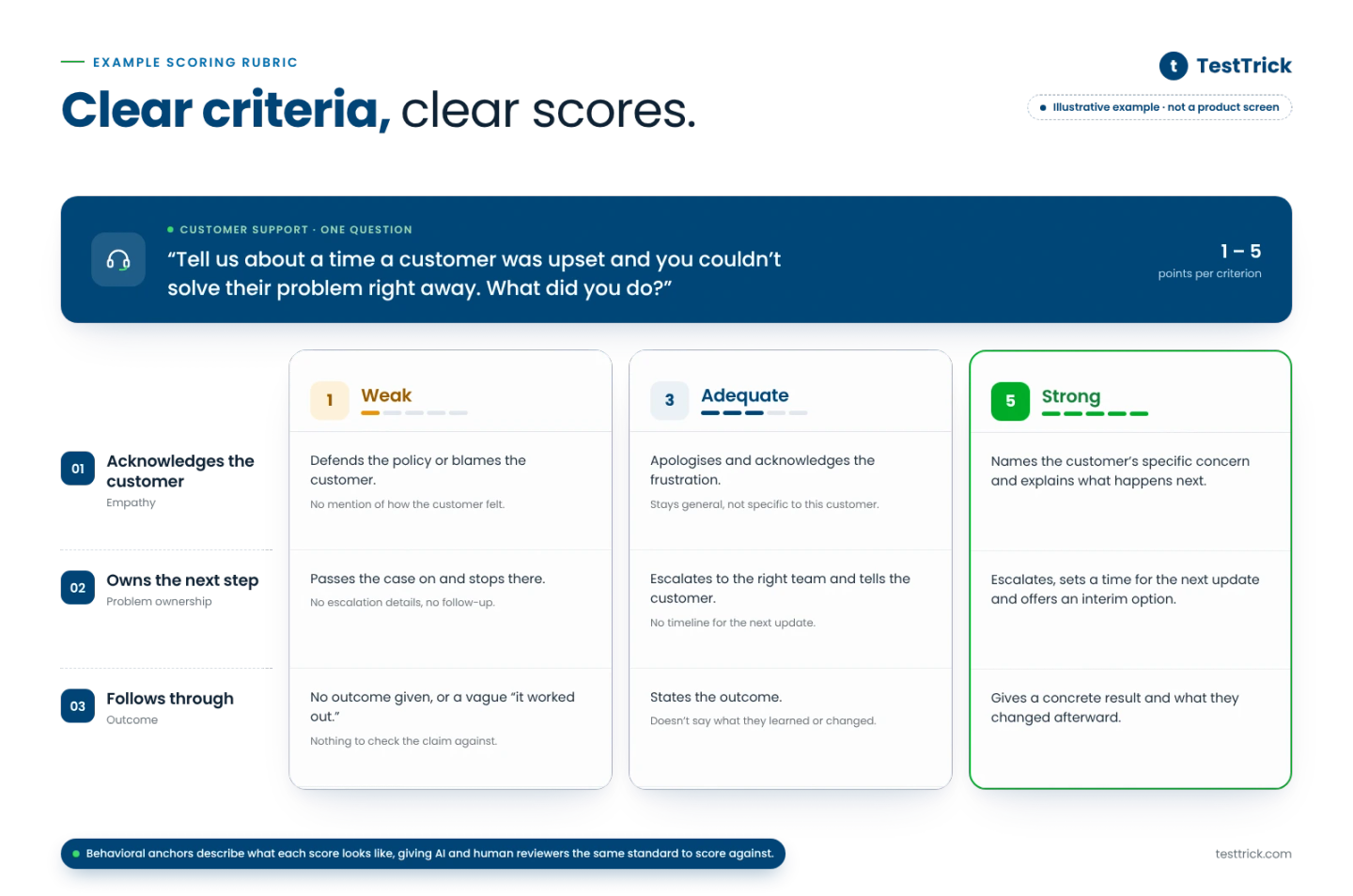
Labelled Example Rubric for One Customer-Support Question
Time is everything - Speeding up is cost-saving - AI fills it
The difference you can measure is time, and the more it consumes, the more your sales might get affected indirectly.
Aptitude Research’s findings conveys: 82% of recruiters have lost quality talent. The cause is poor interview process (the report measures broader interview-process problems, not one-way video scoring speed).
Human screening is a time-taker, which takes up to 2–5 business days once back-and-forth scheduling is added.
Ntrvsta’s efficiency benchmarks claim the time difference as a comparison: traditional phone screening takes an average of 45 minutes, while AI phone screening takes an average of 12 minutes (a vendor cost comparison, not an independent test).
When an enterprise matures, that trivial subject starts wasting significant recruiters' time.
The time savings from AI phone screening depend on the workload and setup: the amount of effort saved varies across teams. The saved time can shift toward sourcing, meeting stakeholders, and high-level corporate conversations dependent on human judgment and discussion.
Do candidates abandon AI?
As we know, AI screening can finish quicker than human screening in vendor comparisons. One cause is the dependency on shared availability in human screening, bringing back-and-forth scheduling when rescheduling becomes a common factor, even before the interview begins.
The finding from Outhire’s benchmarks shows that 70% to 85% of candidates complete AI phone screening interviews in its reported data.
But the format can influence data points. In a separate vendor comparison, Ntrvsta reports phone-based conversational screening completion above 95% and video interview completion between 40% and 60%.
The comparison provides limited detail about the samples and methods, so those figures do not establish completion rates for all AI video interviews.
To dig further into it, Fabric brought to light its own view of the video interview industry. The vendor cites an industry completion rate of 60% to 70%, without providing an independent industry benchmark.
However, Fabric cites a 90% completion rate for its own adaptive interview format, which differs from fixed one-way recordings.
The moment the priority becomes a completion rate, the format choice matters, in particular when the dilemma is between AI and human interaction.
What influences abandonment comes to light in Greenhouse’s 2026 candidate AI interview report: among US respondents, reported reasons for dropping out included pre-recorded AI-scored video without human interaction (33%), undisclosed use of AI (27%), and AI monitoring (26%).
The findings highlight process concerns, not a universal rejection of AI or measured completion rates for each format.
Forecasting recruitment success and retention
Interview format is not the only variable that predicts the hiring outcome; structure also matters. Each candidate receives the same questions built upon the same rubric-mapped grading, with answers measured against concrete examples (anchors) of work behavior.
Researchers Frank Schmidt and John Hunter compared the validity of 19 selection methods and found stronger job-performance prediction for structured than unstructured interviews, while a separate meta-analysis of 111 inter-rater reliability coefficients examined rating consistency rather than predictive accuracy.
Such concrete changes for AI screening are important: automated video interview screening without a well-structured rubric lacks clear evaluation standards, and a recording alone does not create a structured interview process.
Decoding the Structural Advantages of AI Video Interview Scoring
AI video interview scoring can offer an edge where high-volume hiring is the practice, with the potential to apply criteria repeatedly at speed, although consistency alone does not guarantee accurate ratings.
High-Volume Recruitment
Imagine a recruiter in an urgent hiring process hiring eight candidates a day, which is around 40 a week and 160 in a four-week month. Calling each one with back-and-forth rescheduling takes time, whereas AI integration can resolve it within a few hours without a shared interview slot.
Candidates' experiences illustrate the shift: in Greenhouse’s 2026 survey, around 63% of US job seekers reported experiencing an AI-powered interview.
For more on screening at scale, read our blog: High-volume hiring assessment strategy guide.
Assessing AI video interview scoring and human interview quality
An obvious advantage is applying the same AI video interview scoring criteria across candidates. Humans are susceptible to cognitive bias by nature. The horn effect, halo effect, affinity bias, and fatigue-related rating differences can occur, although AI can also repeat bias rather than reduce it.
Comparing AI interviewers with human interviewers solely on quality is a side-by-side comparison of standardized scoring against potentially variable human ratings, not a guarantee of fairness on either side.
Evaluating the culture fits. Human vs AI
Culture fit judgment is a touchpoint where the comparison turns upside down. AI video interview scoring uses NLP and LLMs with semantic analysis and behavioral anchors, lacking emotional understanding.
A recruiter with experience and an understanding of the culture explores a candidate’s unclear answers and role fit, going beyond what the candidate delivers within the script.
The approach Fabric recommends is for AI to handle top-of-funnel screening while humans lead the upcoming conversation about culture fit and personality. The recommendation does not prove that AI should replace every first-round interview.
Algorithmic Fairness vs. Human Bias. A Comparative Analysis of Recruitment Equity
Both methods have their own forms of bias. The question is where those bias live and if there is any possibility of examining it. In AI video interview scoring, clear criteria give both reviewers a shared reference.
How Human Bias Weighs on the Hiring Process
There is division, a lack of documentation, and (often limited evidence) to assess how human bias occurs or how reviewers judge candidates, making the process harder to examine.
Halo effects, affinity bias, or horn effects occur at an individual level, and without proper documentation or quick recorded evidence, the opportunity to detect them can disappear.
According to Greenhouse, US candidates report similar perceived bias from artificial intelligence and human interviewers, with 36% reporting age bias and 27% reporting racial or ethnic bias in both types of evaluations (candidate perceptions, not measured discrimination).
Human and AI bias patterns
AI video interview scoring risks can be critical because of how a system has been designed and trained on past hiring data.
Biased patterns can pass down from the historical hiring data used to build a model, much like inheriting a genetic trait from a parent. We can address the risk through appropriate audits and review.
Still, human training requires consistent effort to address bias, while teams monitor, correct, and measure AI bias at a system level with appropriate data and expertise.
Supporting defensible recruitment records
New York City’s Local Law 144 sets requirements for covered automated employment decision tools, with civil penalties for violations. An independent auditor must conduct a bias audit within a year before use, and employers or employment agencies must publish a summary of the results.
Before using an AI tool, employers or employment agencies must give affected candidates or employees notice at least 10 business days in advance. Failure to meet these requirements can lead to civil penalties.
Even if employers use an outside hiring company or software, they can remain responsible for discriminatory hiring practices. The EEOC describes a rule of thumb called the "four-fifths rule."
A selection rate for a race, sex, or ethnic group below 80% (four-fifths) of the highest group’s selection rate generally indicates possible adverse impact, rather than automatically proving unlawful discrimination. For AI video interview scoring, ask a qualified adviser which rules apply to your hiring locations.
Candidate Experience Benchmarks for AI vs. Human Screening Interviews
Candidate Sentiment in the Age of AI Interviewing
Candidate experience is as important as a recruiter’s experience. AI video interview scoring can support a process if the setup is clear and respectful. Candidates report positive, neutral, and negative experiences. On the other hand, human processes can also be confusing or even disrespectful.
The Impact of Scheduling Speed on Candidate Choice
Scheduling problems can create or even multiply friction at each stage of the screening process. More candidates can lose interest. Recruiters reschedule more interviews. The time increases. The administrative burden adds up. There is back-and-forth, and you are in the loop. AI video interview scoring offers a different workflow.
You just set the questions and the criteria, and then bulk-send the emails. Here, parts of the process can be automated, depending on the platform. You control the schedule. You control the criteria. Candidates provide answers.
How AI vs. Human Interviews Impact Candidate Stress
Greenhouse’s candidate data reveal something, we all expected (and should expect). When an organization discloses upfront how AI will be used during the process, candidates have clearer expectations, although the survey does not establish a completion-rate increase from disclosure.
On the flip side, undisclosed use of AI is one of the top three reported reasons US respondents gave for leaving an AI interview process.
Some candidates and recruiters will always want face-to-face interaction to understand the culture, and a well-curated AI process can give them a way to do both.
So, always explain the role of AI video interview scoring before candidates begin.
AI Screening Might Negatively Affect your Business
Of course, candidates can experience frustration with static scripts, no disclosure, and no human escalation path. But when clarity is the standard and AI video interview scoring follows a structured flow, the process can support a better candidate experience. A structured AI hiring or first-screening process does not guarantee better hires, sales, or word of mouth.
Where human interviewers shine
Where Human Judgment Adds the Most Value
Professional interviews bring pragmatic reasoning and qualitative judgment beyond rubric scoring. Reviewers explore how candidates manage ambiguity, how career-oriented a person is, and how adaptable he or she might be.
Reviewers speak up for candidates with unusual backgrounds who could do a great job after getting the full picture of the candidate’s experience. At later hiring stages, such consequential decisions and qualitative judgments matter most. AI video interview scoring cannot collect fresh evidence from a candidate. A live conversation can.
Where Human Rapport Creates the Clearest Connection
Recruiters can respond to shifting priorities, explore concerns, and build genuine relationships. And research has examined human connections.
In the Curtin University research, which involved qualitative research interviews about fast fashion rather than hiring, human-moderated interviews produced a stronger sense of connection than AI-moderated interviews.
For perceived trust and willingness to disclose information, the researchers found no significant difference. Human connection remains a strength worth preserving, although the study does not establish hiring outcomes.
We understand AI video interview scoring's potential to apply the same criteria without exhaustion, regardless of volume, although consistent scoring does not prove reduced bias. Both AI and humans show solid strengths; they just apply at different stages and need inspection.
Where AI video interview scoring misses key signals
| Signal | AI screening | Human interview |
|---|---|---|
| Career story | Reviews the answer. Fixed recordings leave little room to probe. | Can ask about gaps, career moves and choices. |
| Unusual backgrounds | Narrow rules can miss useful skills. | Can explore skills gained through less common paths. |
| Human connection | Offers less personal contact. | Can build a connection through conversation. |
| Job skills | Applies set rules, including flawed ones. | Uses a rubric, but scores can vary by reviewer. |
| Heavy workload | Does not get tired but can repeat errors. | Can lose focus as the workload grows. |
How to Maintain Data Consistency Across a Distributed Panel
During a distributed interview panel, multiple interviewers can judge answers using the same rubric, with each one applying subjective standards. Even if there is strict guidance to ask everyone the same question, the halo effect can influence judgment.
This is an issue TestTrick address: TestTrick lets hiring teams review AI-generated criteria for video interview assessment before scoring to support more consistent review. Check AI video interview scoring results at criterion level and adjust a response score when needed.
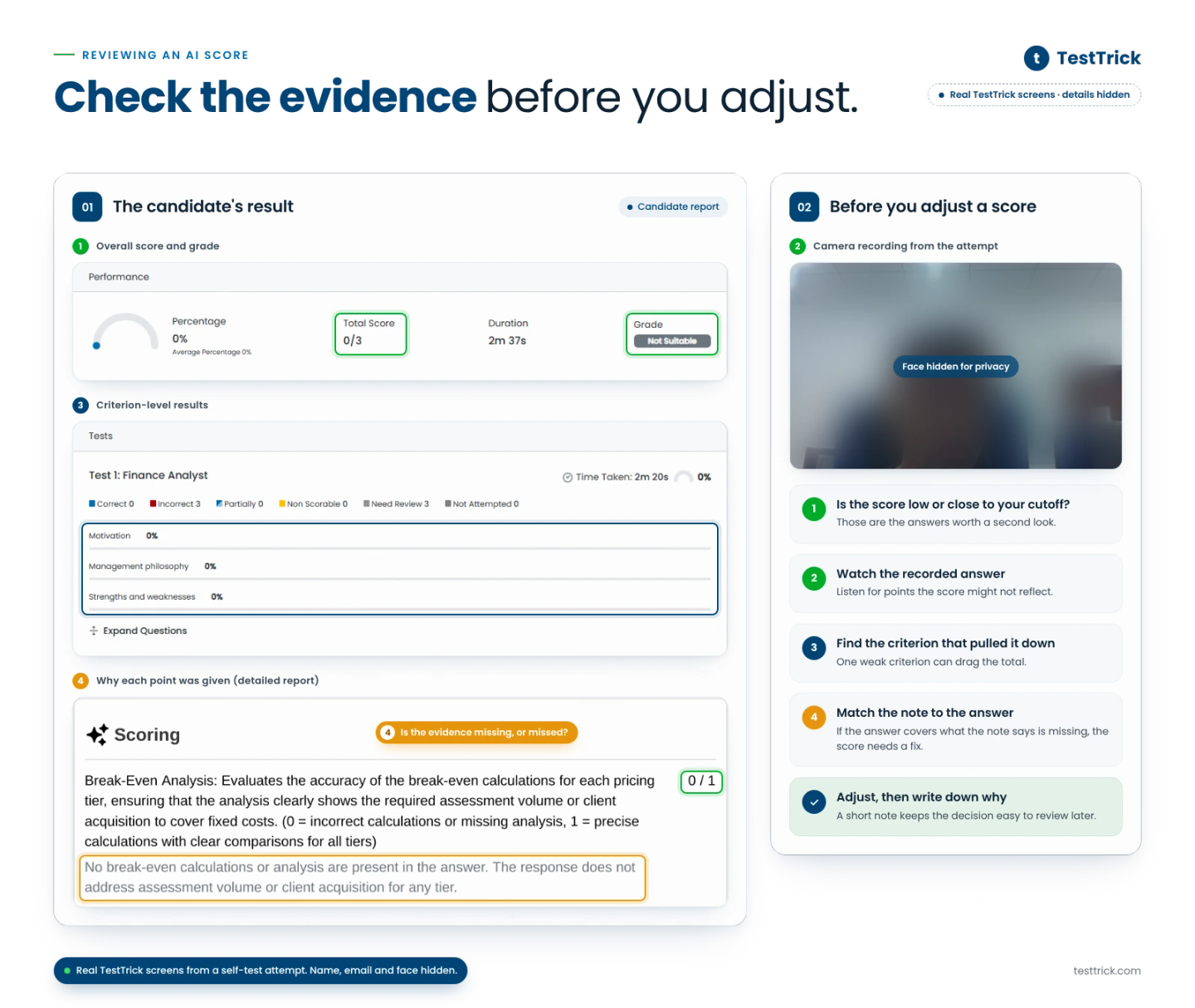
Recorded Response, Criterion-level Results and Score
Want to see AI video interview scoring alongside human review? Explore TestTrick’s one-way video interview software, then compare the scoring criteria with a recorded answer before deciding who advances.
Why In-the-Moment Documentation Delivers Better Interview Debriefs
The closer the scorecard feedback is written to the interview, the lower the chances that the interviewer will be racking their brain to recall what the candidate said and how they delivered it.
Rescheduling tens or hundreds of candidates can multiply the confusion, and if there are many candidates to notify or recall, the gap between the interview and the evaluation can widen.
TestTrick keeps recorded answers available for review. Check out what candidates said instead of relying on memory. Criterion-level AI video interview scoring results give recruiters a starting point for checking scores against the answers.
For more on reviewing candidate results, visit our candidate assessment reports page.
How to Scale Interview Volumes Without Sacrificing Quality
AI video interview scoring can apply the same criteria to the 100th (or even 1000th) candidate as to the first one. That is a key financial motivation: a mix of AI and humans, although accuracy needs validation for each role.
Regardless of the volume, maintaining a well-structured, evidence-based screening system manually can be challenging to manage, even when high-volume hiring is not the primary concern.
Balancing Technology and Human Touch. Choosing Between AI and Interviewers
| Situation | Use | Why |
|---|---|---|
| Many applicants | AI video interview scoring, with human checks | Helps sort answers faster. |
| Low or close scores | Human review | Catches answers AI might miss. |
| Senior roles | Human interview | Allows deeper questions. |
| Final round | Human interview | Both sides can ask questions. |
| Strict record rules | Clear scores and written notes | Shows why each decision was made |
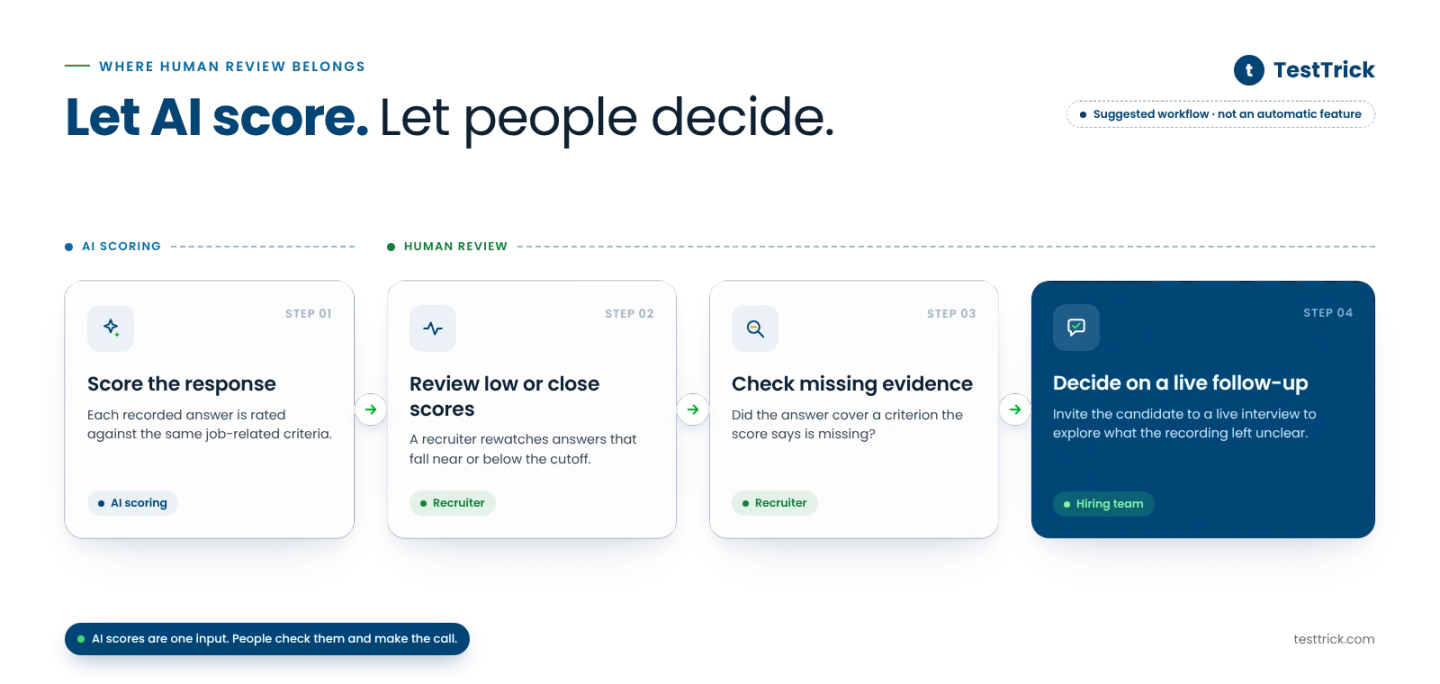
Compact Flowchart Where Human Review Belongs
Scaling High-Volume Screening with AI Video Interview Scoring
Use AI video interview scoring when, first, the volume is high (of course) and, second, the evaluation criteria are clear and job-related: Most IT and finance questions allow more objective evaluation, depending on the task.
First-round screening can suit different job types, depending on the skills the employer needs to assess.
Ensure you invest effort upfront in clear competency rubrics, as those benchmarks help you test agreement between AI and human ratings. Always disclose candidates that AI is part of the process before they begin.
Visit our test library to find assessments that match the skills required for the role.
When to favor live qualitative interviews
Humans are central to making advanced decisions, in particular when contextual judgment matters. Keep human interviews at stages involving culture assessment, executive-level evaluation, and multiple rounds with hiring managers, while the final closing conversation weighs diverse offers.
Organize interviews so reviewers clearly write down the final human feedback and make the results easy to compare. Keep AI video interview scoring results as one input, alongside the evidence gathered during the live interview.
Interacting with Algorithms vs. Watching Video
Not all interviews are the same. A recruiter's choice depends on the completion rates they want to achieve and how comfortable they want to make the experience for candidates.
Regarding pre-recorded AI-scored video, Greenhouse’s candidate data show that 33% of US respondents cited the format without human interaction as a reason for dropping out, not that 33% of all candidates abandon such interviews. One-way interviews, where candidates record answers to fixed questions, can raise concerns about missing human contact.
Ntrvsta reports completion above 95% for its conversational AI phone screening, compared with 40% to 60% for video formats, but the vendor comparison offers limited methodological detail and does not establish universal rates.
Put AI video interview scoring to work with clear review rules. Explore TestTrick’s one-way video interview software to see how recorded responses fit your screening process.
Build a Hiring-Ready Assessment
Create role-specific, anti-cheat assessments and shortlist candidates on evidence, not guesswork.
Start for freeBy Ekrama Taimuri
October 9, 2026
13 min read
Build a Hiring-Ready Assessment
Create role-specific, anti-cheat assessments and shortlist candidates on evidence, not guesswork.
Start for free