How to Test Problem-Solving Skills in Candidates
Most interviews test communication rather than problem-solving. Instead, learn how to effectively test problem-solving skills and identify the right person within minutes.
By Peace Ajayi
September 1, 2026
10 min read
TL;DR – Key Takeaways!
- Most interviews reward candidates who communicate well, not candidates who solve problems well.
- To test problem-solving skills, present a real problem the person in that role would face and watch how they propose a solution.
- Score everything against the same rubric instead of a gut feel.
- Save group exercises for strong candidates in the final round.
- Pay attention to the questions candidates ask you because it says more about their cognitive skills than their resume does.
Most recruiters still mistake good communicators for problem solvers. They see well-polished resumes and confident answers and take that as evidence of skill. But there’s a wide gap between knowing how to describe a solution and ACTUALLY solving the problem. That gap is exactly what most recruitment processes fail to catch.
Workplaces are already full of people who can spot what went wrong or could potentially go wrong in a workflow. The real challenge is finding people who can follow up that observation with a workable plan and see it through. That's what problem-solving actually looks like day-to-day and what this article will show you how to test for.
At the end of this article, you’ll realize that you don't need 4 interview rounds, a 45-minute conversation, or a full-stack assignment to find that person. You can start identifying strong problem-solving signals within the first few minutes of a conversation if you know what to listen for.
What Problem-Solving Skills Actually Look Like on the Job
Problem-solving doesn’t start the moment someone fixes a difficult or long-standing issue. It shows up well before that in steps like:
- How they define the actual problem before jumping to a fix
- How they gather information when they don't have the full picture
- How they weigh trade-offs instead of grabbing the first workable answer
- How they explain their reasoning to other people
- How they respond when their first idea turns out to be wrong
- How soon they figure out a workable solution to a problem
- How fast they execute it
This is what it looks like in practice: a customer success rep gets a call from a client threatening to churn over a bug the engineering team hasn't fixed yet. A weak problem-solver will panic or over-promise a timeline they can't control. A strong one will buy time, loop in the right people, and manage the client's expectations while the fix is in progress.
That's problem-solving on the job. It doesn’t always look like a clean puzzle with one correct answer.
A developer facing a failing test with no obvious cause needs the same core moves as that customer success rep. They define what's actually broken, gather enough information to act, weigh a few options, and explain the fix to teammates who weren't in the room when it happened. So does an admin coordinator whose vendor cancels the day before a launch.
The industry or role may change, but the reasoning process is the same one you're trying to measure.
When to Test Problem-Solving Skills in Your Hiring Process
Timing matters as much as method because different assessment methods work better in different stages.
- Screening stage: Use a short, structured assessment to narrow down your list. If you're getting 200 applications for one role, you don't have 45 minutes per candidate for a case study. This is where a standardized assessment earns its place.
- Interview stage: Bring in behavioral questions and a real, role-specific problem. Pay as much attention to the questions they ask before their initial answer.
- Final stage: Save live, role-specific challenges and group exercises for finalists. These take real time from your team, so reserve them for candidates you're seriously considering.
How to Test Problem-Solving Skills in Candidates
Ask Them Real Problems Relative to The Role
The best way to ask a structured question is to make it relevant to the role you’re hiring for. Better still, ask how they’d handle a real problem the current or previous person in the role is facing.
It could be a supervisor who slow-walks every approval, a cross-functional teammate who’s always busy or three deadlines landing in the same week. How they ask clarifying questions, think aloud through the problem and explain their reasoning is a clear window into how they actually solve things.
This approach also minimizes cheating. Most interview questions are common enough that candidates can find them online and rehearse a polished answer in advance. But bring in a real problem the last person in the role actually tackled. They can't find any version of that answer on the internet or inside an AI chatbot. All they’ll be left with is the problem-solving skills they’ve built through experience and knowledge, and that’s when you see their real ability on display.
Now, back to the real-case scenario question, here’s how a genuine problem-solver would answer:
- They’ll define the problem first by asking clarifying questions about its root cause, what’s within and beyond their control, and who or what is directly involved. This step is the difference between blurting out the first idea that comes to mind and proposing a tailored solution to the problem.
- They’ll think through potential solutions out loud and present one or more ways to solve the problem.
- They’ll commit to one solution and walk it through to resolution. If they mention two possible solutions, they'll explain both. Either way, they’ll land somewhere concrete rather than trailing off.
You can make this even more interesting by introducing a bottleneck to their proposed solution mid-answer and watch how they react. Do they crumble in defeat or move to the next solution quickly? That’s a cheat code for spotting who’s resilient and result-driven.
Assign Work Sample Exercises
Take-home tests are probably the most argued-about way to test problem-solving skills, and both sides have complaints. Job seekers resent the time and energy they have to invest for a role they aren’t sure they’d secure. Recruiters have to deal with poor outputs because candidates see it as a numbers game and put in the bare minimum. The result is that the genuinely good ones get pissed off and bail out entirely, leaving only substandard candidates in the pool.
However, there’s an effective way to run this method:
- Assign a small task rather than a full-stack output. For example, ask candidates interviewing for a customer support role to draft a reply to one angry customer email, not build out an entire macro library.
- Mention a realistic timeframe that the task would require. Don’t tell candidates a task would take 2 hours when it would take 2 days. Non-transparency is a turn-off for competent candidates and can get you losing out on the strong ones early.
- Offer feedback on every submission, even if they don’t proceed to the next step. Candidates for junior roles value companies that can provide honest feedback.
Ask Behavioral Questions on How They Handled a Difficult Situation
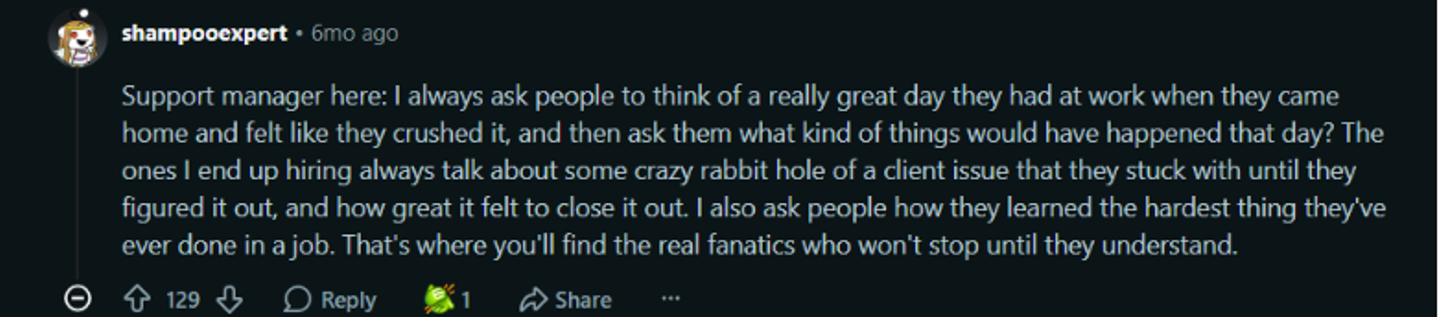
This screenshot above clearly captures how you can identify people who live and breathe problem-solving.
A real problem solver has a track record of staying on an issue until they’ve solved it. I heard someone mention how he gets a dopamine rush once he resolves an issue, and until he does, he can’t rest. That’s the reward mechanism he needs to shut his restlessness off. Not every problem solver would work this way, but most genuine problem solvers have a rich history of solved problems.
So a cheat code question to test problem-solving skills in a candidate is to ask them what a good day at work looks like for them. Real problem solvers will tell you about a time they stayed glued to a problem until they cracked it or how they had to learn to undo a knot.
Turn It Into a Repeatable Workflow With Assessment Tools
A pre-employment assessment tool can turn these methods into a more consistent and scalable candidate screening workflow
TestTrick, for example, bundles video recording, skill-based assessments, proctoring and built-in scoring into one workflow so you can streamline your hiring process. This gives every candidate the same evaluation experience and gives hiring teams comparable scores instead of relying only on interview impressions.
To set this up in TestTrick, choose the problem-solving test from the Cognitive Ability section. You can customize the role, question count, attempts and time, and also combine it with video, essay, or problem-solving questions if needed.
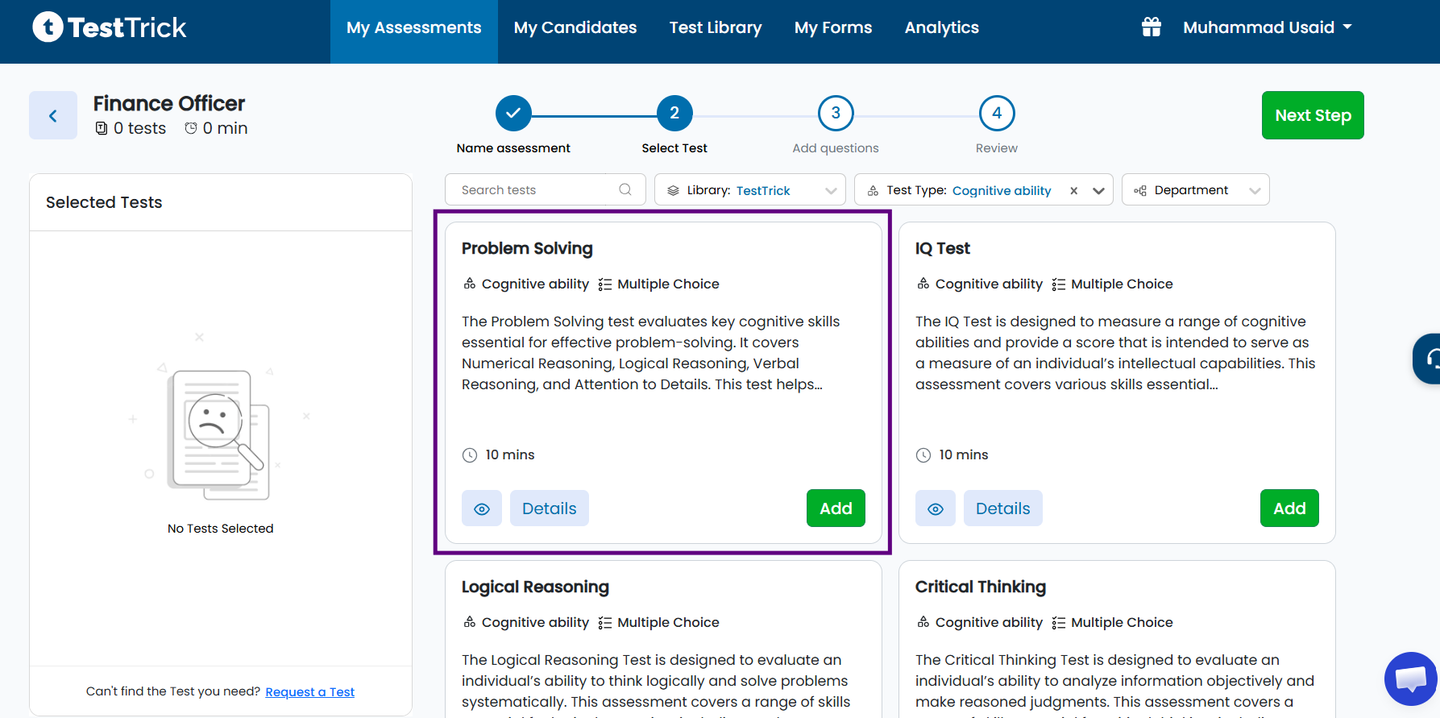
A 7-day free trial gives you access to all of these features without restriction.
Run a Group Problem-Solving Exercise
Bring your final two or three candidates into a room or a call with a real cross-functional problem and watch how they work it out together. Here, you’re checking for who asks the clarifying question, builds on someone else's half-formed idea, and stays steady when the group disagrees.
This stage will take time from your team, so reserve it for your final round and run it only with candidates you're seriously considering. Give the group a scenario with no single correct answer, then step back and take notes on the process and the outcome. A candidate who solves the puzzle but never checks in with the rest of the group is not a top pick but a warning sign.
Bonus Point: Reverse Interviews (use candidate questions as a signal)
The questions a candidate asks you tell you almost as much as the ones you ask them. At the end of the interview, open the floor and pay attention to where they go.
Instead of judging candidates by practical questions about benefits or start dates, look for additional questions that reveal curiosity about problems, constraints, stakeholders, and previous attempts to solve them. For example, a strong candidate may ask what’s broken right now, what has already been tried, or who they would need buy-in from to fix it. Those questions can offer useful insight into how they approach unfamiliar problems.
How to Score Candidate Responses
A great problem-solving interview is wasted if you score it on gut feel. Build a simple rubric before the interview so every interviewer is grading the same things.
Score against the moves you're actually testing for by grading:
- How they defined the problem,
- How they gathered missing information,
- How they weighed trade-offs,
- How clearly they explained their reasoning, and
- How they responded when challenged.
To make scoring more consistent, define what weak, average, and strong performance looks like before the interview.
| Criteria | 1 – Weak | 3 – Average | 5 – Strong |
|---|---|---|---|
| Problem definition | Jumps straight to a solution without fully understanding the problem | Identifies the main issue but misses some important context | Clarifies the problem, assumptions, constraints, and root causes before proposing a solution |
| Information gathering | Makes assumptions without asking relevant questions | Asks a few useful questions but leaves some information unexplored | Identifies the key information needed and asks focused clarifying questions before moving forward |
| Evaluating trade-offs | Suggests one solution without considering alternatives or drawbacks | Considers more than one option but only briefly discusses the trade-offs | Compares multiple options and clearly explains the advantages, risks, and trade-offs of each |
| Explaining reasoning | Gives an answer with little or no explanation | Explains the basic reasoning behind the proposed solution | Walks through their reasoning clearly, logically, and in a way others can easily follow |
| Responding to challenges | Becomes stuck or continues defending the original solution despite new information | Adjusts their approach with some prompting | Quickly reassesses the situation and adapts their solution when new constraints or information are introduced |
A 1-to-5 scale per category works fine. What matters more is that every interviewer fills it out independently before the group convenes. Then collect scores privately and compare.
If two interviewers have very different scores for the same candidate, it doses’t always mean that someone got it wrong. It could mean that the rubric needs sharper criteria.
Common Mistakes When Testing Problem-Solving Skills
Most of these trace back to earlier sections, restated here as the one line you're most likely to forget.
- Rewarding confidence over reasoning. A candidate who sounds sure of themselves isn't the same as one whose logic holds up under a follow-up question. Test the logic, not the delivery.
- Reaching for brainteaser puzzles. Riddles like why manhole covers are round mostly test whether someone has seen the riddle before. They don't tell you how a candidate handles an actual ambiguous problem at work.
- Letting one interviewer's gut decide. Without a shared rubric, "I just liked them" becomes the deciding factor, and that's rarely about problem-solving ability at all.
- Running the same generic scenario for every role. A problem-solving test for a customer success hire should look nothing like one for a backend engineer. Match the scenario to the actual job.
- Skipping feedback on take-home tasks. Good candidates remember which companies respected their time and which ones didn't.
FAQs
How do you assess problem-solving skills?
Give candidates a real, ambiguous problem tied to the role, then watch how they proffer solutions to it. Also ask how they've handled tough situations in the past to know if they’re truly results-driven.
What are the 7 problem-solving skills?
Problem identification, information-gathering, analysis, creative idea generation, decision-making under uncertainty, clear communication of reasoning, and follow-through on execution. Most weak candidates miss one or two of these and not necessarily all seven.
What are some examples of problem-solving skills tests?
Role-specific behavioral interviews, work sample exercises, situational judgment tests, group problem-solving exercises, and structured pre-employment assessments like the cognitive ability tests on TestTrick.
How do I maintain fairness in a problem-solving assessment?
Use the same scenario and rubric for every candidate applying to the same role, score independently before discussing as a group, and keep the criteria tied to the job, not to personal preference.
Conclusion
You don't need multiple rounds of lengthy interviews to spot a real problem-solver. You need one solid real-scenario question, presented early and scored against a rubric instead of a gut feeling. Everything else, including the work sample, group exercise, and reverse interview will simply confirm what you already saw in the first five minutes.
When next you’re assessing candidates for problem-solving, swap one generic interview question for a real problem from the role you're hiring for, and score the answer against the five moves in this article. That single swap will tell you more than a full day of interviews built on the wrong question.
Build a Hiring-Ready Assessment
Create role-specific, anti-cheat assessments and shortlist candidates on evidence, not guesswork.
Start for freeBy Peace Ajayi
September 1, 2026
10 min read
Build a Hiring-Ready Assessment
Create role-specific, anti-cheat assessments and shortlist candidates on evidence, not guesswork.
Start for free