How to Build a Talent Assessment Framework (2026 Guide)
Learn how to build a talent assessment framework in 7 steps, with scoring rubrics, stage sequencing and a worked example for high-volume hiring.

By Sanjana Sankhyan
October 2, 2026
8 min read
Your job post pulls in thousands of applicants. You add a video screen to filter them. Only a small share finish it. And you still end up interviewing people who can't do the job.
Adding more tests rarely fixes this. What's usually missing is the structure behind them. You need to know which skills to test and what score earns an interview.
That structure is a talent assessment framework. With one in place, every applicant gets measured against the same standard, at the same stage.
In this guide, you'll learn:
- What a talent assessment framework is and how it differs from a strategy
- The seven components every framework needs
- How to build a framework in seven steps
- What a finished framework looks like for a high-volume remote role
- How to roll it out across your hiring team
What Is a Talent Assessment Framework?
A talent assessment framework is a documented system for evaluating candidates against the skills a role requires. It sets out which skills matter and which assessments measure them. It also defines how each result gets scored and what score moves a candidate to the next stage.
Without one, every hiring manager fills the gaps with personal judgment. Two interviewers can then rate the same candidate very differently. A framework gives the whole team one shared standard to hire against.
People often treat "framework" and "strategy" as the same thing. The framework is the evaluation model itself. The strategy decides how that model runs across your hiring process, from where assessments sit in the funnel to how often the team reviews them.
Put simply, the framework defines what a strong patient access hire looks like. The strategy makes sure every applicant gets measured the same way, at the same stage.
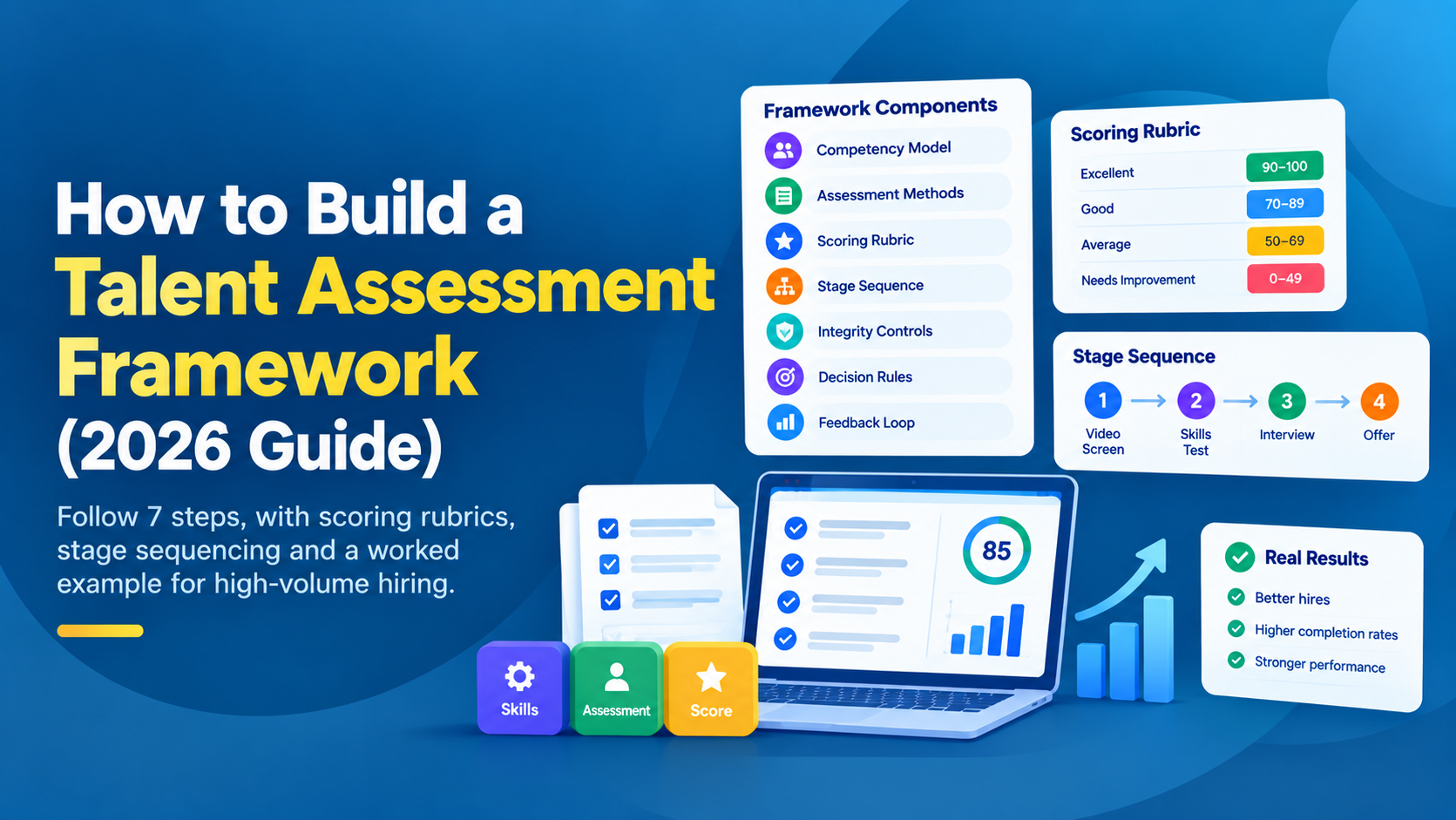
The Core Components of a Talent Assessment Framework
| Component | Question it answers | Example |
|---|---|---|
| Competency model | What does success in this role require? | Phone communication, medical terminology and scheduling accuracy |
| Assessment methods | Which test measures each skill? | A one-way video for communication and a custom terminology test |
| Scoring rubric | What does a strong answer look like? | Excellent, average and poor benchmarks for each video question |
| Stage sequence | In what order do candidates take each test? | A short video screen first, with skills tests in the same sitting |
| Integrity controls | Can you trust the results? | Camera and screen proctoring for remote roles |
| Decision rules | What score moves a candidate forward? | A minimum score on terminology and a ranking on everything else |
| Feedback loop | Does the framework predict job performance? | Scores compared against 90-day performance and retention |
How to Build a Talent Assessment Framework in 7 Steps
Each step below builds one or two of the components above. Work through them for a single role before you roll the framework out to others.
1. Start With the Hiring Problem You Need to Fix
A framework needs a clear job to do. Pick the problem that costs your team the most time right now. That could be interviews with unqualified candidates or early turnover in the first 90 days.
Then record where that metric stands today. Without a baseline, you can't tell whether the framework changed anything. One high-volume remote team we spoke with saw only about 10% of applicants finish their first video screen. They still interviewed people who struggled to hold a clear phone conversation. Those are two separate problems, and each one needs a different fix.
2. Separate Must-Have Skills From Trainable Ones
List every skill the role uses, then sort each one into two groups. Must-have skills are the ones a new hire needs on day one. Trainable skills are the ones your onboarding can teach in a few weeks.
Take a remote patient access role. Clear phone communication with older patients is a must-have. So is prior experience in a clinic or hospital. EMR navigation is trainable, since most teams teach their own system.
Ask the hiring manager to confirm the split. Test must-haves early in the process. Some trainable skills may not need testing at all.
3. Match Each Skill to an Assessment Method
Each skill needs a method that can actually show it. A multiple-choice test can check medical terminology. It can't tell you how someone sounds on the phone.
Use personality results to shape interview questions. Avoid using them as a pass or fail gate.
When no library test fits, build your own. Healthcare roles often need this, because general test libraries rarely cover medical terminology in depth.
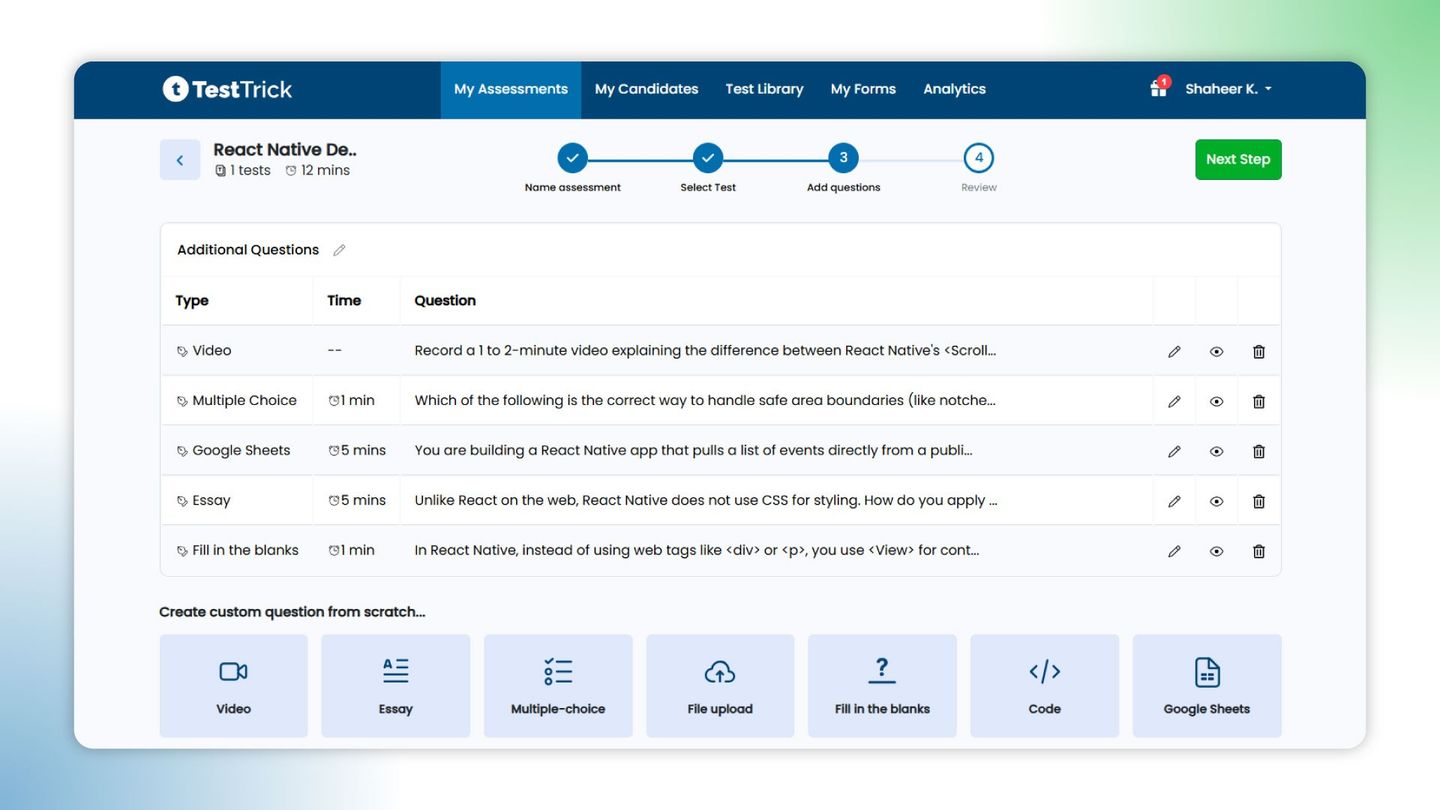
TestTrick's test builder supports seven question types, including video, essay, multiple choice and file upload. For subscribed clients, the TestTrick assessment team can also build a role-specific test on request.
4. Sequence the Stages to Protect Completion Rates
Every extra stage gives candidates another reason to drop out. So the order of your assessments matters as much as their content.
Put your shortest, highest-signal assessment first. For high-volume roles, that is often a two-minute video question on the core must-have skill. Bundle the remaining tests into the same sitting so candidates finish in one session. Time the full assessment yourself before launch, and cut anything that feels like a slog.
Where possible, trigger the invitation from your ATS. A link that arrives right after someone applies catches them while the role is still on their mind.
5. Build Scoring Rubrics and Weights
Structure makes assessment results comparable across candidates. A 2022 meta-analysis in the Journal of Applied Psychology compared common selection methods. Structured interviews ranked highest, with a validity of .42. Cognitive ability tests came in at .31. Consistent scoring criteria are what give structured methods that edge, and every assessment in your framework needs them.
Write a rubric for each open-ended question. Describe what an excellent, average and poor answer looks like for that specific question.
Then decide how scores turn into decisions. Use knockout rules for must-haves, such as a minimum score on the terminology test. Rank candidates on everything else, using weights that reflect the role. A phone-heavy role might weight communication at 40% and cognitive ability at 20%.
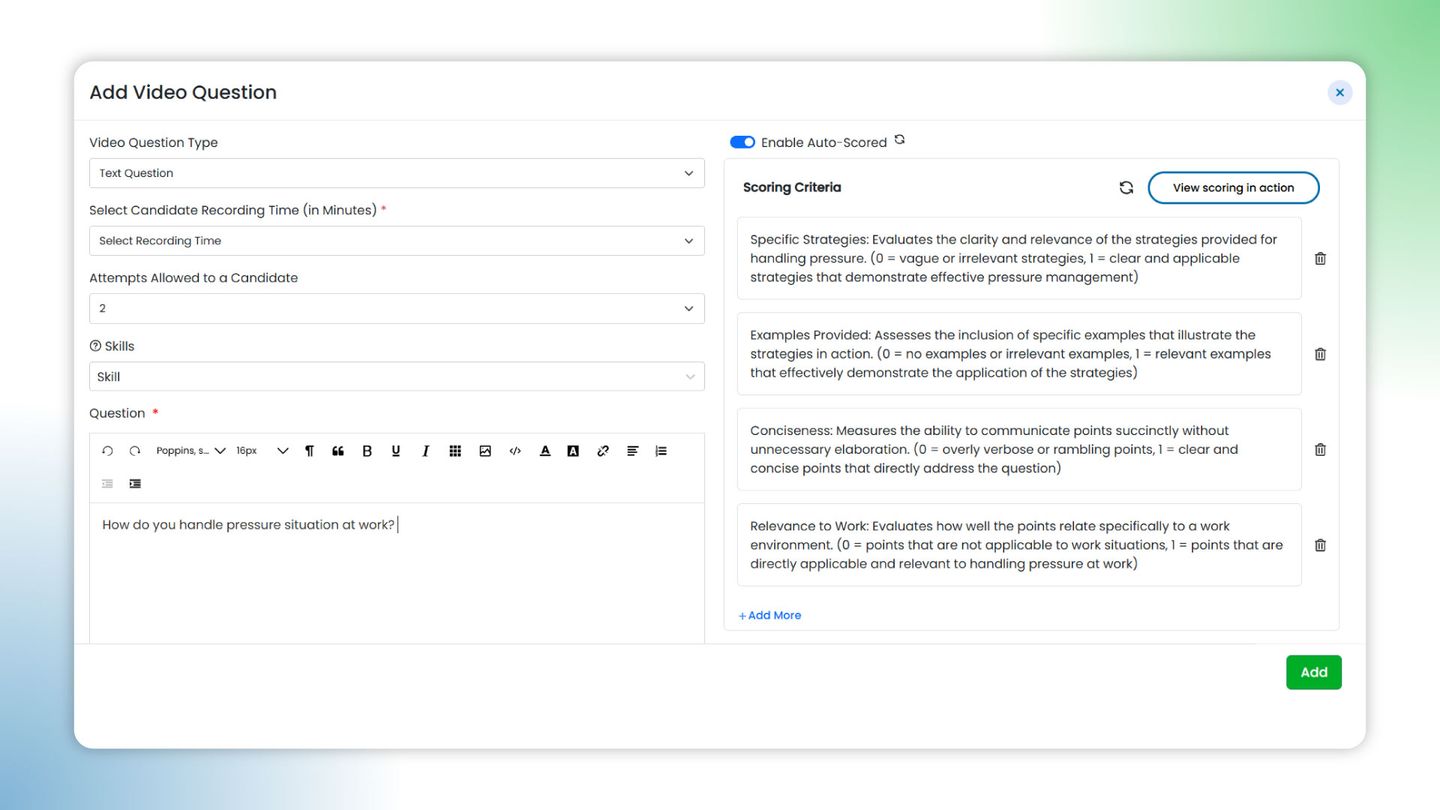
TestTrick applies your rubric to video answers through AI scoring criteria. It shows sample excellent, average and poor answers, and you can test your own response before going live. Each score comes with a short justification drawn from the transcript.
6. Set Integrity Controls That Match the Role
Remote assessments carry a higher risk of outside help. Your controls should reduce that risk without penalizing honest candidates.
Most platforms offer camera proctoring, screen proctoring, copy-paste blocking and tab tracking. Turn on the controls each test needs. A coding test calls for stricter screen monitoring than a personality assessment does.
Treat every flag as a prompt for review. A candidate who glances away while thinking isn't cheating. Decide in advance who reviews flagged results and what evidence leads to a rejection.
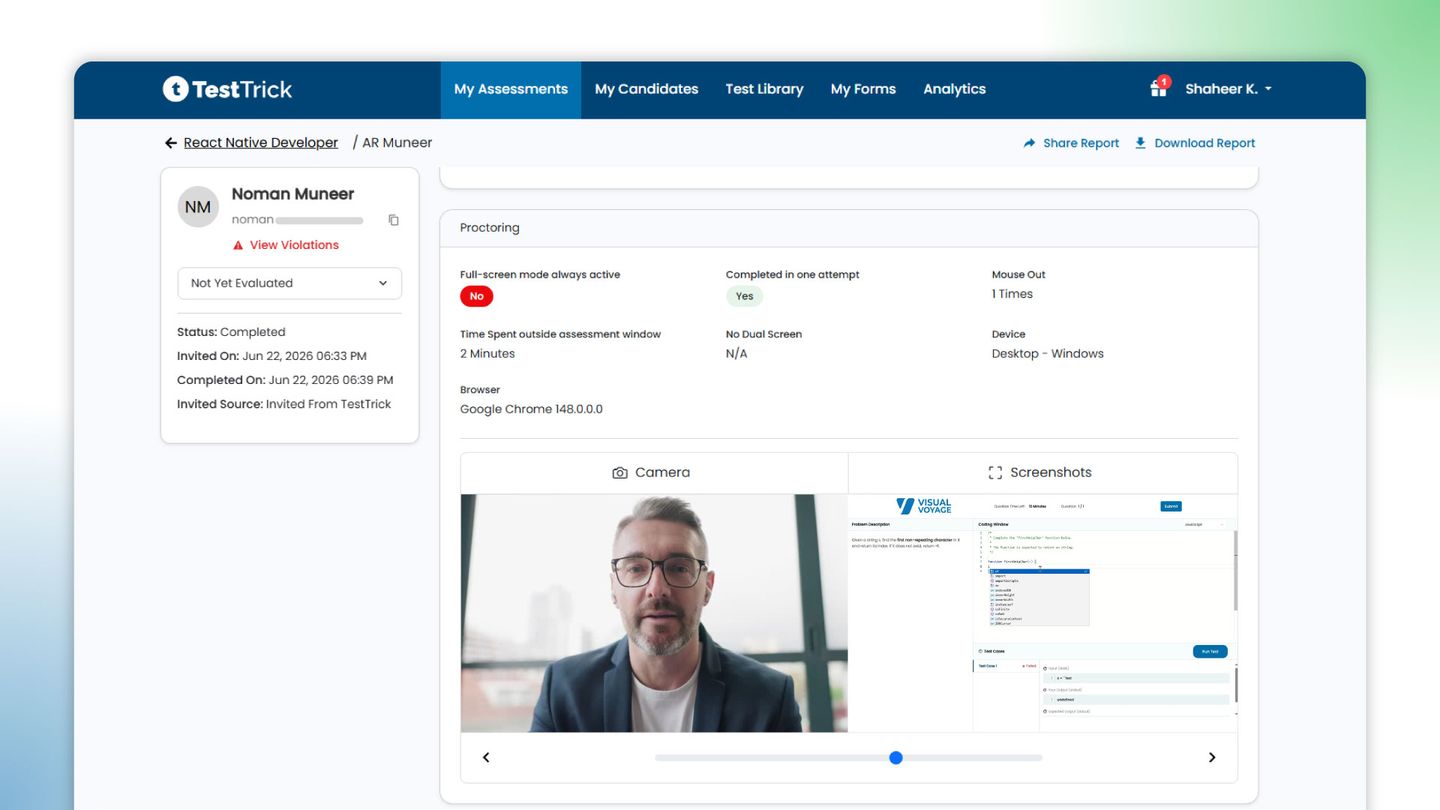
TestTrick separates proctoring signals from violations. Signals log activity such as time spent outside the assessment window. A violation gets flagged when those signals point to cheating, such as more than two minutes away from the window. Camera snapshots every 30 seconds give reviewers evidence to check before they decide.
7. Pilot, Calibrate and Review
Run the assessment on a few current employees before candidates see it. Your strongest performers should score well. If they don't, the test is measuring the wrong thing or your cutoffs sit too high.
Once new hires start, compare their assessment scores against 90-day performance and retention. Adjust weights and cutoffs wherever scores fail to predict results. Review the full framework every quarter, or sooner if the role changes.
Example Framework for a Remote Patient Access Role
| Stage | Assessment | Skill measured | Weight | Pass rule |
|---|---|---|---|---|
| 1 | ATS screening question | Prior clinic or hospital experience | Knockout | Must confirm experience |
| 2 | Two short one-way video questions | Phone communication and clarity | 40% | AI score of 60% or higher |
| 3 | Custom terminology and scheduling test | Job knowledge | 30% | Minimum score of 70% |
| 4 | Cognitive ability test | Learning speed for EMR training | 20% | Ranked, no cutoff |
| 5 | Situational judgment test | Handling confused or upset patients | 10% | Ranked, no cutoff |
| 6 | Personality assessment | Work style | Not scored | Guides interview questions |
Note: Weights apply only to the four scored assessments and add up to 100%. The experience question is a pass or fail gate, so it carries no weight. Personality results inform interviews and never affect the score.
Turning Your Framework Into a Talent Assessment Strategy
A framework only works if your team runs it the same way every time. That's the job of your talent assessment strategy.
1. Assign Clear Owners
- Framework owner: One person maintains the framework for each role and approves every change.
- Recruiters: They send assessments and review flagged results.
- Hiring managers: They sign off on must-have skills and cutoffs before launch.
Managers who help set the criteria are more likely to trust the scores later.
2. Connect Assessments to Your ATS
Invitations should go out automatically at a fixed stage. Results should land where recruiters already work. If your ATS has no native integration, ask your vendor whether they can build one.
3. Support Candidates Through Setup
Most technical issues involve cameras, microphones or browser permissions. Send a troubleshooting guide with every invitation. A candidate stuck on setup will often just leave.
4. Check Fairness Every Quarter
Under the EEOC's four-fifths rule, a group selection rate below 80% of the highest group's rate generally signals adverse impact.
- Review pass rates by group at each stage.
- Confirm that any assessment showing a gap measures a real job requirement.
- If you hire in the EU or UK, check that your vendor handles candidate data under GDPR.
5. Budget by Completions
Many platforms charge per completed assessment. Estimate completions from your applicant volume and expected completion rate. A high-volume role can use far more assessments than its headcount suggests.
How TestTrick Supports Each Layer of the Framework
TestTrick is a skills screening platform that runs a full talent assessment framework in one place. Here's how it maps to the steps above.
- Assessment methods: A library of 500+ built-in tests covers role-specific skills, cognitive ability, situational judgment and personality. Personality options include DISC, OCEAN and MBTI.
- Custom tests: The test builder supports seven question types, including video, essay and multiple choice. Subscribed clients can also request a custom test from TestTrick's assessment team.
- Scoring rubrics: AI scoring criteria apply your rubric to every video answer. Each score includes a transcript and a short justification.
- Stage sequence: You can combine several tests into one assessment and set the order candidates see them.
- Integrity controls: Camera proctoring, screen proctoring, copy-paste blocking, tab tracking and multiple-monitor detection can be set for each assessment.
- Rollout: TestTrick offers 12 native ATS integrations. Hiring managers get role-based access to results.
- Candidate support: Every invitation includes a troubleshooting guide and a way to raise support tickets.
- Budget: Pricing is credit-based from $35/month, and one credit covers one completed assessment. Plans have no feature caps.
Ready to put your framework into practice? Start a free trial of TestTrick.
FAQs
What is the difference between a talent assessment framework and a strategy?
The framework defines what you measure and how you score it. The strategy decides how, when and by whom that framework runs across your hiring process.
How many assessments should one role include?
Most roles need three to five tests covering must-have skills. Keep the total short enough for candidates to finish in one sitting.
How often should you review a talent assessment framework?
Review it every quarter against 90-day performance and retention data. Update it sooner if the role or its requirements change.
Can a small recruiting team build a talent assessment framework on a budget?
Yes. TestTrick offers credit-based pricing from $35/month, with no feature caps on any plan.
Build a Hiring-Ready Assessment
Create role-specific, anti-cheat assessments and shortlist candidates on evidence, not guesswork.
Start for freeBy Sanjana Sankhyan
October 2, 2026
8 min read
Build a Hiring-Ready Assessment
Create role-specific, anti-cheat assessments and shortlist candidates on evidence, not guesswork.
Start for free