HackerRank Pricing: Plans, Costs & What's Included
HackerRank pricing starts at $99/month, but the real cost depends on attempts, users, and which features you actually need. Here's the full breakdown.
By Favour Etinosa Ogie
July 27, 2026
7 min read
Key Takeaways!
- HackerRank is built for technical hiring specifically, and it does that job well, with a large question library and a genuinely strong coding IDE
- Pricing runs from $99/month (Starter) to $449/month (Pro), with custom Enterprise pricing on top
- Both paid plans are attempt-based, and going over your monthly limit costs $20 per additional attempt
- G2 reviewers rate the platform 4.6 out of 5, but cost is the complaint that comes up most often
- TestTrick includes the same coding depth, proctoring, and ATS integrations at every plan tier, starting at $49/month
HackerRank has built its name around one specific job: helping companies hire developers based on what they can actually build, not their resume. It does that job well, with a mature coding environment, thorough proctoring, and a deep question library.
At a glance, HackerRank pricing looks simple: Starter runs $99 a month, Pro runs $449, and Enterprise is custom. But those headline numbers don't show what each plan actually includes, or what happens the moment your hiring volume goes over plan. Here's the full picture before you commit.
What is HackerRank?
HackerRank's Developer Skills Platform is a technical hiring tool built around coding assessments, live technical interviews, and AI-assisted proctoring. It is one of the more established developer assessment tools on the market. Companies use it to screen developers before they ever reach a human interviewer, replacing guesswork with an actual coding sample.
The platform supports 14 question types across general, programming, and real-world categories, with dedicated environments for frontend, backend, and full-stack roles. It also includes plagiarism detection, code playback for reviewing how a candidate worked through a problem, and AI-assisted evaluation tools on its higher tiers.
Live interviews let interviewers and candidates share the same coding window in real time, which is useful for teams that still want a human conversation alongside the automated screening.
HackerRank holds a 4.6 out of 5 rating from more than a thousand verified G2 reviews. That puts it firmly among the more established names in technical hiring, and it's a common reference point whenever teams start comparing technical assessment platforms.
HackerRank Pricing at a Glance
HackerRank sells three plans, priced by user count, monthly attempts, and feature access. Paying annually knocks two months off the monthly rate on any tier.
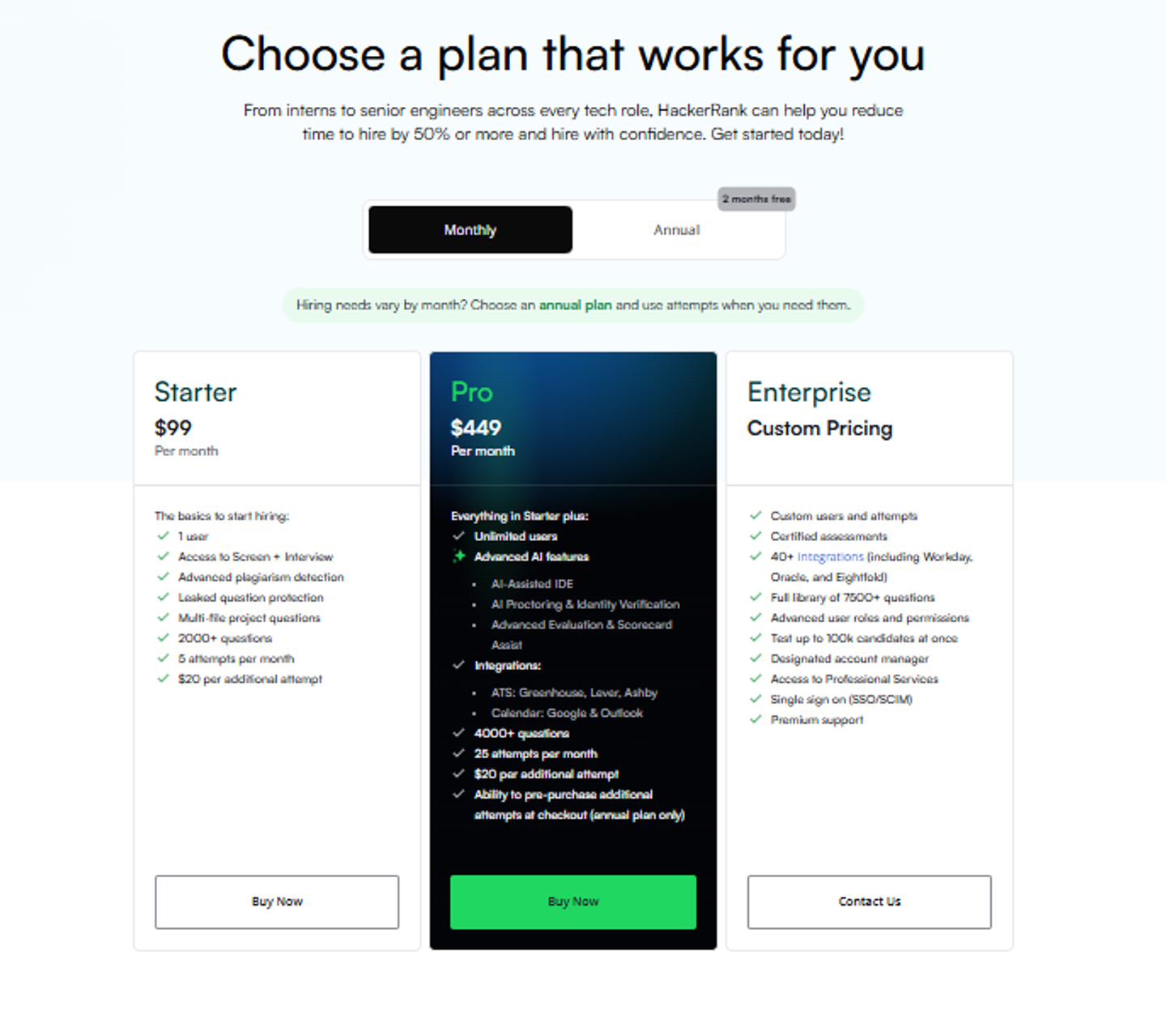
Starter: $99/month
- 1 user
- Access to Screen and Interview
- Advanced plagiarism detection and leaked-question protection
- Multi-file project questions
- 2,000+ questions
- 5 attempts per month, then $20 per additional attempt
Pro: $449/month
- Everything in Starter, plus unlimited users
- AI-assisted IDE, AI proctoring and identity verification, and scorecard assist
- ATS integrations with Greenhouse, Lever, and Ashby
- Calendar sync with Google and Outlook
- 4,000+ questions
- 25 attempts per month, then $20 per additional attempt
- Ability to pre-purchase additional attempts at checkout (annual plans only)
Enterprise: Custom Pricing
- Custom users and attempts
- Certified assessments
- 40+ integrations, including Workday, Oracle, and Eightfold
- Full library of 7,500+ questions
- Advanced user roles and permissions
- Ability to test up to 100,000 candidates at once
- Dedicated account manager and premium support
What You Get for That Price, and What You Don't
What Starter Includes and What It Doesn't
At $99 a month, Starter gets you a working technical screening tool for one recruiter, with a real question library and solid anti-cheat basics. What it doesn't include is any of the platform's newer AI capabilities.
The AI-assisted IDE, AI proctoring, and every ATS integration sit behind Pro. That means a small hiring team pays $99 for the base product, then pays $350 more to get features that are already built into the platform.
Why Attempts Turn Into a Real Cost
Attempts are the other thing worth understanding before you commit. An attempt counts each time a candidate completes a Screen assessment or takes part in an Interview, and sending an invite doesn't use one.
Five attempts on Starter and 25 on Pro sound reasonable in a quiet month. That included number stops looking reasonable the moment a real hiring push hits. Staffing up a team of 15 engineers in one quarter can easily mean 30 to 40 attempts, not five or even 25, which means $500 to $700 in extra charges on top of the base subscription in a single month.
That unpredictability is the real issue, not just the dollar figure. A finance team can budget around a fixed $449 monthly subscription without much trouble. It's much harder to budget around a bill that might be $449 one month and $900 the next, purely because two roles happened to open at the same time.
What Enterprise Changes and What It Doesn't
Enterprise doesn't have a published price. You get a quote after a sales call.
In exchange, you get a dedicated account manager, a negotiated rate that can work out well at scale, and access to the full 7,500+ question library along with 40+ integrations. The tradeoff is that you won't know the exact number until you're in that conversation, which is worth knowing going in if you're trying to budget ahead of time.
What Users Have to Say
Reviewers are largely positive about what HackerRank does, and specific about where it gets expensive.
On the positive side, some G2 reviewers say that the dedicated IDE has gotten more stable and reusable for candidates over time, and call the newer AI-supported proctoring a real step forward for fairness in evaluation.
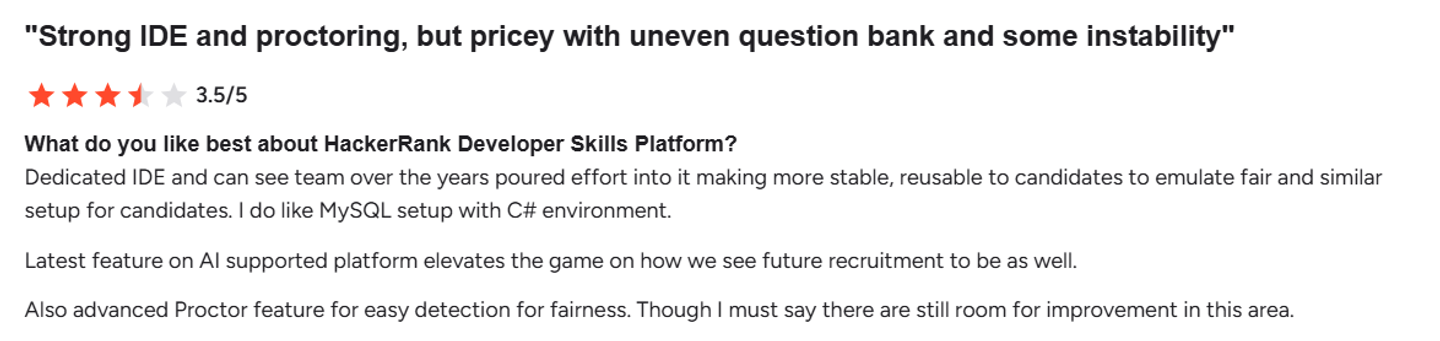
Another user added that the platform scales well and that hands-on help from their account manager made building out tests far easier.

Price is where the tone shifts. Users who praised the IDE also flagged the platform as pricey, and said the out-of-the-box questions rarely reflect real work. Some questions were too simple to use, forcing teams to build their own anyway.

A verified user in banking called the product straightforward and versatile, but somewhat expensive, with an interface that could use some polish.

A reviewer in IT added that the test environment can feel rigid next to real-world coding work, with strict formats that don't always match how a developer would solve the same problem on the job.

The pattern across these reviews is consistent: people rate HackerRank highly for what it does, and cost is the thing they bring up most when asked what they'd change. That's a useful signal if you're weighing a purchase.
If you're a founder, or your hiring spikes seasonally instead of running steady all year, that's worth weighing before you sign. Teams in that spot are usually reading through HackerRank alternatives before committing.
A Better Alternative: TestTrick vs. HackerRank Pricing
If HackerRank's cost curve doesn't match your hiring volume, TestTrick is worth a look before you sign anything.
TestTrick Overview
TestTrick is an all-in-one pre-employment assessment platform, built for technical and non-technical hiring alike.
Technical recruiters get the same core depth HackerRank offers: coding skills assessment across 12 or more programming languages, with line-by-line code playback to review exactly how a candidate approached a problem.
Alongside that, TestTrick covers async video interviews for early-stage screening, a full anti-cheating software stack with AI face detection and code-paste detection, and native ATS integrations with platforms like Greenhouse and Lever. Every completed assessment rolls into a shareable candidate assessment report, so hiring teams aren't piecing scores together manually.
TestTrick Pricing
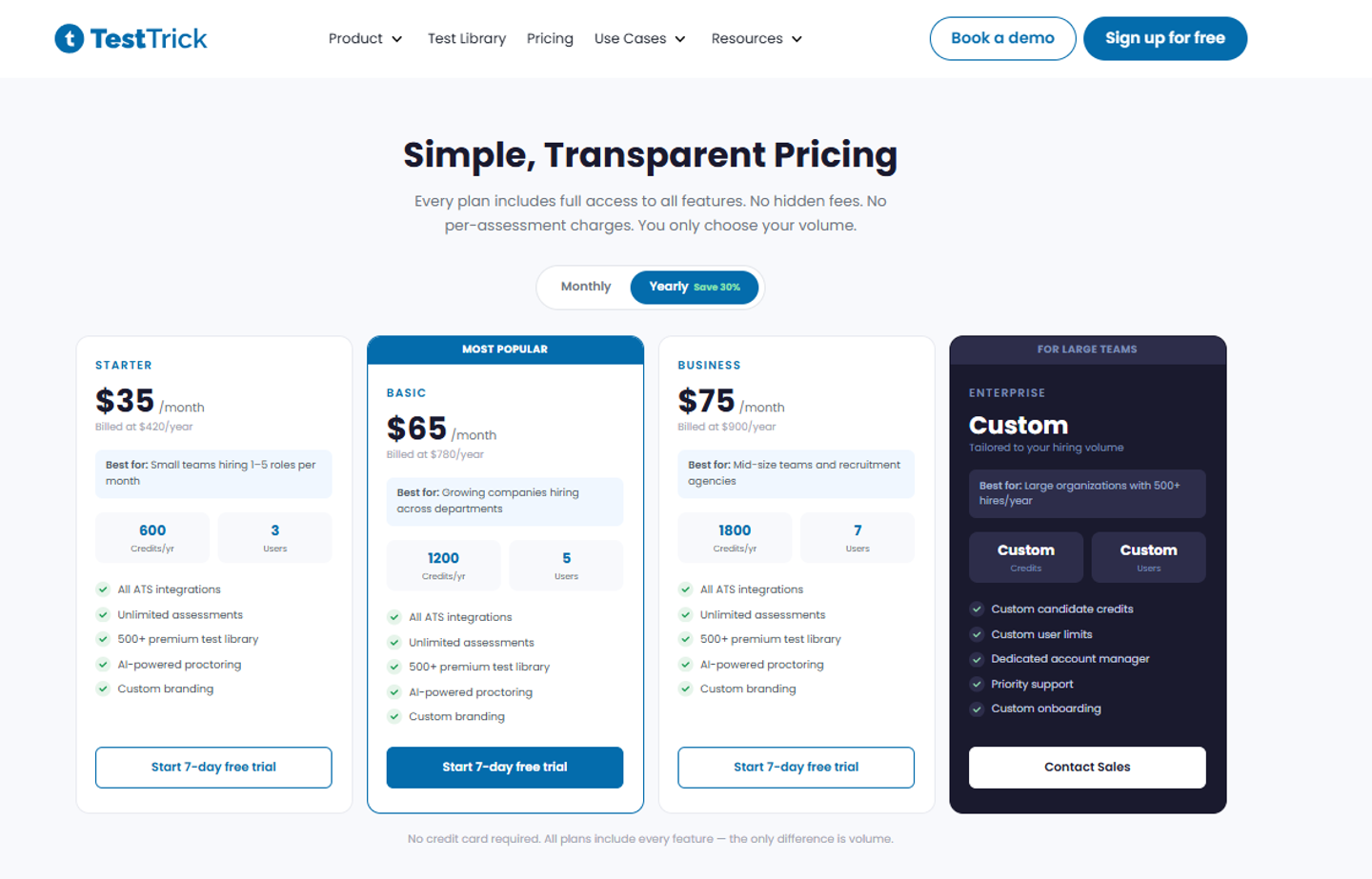
TestTrick's four tiers scale by candidate credits and user seats, not by which features you're allowed to use. That's the core difference from HackerRank's structure.
- Starter: $49/month. 50 credits and 3 users. Best for small teams hiring one to five roles a month.
- Basic: $75/month. 100 credits and 5 users. TestTrick's most popular plan, built for growing companies hiring across departments.
- Business: $99/month. 150 credits and 7 users. Suited to mid-size teams and recruitment agencies.
- Enterprise: custom pricing. Custom credits and users, plus a dedicated account manager, for organizations hiring 500 or more people a year.
- Every plan includes coding assessment, async video interviews, proctoring, and ATS integrations. Only credit and user volume change between tiers.
- Credits work on completion, not usage: creating an assessment and inviting candidates cost zero credits, and a credit is only spent once a candidate finishes.
- Extra credits cost $2 each if you run short mid-cycle, with no plan upgrade required.
- Every tier comes with a 7-day free trial, no credit card required to start, and results roll into a shareable candidate assessment report.
HackerRank vs. TestTrick Pricing Compared
| TestTrick | HackerRank | ||
|---|---|---|---|
| Plans | Starter, Basic, Business, Enterprise | Starter, Pro, Enterprise | |
| Starting price | $49/month | $99/month | |
| Extra charges | $2 per extra credit | $20 per extra attempt | |
| AI and proctoring | Included on every plan | Only on Pro and Enterprise | |
| ATS integrations | Included on every plan | Only on Pro and Enterprise |
Put the two side by side and the value gap is straightforward. For less than half of HackerRank's Starter price, TestTrick's pricing gets you the AI proctoring, ATS integrations, and coding depth that HackerRank only gives you once you're paying $449 a month. If your team ever goes over its included volume, that extra charge costs $2 on TestTrick instead of $20, which makes TestTrick the more predictable investment for the same category of hiring work.
Conclusion
HackerRank is a genuinely strong tool for technical hiring, backed by a 4.6 out of 5 rating across more than a thousand G2 reviews. The question library, coding IDE, and AI proctoring hold up well for teams hiring at steady, high volume.
The catch is cost. Pro costs $350 more than Starter, and that's the only way to get AI features and ATS integrations. Go over your monthly attempt limit and each extra one costs $20. For a lean team or seasonal hiring, that adds up fast.
TestTrick includes the same coding depth, proctoring, and ATS integrations on every plan, starting at $49 a month, with extra charges priced at $2 instead of $20. Sign up for a free trial to see how it works before you commit to either platform.
Frequently Asked Questions
Build a Hiring-Ready Assessment
Create role-specific, anti-cheat assessments and shortlist candidates on evidence, not guesswork.
Start for freeBy Favour Etinosa Ogie
July 27, 2026
7 min read
Build a Hiring-Ready Assessment
Create role-specific, anti-cheat assessments and shortlist candidates on evidence, not guesswork.
Start for free