8 Best Criteria Corp alternatives in 2026
Comparing the best Criteria Corp alternatives for 2026, with real G2 and Capterra reviews, pricing, and what each platform actually does well.

By Sanjana Sankhyan
September 11, 2026
13 min read

Criteria Corp has been in pre-employment assessment since 2006, and its testing science holds up well. Most teams looking elsewhere are not questioning the assessments themselves. They are usually responding to something more practical.
Renewal terms can shift as assessment volume is reviewed. Support that felt quick during onboarding can take longer once the account is running. Integrations are in place, though some teams still find themselves signing into a second system to pull reports.
If any of that sounds familiar, there are now several credible options worth a look. Some go deeper on validated psychometrics. Others specialise in video interviewing, high-volume hourly hiring, or leadership assessment. A few bring the full screening workflow into one platform and publish their pricing openly.
This guide covers eight of them. Each entry explains what the platform does well, where reviewers see room for improvement, and what it costs, so you can build a shortlist without booking eight sales calls.
Why consider a Criteria Corp alternative
Criteria scores well overall on both review sites, with 4.4 on G2 and 4.7 on Capterra. The concerns that do come up tend to sit with commercial terms and day to day operations rather than assessment quality. Here are the themes that repeat most often:
Renewal pricing can change after the contract is agreed: Some reviewers describe renewal figures being revised upward once assessment volume is reviewed, including on plans they understood to be uncapped. Others report annual increases of 17 to 20 percent for accounts that do not commit to a three year term (G2, Capterra).
That makes it worth comparing skills assessment software pricing carefully before committing to a long-term contract.
Support slows down after onboarding: Delayed customer support appears in G2's own summary of what users dislike about the platform. Reviewers describe waiting several days for a reply once the account is live, and inconsistent response times to candidates during high volume campaigns (Capterra).
Integrations leave manual work behind: Reviewers report that HRIS and ATS connections are less seamless than expected, so teams continue logging into Criteria to send assessments and pull reports. Scores can also be hard to read inside Greenhouse, and exporting results by job often requires building a custom report first (G2, Capterra).
How this list was tested and selected
Teams leaving Criteria are not shopping for a bigger question bank. They already run cognitive tests, personality tests, and interview scoring in one place, usually wired into an ATS. Anything that replaces that has to cover the same ground.
Here's what we checked before a tool made the list:
Assessment range: The platform had to handle cognitive ability and personality alongside role-specific skills, since most Criteria accounts stack several tests into one sitting.
Interviewing built in: We only included tools that support structured interviews or one-way video screening. Nothing here makes you buy a second product for the stage after the test.
Real integration depth: We compared documented native ATS connections against what reviewers actually say about setup, including how much manual reporting is left over.
Visible pricing: Platforms with published plans or a stated credit model ranked above quote-only pricing. Criteria reviewers flag surprise renewal costs often enough that this matters.
Candidate experience: We looked at test length, language coverage, and what recruiters report about completion rates.
Criteria Corp alternatives at a glance
| Tool | Best for | Standout strength | Pricing |
|---|---|---|---|
| TestTrick | Teams wanting skills tests, psychometrics, video interviews, and proctoring in one workflow | 500+ tests plus a custom builder with seven question types and AI-scored video | From $35/month billed yearly; 7-day free trial |
| SHL | Large talent teams testing across multiple countries and job levels | Deepest validated psychometric portfolio, 30+ languages | Quote-only; self-serve tier for smaller teams |
| Mercer Mettl | Volume hiring across India, the Middle East, and APAC | Heavy AI proctoring built for large exam drives | Custom quote by volume; free trial available |
| Wonderlic | Small and mid-sized teams wanting one score per candidate | WonScore combining cognitive, personality, and motivation | Quote after demo; no free trial |
| The Predictive Index | Companies feeding behavioral data into management, not just hiring | Six-minute behavioral assessment that follows the hire post-offer | From $10,000/year, priced by headcount |
| HireVue | Enterprise teams whose main need is the interview stage | On-demand video interviewing at scale with FedRAMP authorization | Quote-only, annual or multi-year; no free trial |
| Harver | High-volume hourly hiring in retail, BPO, and hospitality | Gamified assessments and realistic job previews that drive self-selection | Quote on request; no free trial or free tier |
| Hogan Assessments | Leadership and executive hiring | Derailment risk profiling under pressure | Quote via certified partners; priced per report |
The best Criteria Corp alternatives to try
1. TestTrick

Best for: Recruiting teams that want skills tests, psychometrics, video interviews, and proctoring in one workflow at published pricing.
TestTrick is an all-in-one pre-employment assessment platform built for skills-based hiring across technical and non-technical roles. Instead of running psychometrics in one tool and phone screens in another, teams run skills tests, coding challenges, cognitive and personality assessments, and one-way video interviews from a single dashboard.
You start from a library of 500+ pre-built tests spanning multiple skill domains, or build your own from scratch. Those tests then get combined into one assessment that a candidate completes in a single sitting. A sales hire might get a negotiation test, a cognitive test, and two recorded video answers in one link, all scored before a recruiter opens the report.
Key features
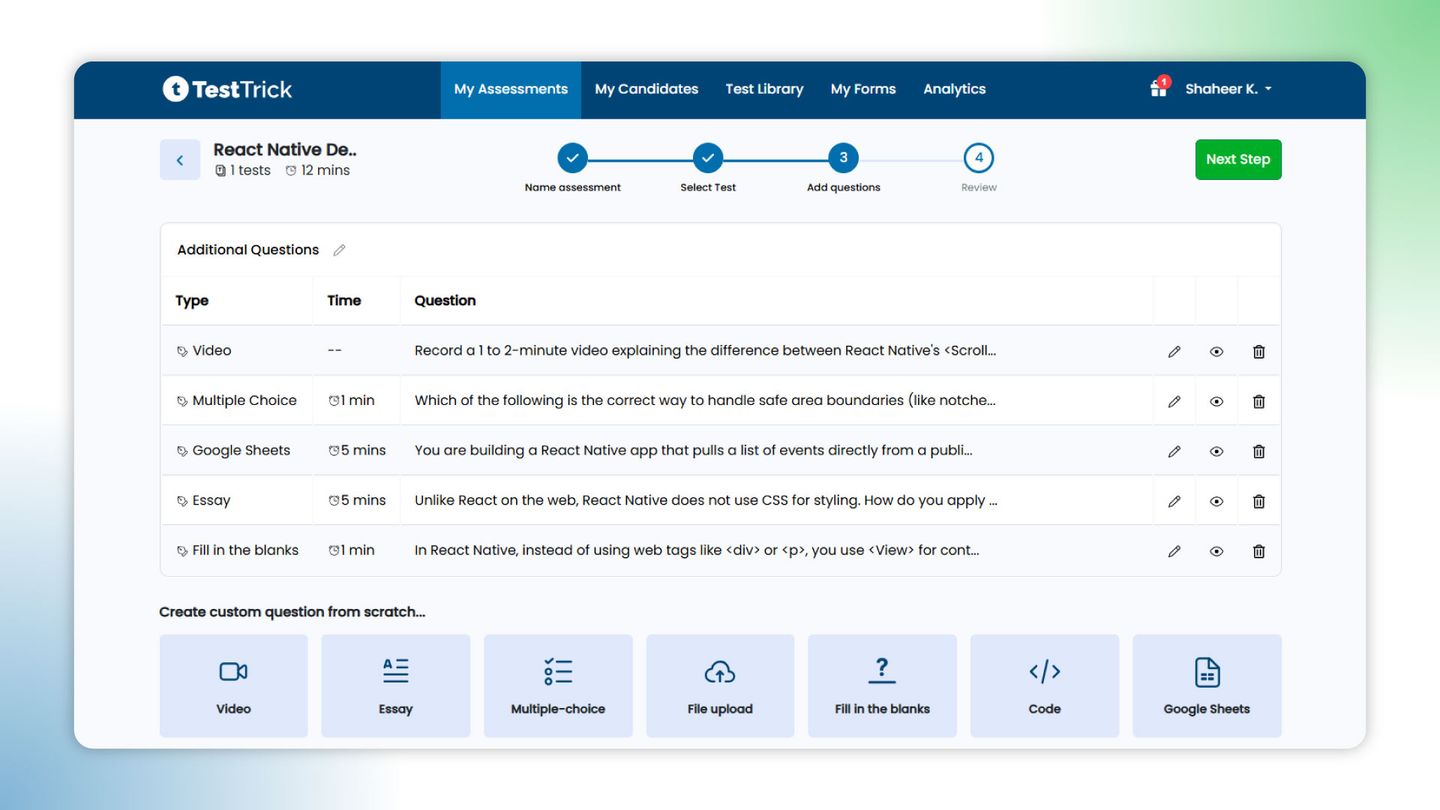
- Custom test builder: Seven question types including video, multiple choice, essay, fill in the blanks, file upload, coding, and Google Sheets, so one test can cover written, practical, and spoken skills.
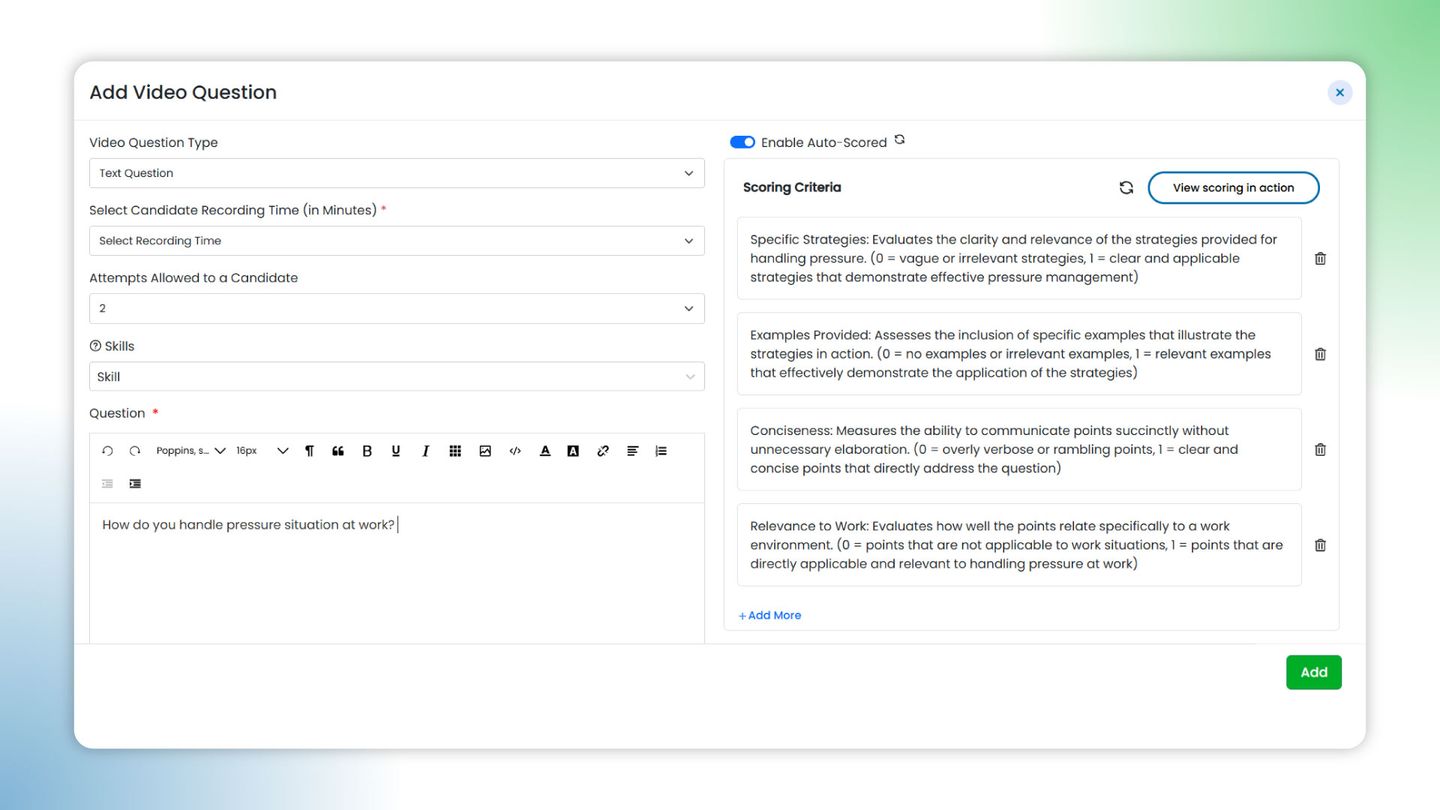
- AI-scored video interviews: You define the scoring criteria in plain language, and the AI grades every recorded answer against the same standard. Each response comes back with a transcript, an AI summary, and a justification for the score.
- Psychometric and cognitive assessments: DISC, Big Five, and MBTI personality tests alongside cognitive ability, situational judgment, and language tests, with full behavioral reports for shortlisted candidates.

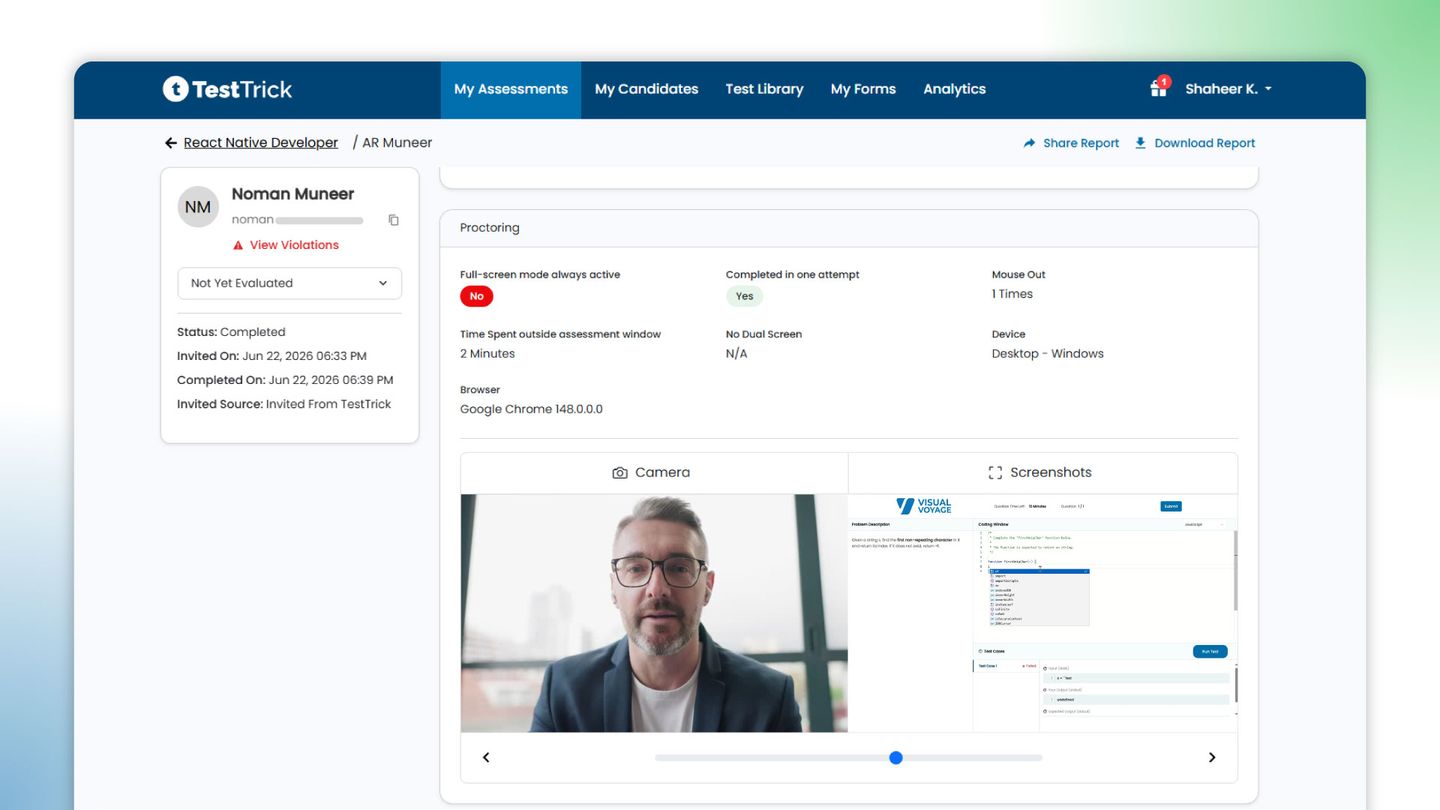
- Anti-cheating measures: AI-powered proctoring includesCamera and screen snapshots at 30-second intervals, copy-paste disabling, tab-switch tracking with duration logged, and dual monitor detection. Suspicious activity is flagged automatically, and the report separates proctoring signals from actual violations.
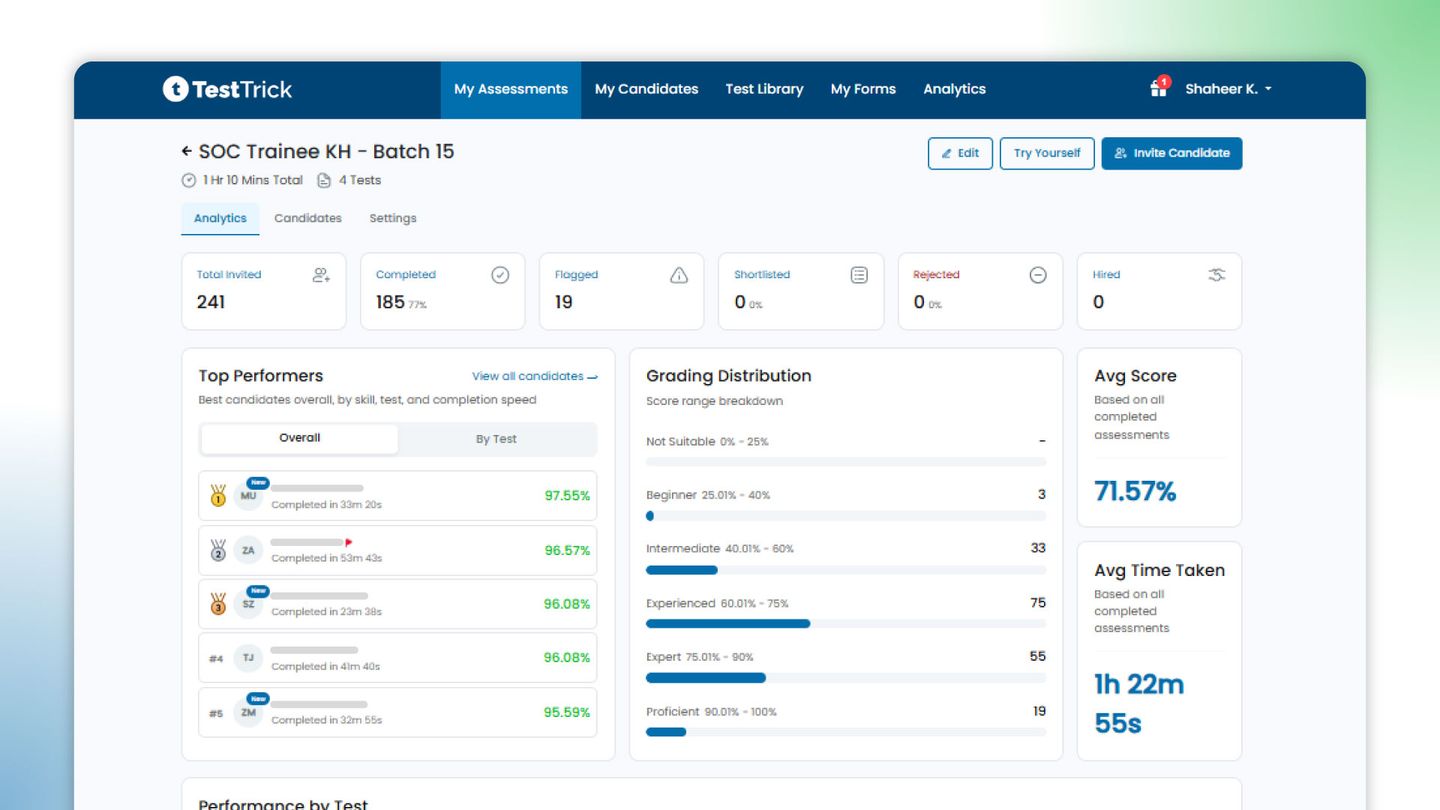
- Candidate reports: Overall score, test-wise breakdown, and skill-level scoring inside each test, so hiring managers can see where a candidate is strong rather than just whether they passed.
- Invites and integrations: Invite by email, public link, or bulk CSV upload, with 15+ native ATS integrations and custom integrations built on request.

Pricing: Starts at $35/month, billed yearly. Basic is $65/month, Business is $75/month, and Enterprise is custom. A credit is counted when a candidate completes an assessment, and there is a seven-day free trial.

Criteria Corp vs TestTrick: Which One Should You Choose?
Criteria Corp is a strong choice for teams that want scientifically validated psychometrics with decades of research behind them. Its cognitive and personality assessments are well documented, and the platform extends past hiring into employee development, which suits organizations building a long-term talent programme rather than filling roles this quarter.
TestTrick is a better fit for teams that want the whole screening workflow in one place at a predictable cost. It combines role-specific skills tests, coding challenges, psychometric assessments, one-way video interviews, and proctoring, with pricing published on the site rather than quoted after a discovery call.
For a deeper feature-by-feature breakdown, see our full TestTrick vs Criteria Corp comparison
| Area | Criteria Corp | TestTrick |
| Assessment coverage | Cognitive ability, personality, and emotional intelligence assessments, plus role-based test batteries | 500+ tests covering role-specific skills, coding, cognitive ability, personality, situational judgment, and language |
| Custom tests | Limited customization; reviewers report generic job families and difficulty uploading their own questions | Full custom test builder with seven question types, including coding and Google Sheets tasks |
| Video interviewing | Video interviewing and Interview Intelligence available, with setup reviewers describe as tedious | One-way video interviews with AI scoring against criteria you define, plus transcript and summary |
| Proctoring | Available across assessments | Camera and screen snapshots, copy-paste disabling, tab-switch tracking, and dual monitor detection |
| Reporting | Detailed reports, though reviewers flag difficulty exporting results by job | Test-wise and skill-wise breakdowns, AI summaries, and a separate proctoring monitor |
| ATS integrations | Integrates with most major ATS and HRIS platforms; some reviewers report manual work remains | 20+ native ATS integrations, with custom integrations built on request |
| Pricing model | Quote-based; reviewers report renewal increases and volume disputes | Published plans from $35/month billed yearly, priced by candidate credits |
| Free trial | Available on request | Seven-day free trial |
| Best for | Teams that want validated psychometrics and post-hire development tools | Teams that want skills, psychometrics, video interviews, and proctoring in one workflow |
2. SHL

Best for: Large talent teams running validated psychometric testing across multiple countries and job levels.
SHL is the oldest name in psychometrics and the closest match to Criteria on scientific depth. The portfolio covers cognitive ability, personality, situational judgment, and coding, with video interviewing layered on top. The trade-off is scale. It is built for enterprises with the budget and admin capacity to run it, so smaller recruiting teams tend to find it heavy.
eams comparing the two may also want to look at other SHL alternatives before committing to an enterprise platform.
Key features
- Verify cognitive tests and the OPQ personality questionnaire
- Situational judgment tests and job-focused simulations
- Smart Interview for on-demand and live video
- Remote proctoring, 30+ languages, and ATS integration via API
Pros
- Broad library of validated screening assessments inside TalentCentral
- Tests can be customised around specific role requirements
- Strong language coverage for international hiring (G2)
Cons
- Rigid question formatting, and poorly formatted content can affect results
- Candidate-side readability draws repeated criticism
- ATS integration often carries an additional fee worth clarifying before signing (G2)
Pricing: No published price list. SHL Online is self-serve for smaller teams, with prices visible only after you register. Enterprise pricing is quote-only.
3. Mercer Mettl

Best for: Teams hiring at volume across India, the Middle East, and APAC who need heavy proctoring.
Mettl covers similar ground to Criteria with cognitive tests, personality tools, and situational judgment, then goes further on invigilation. Its AI proctoring and question bank were built for large exam drives, which is useful if remote cheating is your main worry. The platform leans technical, so the interface has more depth than a small recruiting team usually needs.
Key features
- Aptitude, personality, and behavioral assessments
- Coding assessments with 26+ question formats
- AI proctoring, including live and record-and-review
- Modular tests you can combine into one sitting
Pros
- Fast interface with a large built-in question library
- Modular tests can be combined into a single assessment
- Proctoring is thorough enough to remove the need for a human invigilator (G2, Capterra)
Cons
- Per-assessment charges run high for smaller teams
- Support follow-ups often require chasing
- Test builder has limits, and results occasionally come back inconclusive (G2)
Pricing: No published rates. Mettl runs custom quotes based on assessment volume, with a free trial available.
4. Wonderlic

Best for: Small and mid-sized teams who want one cognitive and personality score per candidate, without much setup.
Wonderlic is the assessment Criteria gets compared to most often, and several Criteria reviewers on G2 describe the platform as a Wonderlic replacement. It combines cognitive ability, personality, and motivation into a single WonScore, so hiring managers get one number rather than a report to interpret. That simplicity is the appeal, and also the limit. There is no video interviewing to speak of, and assessments run in English only.
Key features
- WonScore combining cognitive, personality, and motivation
- Role-specific benchmarks with pass ranges
- Wonderlic Develop for post-hire coaching
- ATS integrations, though the list is short
Pros
- Quick to set up with minimal configuration
- Results return fast and read clearly without training
- Single score makes shortlisting straightforward for hiring managers (G2)
Cons
- Test length contributes to candidate drop-off
- Historical results have been lost through platform updates
- Role descriptions stay too generic for specialist positions (G2, Capterra)
Pricing: Not published. Wonderlic quotes after a demo request, with no free trial or self-serve signup.
5. The Predictive Index

Best for: Companies that want behavioral and cognitive data feeding into management, not just hiring.
PI sits closest to the Criteria Develop side of the product. The Behavioral Assessment takes about six minutes, and the results follow the person past the offer stage into onboarding, coaching, and team reports. If your reason for leaving Criteria is hiring throughput, this is the wrong shape. PI prices on headcount rather than assessments, and it covers behavior and cognitive ability only, so hard skills testing sits outside it.
Key features
- Behavioral Assessment and Cognitive Assessment
- Job Targets with candidate fit scoring
- Interview question builder tied to results
- Team and manager reports for post-hire use
Pros
- Short assessment with clear, readable reports
- Adds structure to hiring decisions
- Gives managers a shared language for how their teams work (Capterra)
Cons
- Hiring managers need training to interpret results properly
- The performance module takes effort to implement
- The five-star fit scale reduced the precision of candidate scoring (Capterra)
Pricing: Plans start at $10,000 a year, priced by company size. Annual only, with no per-assessment option.
6. HireVue

Best for: Enterprise teams whose main Criteria use is the interview stage, not the test.
HireVue built the on-demand video interview category and now bundles game-based and technical assessments around it. Structured rating guides, 24/7 candidate support, and FedRAMP authorization make it a fit for regulated and high-volume hiring. The catch is scale and cost. It is designed for organizations processing tens of thousands of applications a year, so a small recruiting team will pay for capacity it never uses.
Key features
- On-demand and live video interviews with structured scoring
- Game-based and technical assessments
- Interview scheduling and ATS integrations
- Compliance coverage including SOC 2, GDPR, and FedRAMP
Pros
- Standardises interviews across global teams
- Round-the-clock support for candidates and interviewers
- Handles very high application volumes without strain (G2, Capterra)
Cons
- Outages and bugs are a recurring theme
- Note taking during interview reviews is clunky
- One-way interviews can feel impersonal, and pricing is hard to establish without sales (G2, Capterra)
Pricing: Nothing published. HireVue quotes through sales on annual or multi-year contracts, with no free trial.
7. Harver

Best for: High-volume hourly hiring in retail, contact centres, BPO, and hospitality.
Harver is built for the pipeline shape where thousands apply for entry-level roles and speed matters more than depth. Candidates move through gamified behavioral tests, situational judgment, and a realistic job preview in one sitting, so self-selection does part of the filtering. Its algorithm scores fit automatically. That focus is also the constraint. Harver only lists six ATS integrations, and reviewers say the economics stop making sense below a few hundred hires a year.
Key features
- Gamified behavioral and cognitive assessments
- Realistic job previews and work-from-home readiness tests
- Video pitch recording and interview scheduling
- Automated candidate scoring and workflow rules
Pros
- Replaces gut-feel screening with structured scoring
- Delivers better-prepared candidates to the interview stage
- Implementation support is responsive during setup (Capterra)
Cons
- No mobile app and an interface that feels dated
- Short list of native ATS integrations
- Cost is hard to justify until hiring volume is consistently high (Capterra)
Pricing: Not published. Harver quotes on request, with no free trial or free tier.
8. Hogan Assessments

Best for: Leadership and executive hiring where personality risk matters more than throughput.
Hogan is a personality specialist rather than a screening platform. Its three inventories measure day-to-day reputation, derailers that surface under pressure, and underlying values, which is why it turns up most often in succession planning and senior hiring. Criteria covers similar territory with its personality tests, but Hogan goes deeper on interpretation and expects a certified practitioner to walk stakeholders through results. There is no cognitive testing, no skills library, and no video interviewing.
Key features
- HPI, HDS, and MVPI personality inventories
- Derailment risk profiling for leadership roles
- Role-specific and 360 development reports
- Certification programme for internal practitioners
Pros
- Detailed and accurate personality data
- Reports make senior hiring decisions easier to defend
- Certification lets internal teams run debriefs themselves (G2)
Cons
- Candidate experience is not always smooth
- Data can be slow to load
- Steep pricing for a tool covering personality alone, with thin review volume across both sites (G2)
Pricing: Not published. Hogan sells through certified partners and direct quotes, with report costs varying by assessment and debrief.
What to look for in a Criteria Corp alternative
1. Pricing that holds for the length of the contract
Most assessment platforms sell on volume, and that is where the surprises come from. Criteria customers describe agreed renewals being reopened over how many assessments they ran. A good alternative tells you upfront what a credit is, when one gets counted, and what happens the month you go over.
2. Support that behaves the same after you sign
Every vendor is responsive during onboarding. What matters is the queue you land in six months later, when a candidate cannot get their camera working an hour before a shift starts. Response time targets, candidate-side ticketing, and a named contact after year one are all worth asking about.
3. An assessment library that fits your actual roles
Generic job families are behind most of the complaints about tests not matching the work. Look for a library you can filter by role, and a builder that lets you write your own questions and upload them without going through support.
4. Integrations that put results where recruiters already work
A logo on an integration page does not mean much. The question is whether scores land inside your ATS in a form a hiring manager can read, and whether you can pull results by job without building a custom report first.
Frequently Asked Questions
1. Is Criteria Corp still worth using?
For teams that want validated cognitive and personality testing with research behind it, yes. The complaints in reviews are about renewal pricing and support, not assessment quality.
2. Which alternative is closest to Criteria Corp?
SHL and Wonderlic overlap most on validated psychometrics. TestTrick is closer if you also need skills tests, video interviews, and proctoring in the same workflow.
3. How much does Criteria Corp cost?
Criteria does not publish rates. Reviewers describe annual contracts with increases of 17 to 20 percent unless you sign for three years.
4. Can we switch assessment platforms mid-hiring cycle?
Yes, though finish any assessment already sent before you cut over. Export your historical scores first, since several reviewers report losing access to old results after platform changes.
5. Do pre-employment assessments actually reduce bad hires?
Validated assessments can help improve quality of hire when used alongside structured interviews rather than as a standalone filter
Making the final call on your Criteria Corp alternative
The right pick depends on why you are leaving. If the assessments were fine and the contract was the problem, look for published pricing and a clear definition of a billable candidate. If the interview stage mattered more than the test, HireVue and TestTrick both handle it. For hourly hiring at volume, Harver fits that pipeline shape, and for leadership roles, Hogan goes deepest.
Whichever way you lean, ask each vendor what triggers a price change mid-contract and whether a hiring manager can read scores inside your ATS without exporting anything.
If you want skills tests, psychometrics, video interviews, and proctoring in one workflow at a price you can see upfront, TestTrick covers all of it. Start your free trial or book a demo to see how it fits your process.
Build a Hiring-Ready Assessment
Create role-specific, anti-cheat assessments and shortlist candidates on evidence, not guesswork.
Start for freeBy Sanjana Sankhyan
September 11, 2026
13 min read
Build a Hiring-Ready Assessment
Create role-specific, anti-cheat assessments and shortlist candidates on evidence, not guesswork.
Start for free