Pre-Employment Assessments: Types + When to Use Each
Learn the main types of pre employment assessment tests and when to use them. A practical guide for recruiters using pre-employment testing for hiring.

By Tooba Noman
March 9, 2026
15 min read
Hiring decisions often start with resumes and interviews. But these methods do not always show whether a candidate can actually perform the job. Resumes highlight experience, and interviews focus on conversation, yet neither consistently measures real ability.
This is why many recruiters now use pre employment assessment tests during the hiring process. These assessments help evaluate technical skills, cognitive ability, judgment, and role fit before moving candidates further in the selection process.
Different roles require different types of employment tests. A developer may need a coding assessment, while a customer support candidate may need a situational judgment test or communication evaluation.
In this guide, we explain the main types of pre-employment assessments, when to use each one, and how hiring teams can choose the right pre assessment test for employment based on the role they are hiring for.
What Are Pre-Employment Assessments?
Pre employment assessments are tests used during hiring to evaluate a candidate’s skills, cognitive ability, personality traits, or judgment before interviews or final selection. These pre employment assessment tests help recruiters measure whether a candidate can actually perform the job.
Unlike resumes and interviews, pre-employment testing focuses on measurable evidence. Resumes show past experience, while interviews can be subjective. Assessments allow hiring teams to evaluate technical skills, cognitive ability, and personality traits using standardized tests.
Recruiters use different types of pre-employment tests depending on what they need to measure. These may include skills assessment tests, cognitive tests, personality tests, or situational judgment tests, helping teams compare candidates more fairly during the hiring process.
Why Employers Use Pre-Employment Assessments
Hiring teams often receive a large number of applications for a single role. Reviewing resumes alone makes it difficult to identify candidates who actually meet the job requirements.
One common issue is resume inflation.
Many applicants list skills or achievements that are hard to verify during early screening. Pre employment assessment tests help recruiters check those claims by asking candidates to complete structured tasks or answer job-related questions.
Another challenge is inconsistent interviews.
Different interviewers may focus on different topics, which makes it harder to compare candidates fairly. Using pre-employment testing introduces a consistent step where every applicant completes the same employment tests.
Hiring has also become more complex with remote and global recruiting. When candidates are not evaluated in person, assessments provide a way to measure ability before scheduling interviews.
Employers also use pre employment assessment tests when they need role-specific screening.
By adding structured assessments earlier in the hiring process, recruiters can:
- screen candidates faster
- compare applicants using the same evaluation criteria
- align hiring decisions with the actual demands of the job
These outcomes help hiring teams reduce the risk of bad hires and make talent acquisition decisions more consistent.
The Main Types of Pre-Employment Assessments
Recruiters use different types of employment tests depending on what they want to measure. Some pre employment assessment tests measure technical ability, while others evaluate reasoning, personality traits, or decision-making.
Below are the main types of pre-employment assessment tests used in structured hiring.
1. Skills Assessments
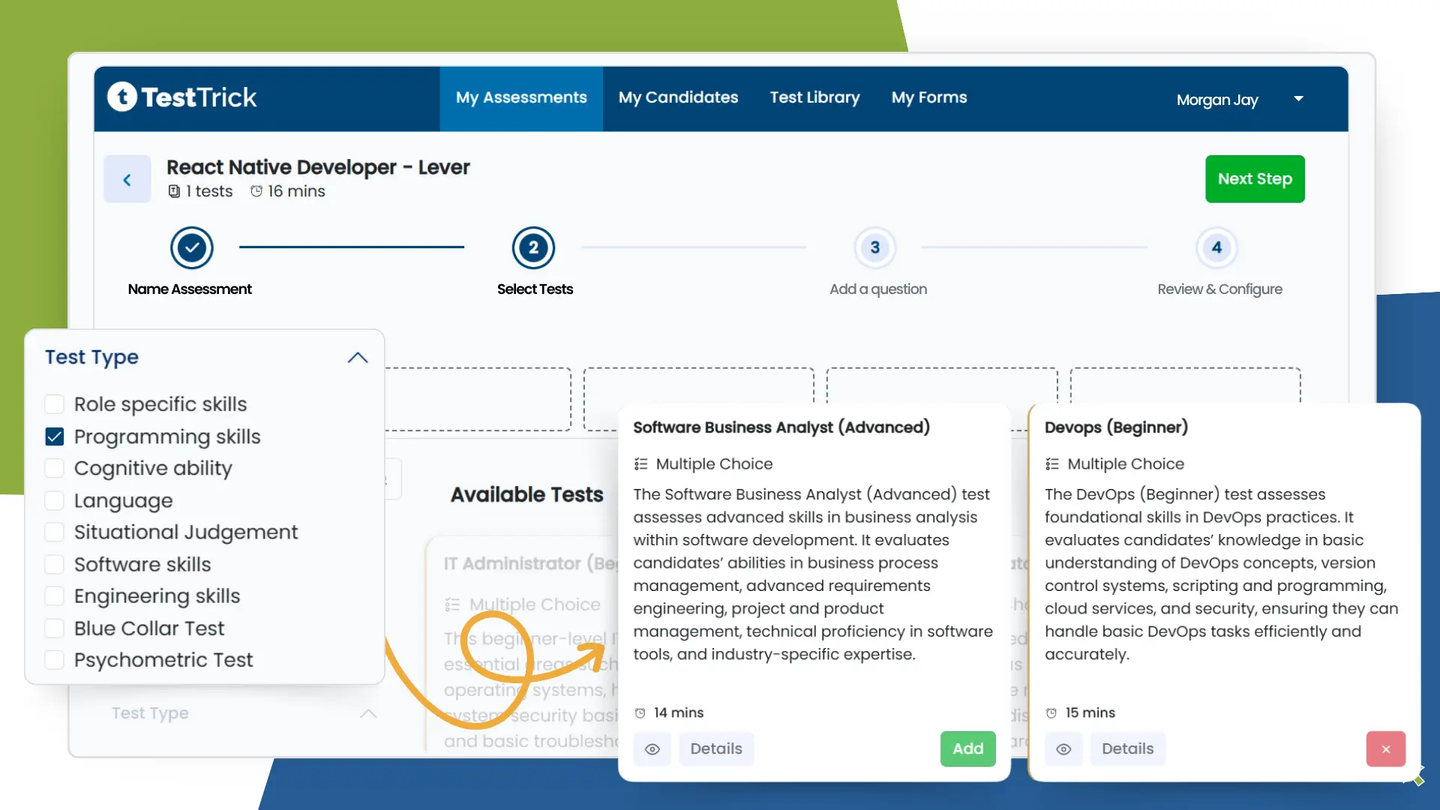
Skills Assessment tests in TestTrick
Skills assessment tests measure whether a candidate can perform the tasks required for a specific role. These employment tests evaluate practical ability rather than theoretical knowledge.
Skills assessments often include:
- Microsoft Office tests
- Excel tests
- computer skills tests
- accounting tests
- attention to detail tests
- job knowledge tests
Some platforms provide an interactive test format where candidates complete work-related tasks.
What it measures
Skills assessments measure a candidate’s ability to perform job-related tasks, such as writing responses for customer support, preparing reports for finance roles, analyzing marketing data, handling data entry tasks, or completing role-specific job knowledge exercises that reflect actual responsibilities.
Best-fit roles
- customer support
- sales representatives
- administrative assistants
- finance and accounting roles
- marketing coordinators
- data entry operators
Skills assessments are often paired with structured interview rounds to confirm candidate understanding and communication ability.
2. Cognitive Ability Tests
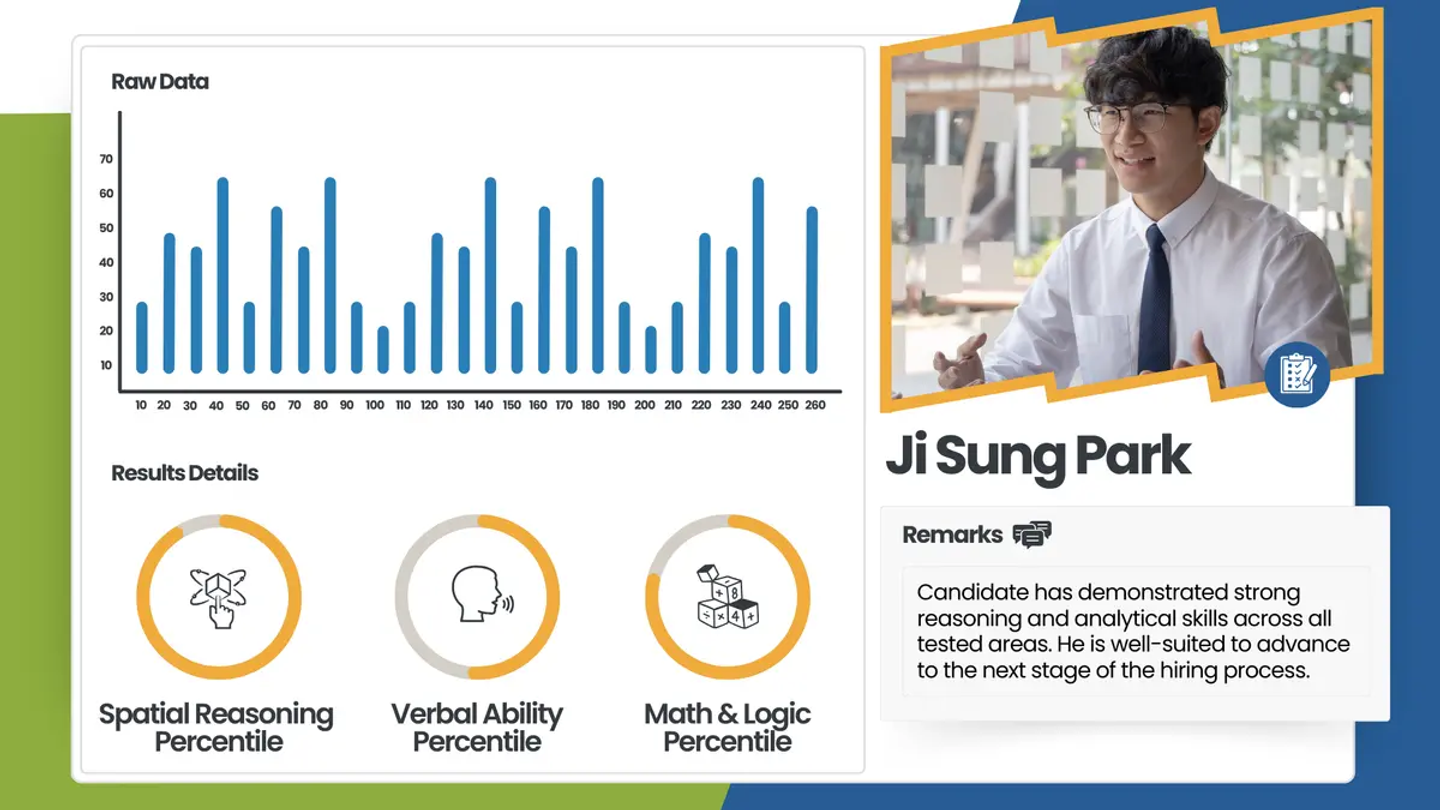
Cognitive ability assessments
Cognitive tests measure reasoning ability, learning speed, and problem-solving capacity. These are often categorized as aptitude tests or cognitive and reasoning tests.
A pre employment cognitive assessment may evaluate:
- verbal reasoning
- numerical reasoning
- logical reasoning
- abstract reasoning
- reading comprehension
Some cognitive tests may also assess abilities such as mechanical concepts or analytical thinking.
Important note: Cognitive tests should support hiring decisions, but should not be the only evaluation method. They should align with the actual requirements of the job.
3. Personality Assessments
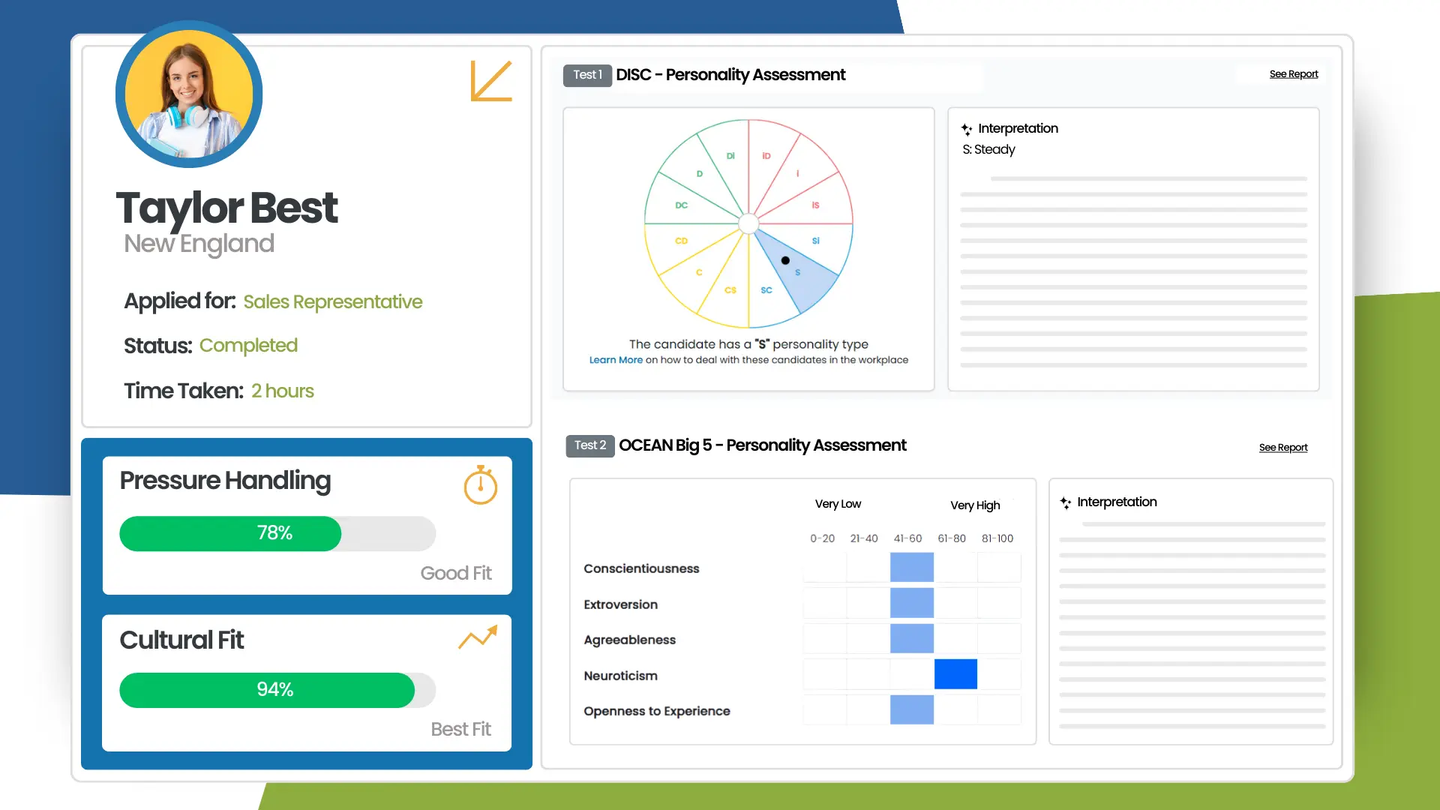
Personality assessments in TestTrick
Personality tests evaluate behavioral tendencies and workplace preferences. These tests measure personality traits and work style rather than technical skills.
Typical areas measured include:
- communication style
- collaboration tendencies
- conscientiousness
- dependability
- emotional intelligence
- work preferences
These tests generate personality insights that help hiring teams understand how a potential candidate may behave in a team environment or how they may perform under pressure.
Best scenarios
- customer-facing roles
- leadership-track hiring
- team-based environments
Personality tests should support skills assessment tests rather than replace them in the hiring process.
4. Situational Judgment Tests
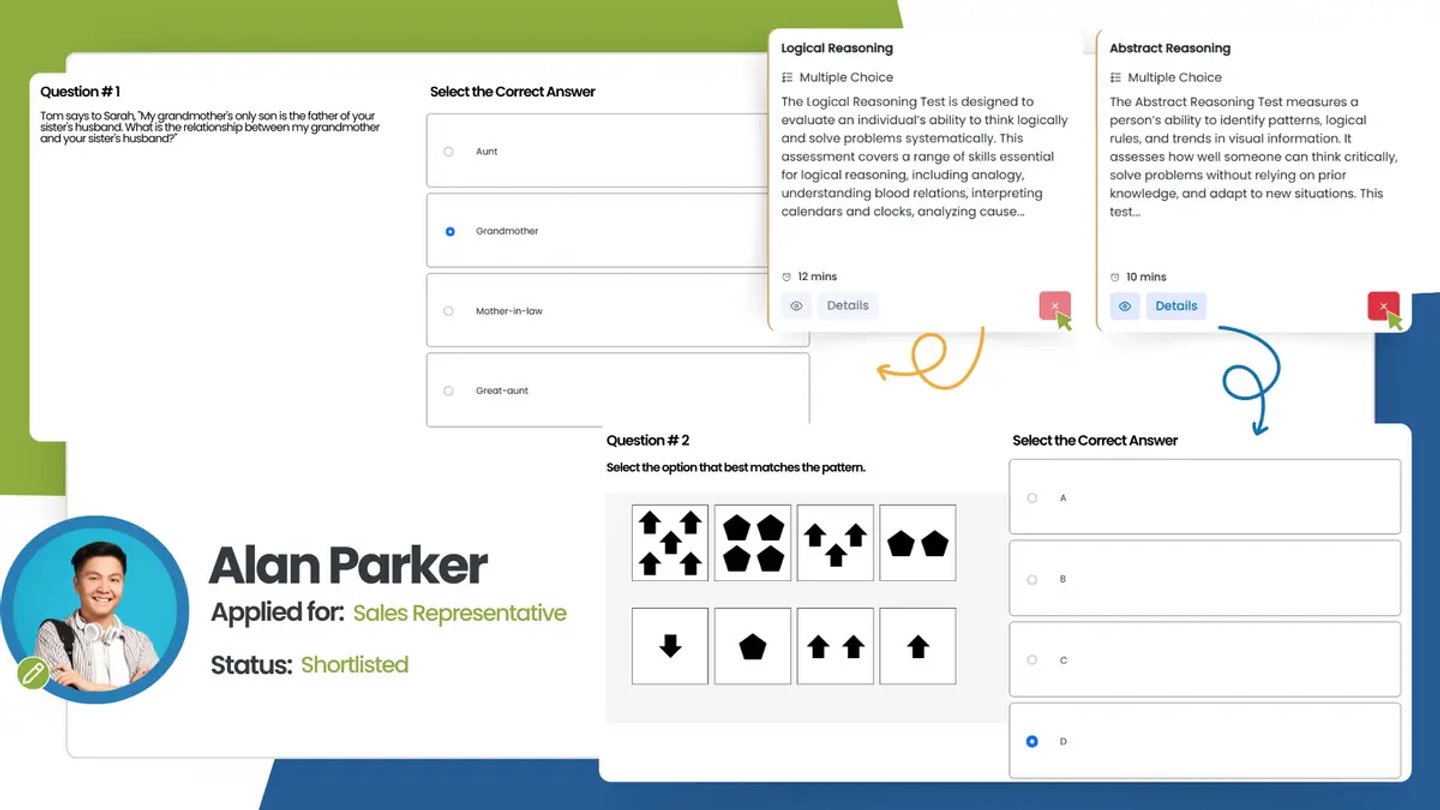
Situational judgment tests in TestTrick
Situational judgment tests present candidates with workplace scenarios and ask them how they would respond. These pre-employment assessment tests evaluate decision-making and applied judgment.
Candidates may be asked to respond to situations such as:
- handling a customer complaint
- resolving a team conflict
- responding to a sales objection
- managing service requests
These assessments measure applied judgment in job contexts, which makes them more relevant than abstract testing.
5. Coding Assessments
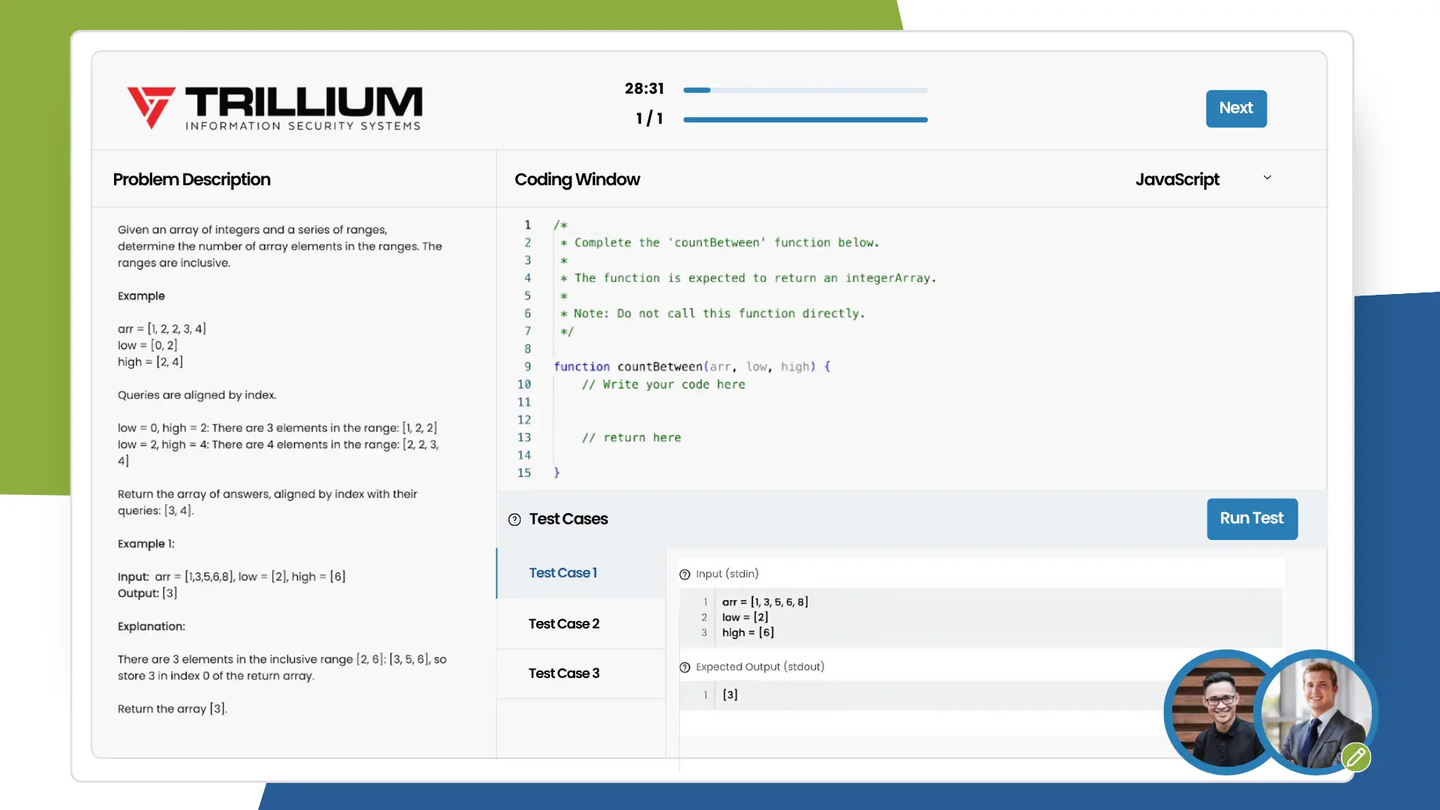
Coding Skills assessments in TestTrick
Coding assessments are technical pre employment assessment tests used to evaluate programming ability.
These tests help recruiters evaluate developer candidates before scheduling technical interviews.
Coding assessments typically include:
- programming challenges
- debugging exercises
- language-specific tasks
- algorithm questions
Some platforms simulate real development environments.
TestTrick supports coding assessments with coding tasks in 12+ programming languages, plagiarism checks, browser lockdown, screen recording and other advanced capabilities like auto-grading and code playback.
The platform also allows candidates to complete HTML and CSS coding simulations, helping recruiters evaluate technical skills in a practical coding environment.
6. Job Simulations and Work Sample Tests
Work sample tests ask candidates to complete tasks similar to what they would do in the job.
Examples include:
- writing a customer support email
- reviewing a spreadsheet
- responding to a support ticket
- preparing a marketing brief
- analyzing financial data
These tests measure job performance ability rather than theoretical knowledge.
Because candidates perform tasks related to the job, these tests often have strong credibility with applicants.
7. One-Way Video Interviews
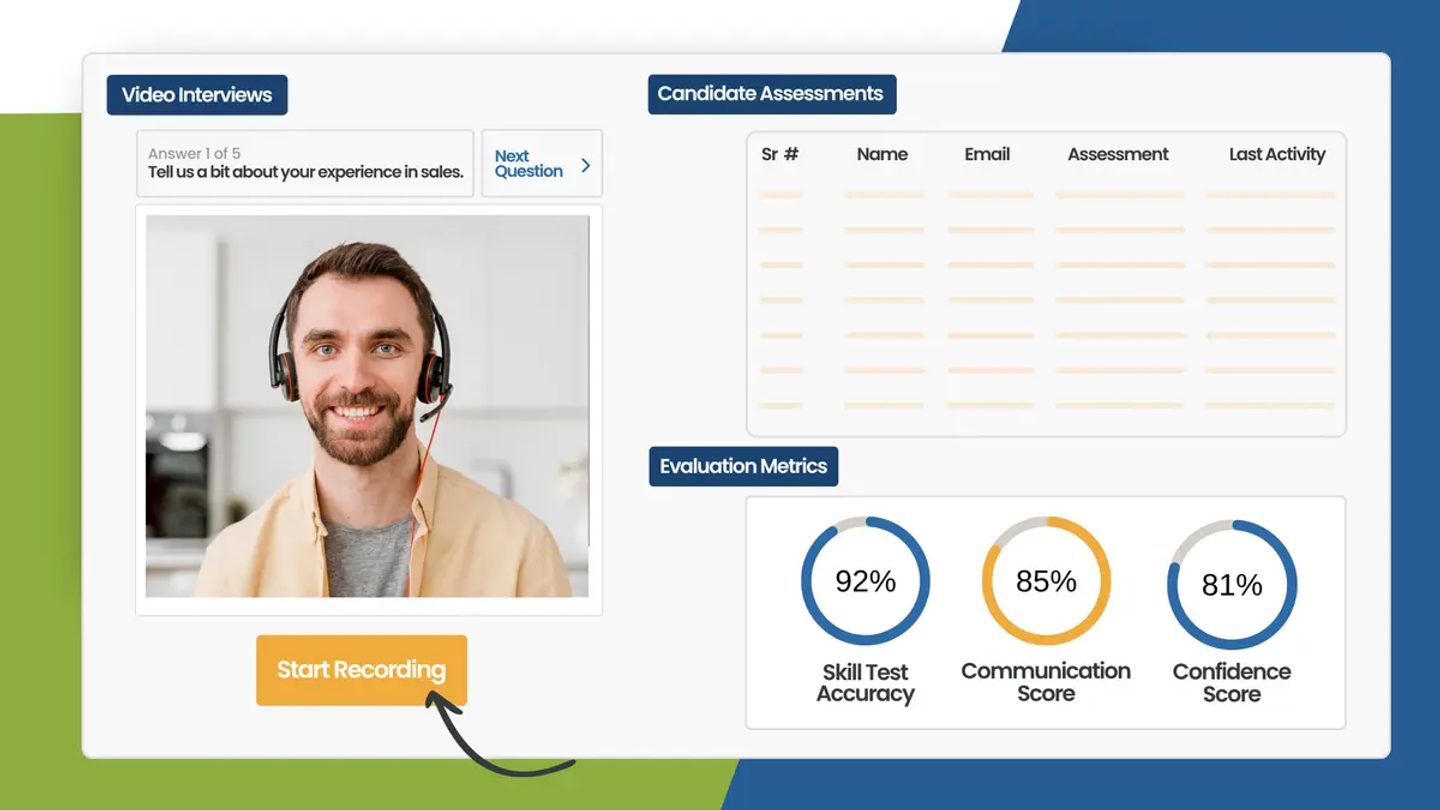
One-way video interviews in TestTrick
One-way video interviewing is often used as a structured pre-screening step rather than a traditional test.
Candidates record answers to predefined questions and recruiters review the responses later instead of scheduling live interviewing sessions.
What it evaluates
- communication skills
- clarity of response
- confidence and professionalism
- role understanding
When to use
One-way video interviews work well for communication-heavy roles, early-stage screening, remote hiring, and high-volume applicant pipelines.
8. Psychometric Assessments
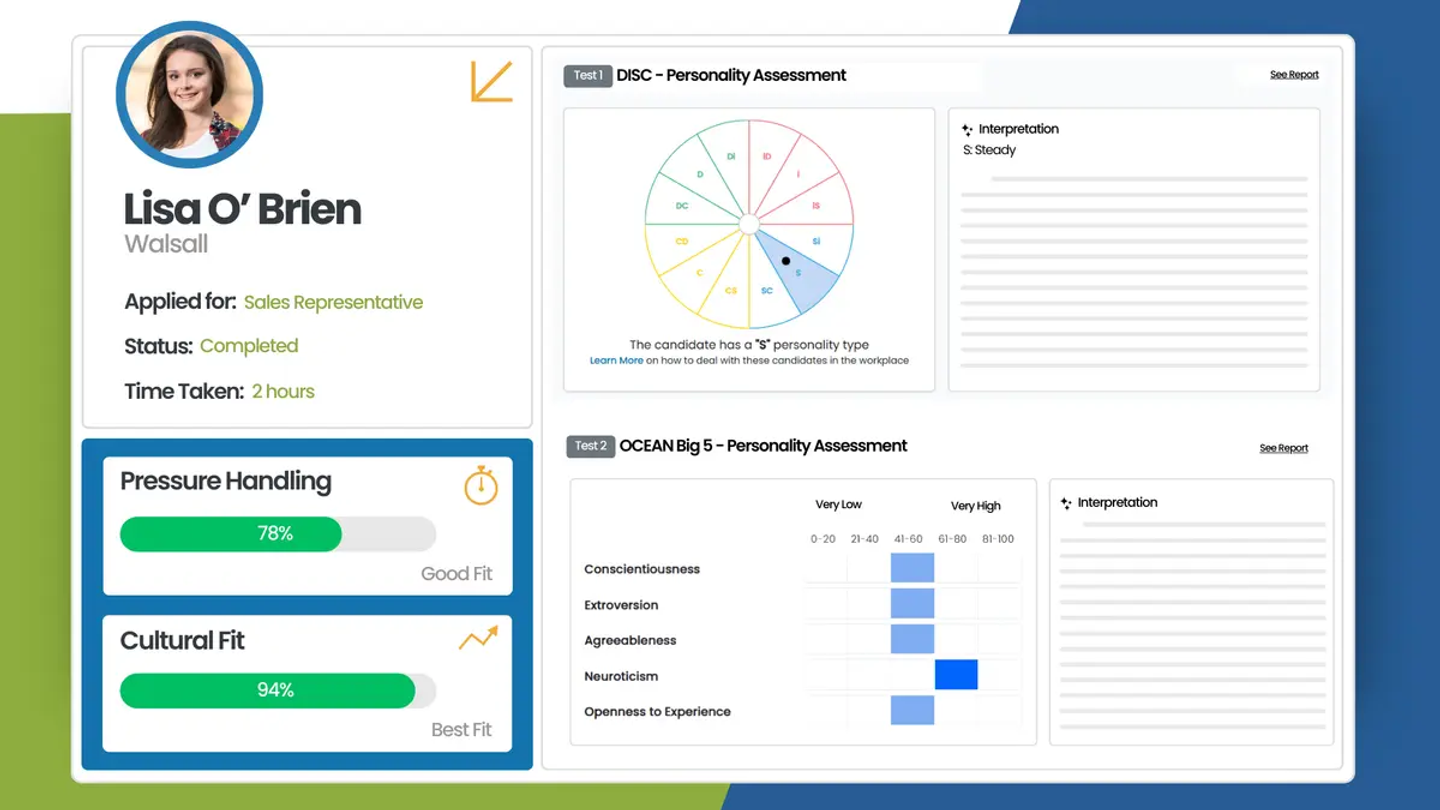
Psychometric assessments in TestTrick
Psychometric testing is a broader category of standardized assessments used in structured hiring.
Psychometric assessments commonly include personality tests, cognitive tests and behavioral assessments. These scientifically validated assessments help employers evaluate thinking patterns and behavioral tendencies.
When to use
Psychometric assessments are commonly used for:
- leadership hiring
- structured hiring programs
- large organizations
- layered hiring processes
It is important to note that psychometric testing is a category of assessments, not a synonym for all pre-employment assessment tests. Different tests measure different capabilities depending on hiring goals.
Comparison Table: Pre-Employment Assessment Types at a Glance
The table below summarizes the most common pre employment assessment tests used in hiring.
| Assessment Type | What It Measures | Best For | Use Case | Not Ideal When | Hiring Stage |
|---|---|---|---|---|---|
| Skills Assessment Tests | Technical skills, job knowledge, attention to detail | Admin, finance, marketing, support roles | Microsoft Office tests, Excel tests, accounting tests, computer skills tests | When the role focuses mainly on abstract reasoning | Early screening |
| Cognitive Ability Tests | Reasoning ability, problem-solving, learning speed | Analysts, graduate roles, operations roles | Cognitive and reasoning tests, aptitude tests, reading comprehension | Highly routine jobs with fixed tasks | Early screening |
| Personality Tests | Personality traits, collaboration style, emotional intelligence | Customer-facing roles, leadership-track roles | Personality insights for team fit and communication style | When used as the main hiring decision tool | Mid screening |
| Situational Judgment Tests | Decision-making and behavioral judgment | Customer support, sales, service roles | Scenario-based employment tests evaluating candidate responses | Highly technical or coding roles | Early screening |
| Coding Assessments | Programming ability and debugging skills | Software developers, engineering roles | Language-specific coding tasks, debugging challenges | Non-technical roles | Technical screening |
| Work Sample Tests | Practical job performance and task output | Marketing, writing, operations, finance roles | Writing emails, reviewing spreadsheets, campaign tasks | When candidates are still at very early screening stage | Mid screening |
| One-Way Video Interviews | Communication skills and response clarity | Sales, recruiting, customer-facing roles | Video interviewing for remote hiring or high-volume hiring | When technical skills must be measured first | Early screening |
| Psychometric Assessments | Behavioral tendencies, thinking patterns | Leadership hiring, structured hiring programs | Standardized assessments measuring personality or cognitive patterns | Small hiring processes with limited evaluation stages | Mid screening |
When to Use Each Pre-Employment Assessment Type
Choosing the right pre employment assessment tests depends on what the role actually requires. Recruiters should match the types of pre-employment tests with the skills, reasoning ability, or behavior needed for the job.
Below are common hiring scenarios and the assessment types that work best.
Use Skills Assessments When Job Performance Can Be Tested Directly
Skills assessment tests are useful when a role involves tasks that can be measured clearly. These pre employment tests help verify whether candidates can complete the work they claim to know.
When to use
Use skills assessments when:
- the role has clear task-based responsibilities
- resumes cannot verify real ability
- hiring is happening at scale
These pre employment assessment tests work well when resumes are not enough to confirm skills or job knowledge tests, especially for tech companies.
Use Cognitive Ability Tests When Reasoning and Learning Speed Matter
Cognitive tests measure how candidates analyze problems and process information. These cognitive and reasoning tests are often used when jobs require learning new systems quickly.
A pre employment cognitive intelligence assessment may evaluate reasoning ability through aptitude tests, reading comprehension, numerical reasoning, and logical reasoning.
Cognitive ability tests work best commonly for analytical roles, graduate hiring programs, management trainee roles, or jobs requiring quick learning.
These tests are useful when a role requires problem-solving rather than routine tasks.
Use Personality Assessments When Work Style Matters, but Not Alone
Personality assessment tools evaluate how a candidate behaves in workplace situations. These pre-employment tests measure personality traits, collaboration tendencies, and emotional intelligence.
They help recruiters understand how candidates may interact with teams or customers.
Personality tests should support skills assessment tests or job knowledge tests, not replace them in hiring decisions.
When to use
Personality assessments are useful for:
- customer-facing roles
- leadership-track hiring
- team-based environments
- roles where collaboration matters
Use Situational Judgment Tests When Decision-Making Quality Matters
Situational judgment tests present candidates with workplace scenarios and ask them how they would respond. These employment tests measure applied judgment and decision quality in job-related situations.
Situational judgment tests are commonly used for:
- customer support roles
- sales teams
- people management positions
- compliance-heavy environments
- service-based roles
These tests are particularly useful when hiring roles where employees must handle real workplace situations.
Use Coding Assessments for Technical Screening Before Live Interviews
Coding assessments are technical tests used to evaluate programming ability, debugging skills, and problem-solving across different programming languages and development tasks.
These tests often include programming tasks, debugging exercises, and language-specific coding challenges.
Best scenarios to use in:
- backend developers
- frontend developers
- full-stack engineers
- junior developer hiring
- remote engineering recruitment
Use Work Sample Tests When You Want the Most Role-Relevant Proof
Work sample tests require candidates to complete tasks similar to those they would perform on the job.
These pre-employment assessment tests measure practical performance rather than theoretical knowledge.
Examples include:
- writing a marketing brief
- responding to a support ticket
- reviewing a spreadsheet
- analyzing finance data
Best scenarios
Work sample tests work best when:
- the role produces measurable outputs
- practical job performance matters most
- hiring mid-level functional roles
This is mostly for marketers, writers, support agents, operations coordinators, and finance associates.
As candidates perform job-related tasks, work sample tests provide strong evidence of ability.
Use One-Way Video Interviews When Communication Is Important
One-way video interviewing helps recruiters evaluate how candidates communicate and present their responses.
Best scenarios
- customer support roles
- sales positions
- recruiting roles
- client-facing operations
Video interviews are often used alongside pre employment assessment tests to evaluate communication skills after a technical or task-based evaluation.
How to Choose the Right Assessment for the Role
Choosing the right pre employment assessment tests starts with understanding the actual work involved in the role. Hiring teams should focus on the skills and abilities that directly affect job performance instead of using the same types of employment tests for every position.
A practical way to approach pre-employment testing is to begin with the job itself.
1. Start With the Actual Job Tasks
Look at what the employee will do daily. If the role involves spreadsheets, reporting, or documentation, skills assessment tests such as Excel tests or computer skills tests may be appropriate.
If the role requires analysis or reasoning, cognitive and reasoning tests or aptitude tests may provide better insight.
2. Identify the Must-Have Skills
Not every skill needs to be tested. Focus only on the abilities that determine whether someone will succeed in the role.
These may include:
- technical skills
- job knowledge tests
- cognitive ability
- personality traits and emotional intelligence
Testing too many areas can create unnecessary complexity in the hiring process.
3. Decide What Should Be Tested vs Discussed in Interviews
Some skills are easier to measure through pre employment tests, while others are better evaluated during interviews.
For example:
- technical skills or computer skills can be verified through skills assessment tests
- communication style or personality insights may be explored during interviews
Using this balance helps avoid relying on gut-based interviews alone.
4. Match the Assessment to the Skill Type
Different skills require different types of pre-employment tests.
Examples include:
- technical skills - skills assessment tests or job knowledge tests
- problem solving - cognitive ability or aptitude tests
- behavior and collaboration - personality tests
This alignment helps ensure that pre employment assessment tests reflect the real demands of the role.
5. Keep Candidate Effort Reasonable
Long assessments can discourage applicants, especially in a competitive job market. Many organizations aim for shorter pre-employment assessment tests that measure the most important abilities without requiring excessive time.
6. Use Layered Screening Instead of Too Many Tests
Instead of testing everything at once, hiring teams can use layered selection procedures.
For example:
early skills assessment tests or cognitive tests
short video interviewing stage
structured interview with the hiring manager
Using a pre-hire assessment platform such as TestTrick allows recruiters to organize these assessments into a clear screening workflow, helping teams evaluate candidates through structured pre-employment assessment tests before interviews.
Best Assessment Combinations for Common Hiring Scenarios
Different roles require different pre employment assessment tests. Recruiters often combine a few types of pre-employment tests to evaluate both ability and decision-making before interviews.
For Customer Support Hiring
Customer support hiring usually combines a situational judgment test with a short written communication assessment. Many teams also add one-way video interviewing to review how candidates explain solutions to customer problems.
For Sales Hiring
Sales hiring often includes a situational judgment test and a role-play or objection-handling exercise. A personality test can be added to understand communication style and interpersonal behavior.
For Developer Hiring
Developer hiring usually begins with a coding assessment to evaluate programming ability. Recruiters may add problem-solving questions or cognitive tests, followed by a technical interview to review the candidate’s approach.
For Campus Recruitment
Campus hiring programs often combine a cognitive ability test with a role-based skills assessment test. A short communication screen or video interviewing step may follow before interviews.
For High-Volume Non-Technical Hiring
For operational or administrative roles, recruiters often start with a short skills assessment test, such as computer skills or attention to detail. A situational judgment test may follow, with optional video screening for communication.
For Leadership or Managerial Roles
Leadership hiring typically includes:
- situational judgment test
- psychometric or personality assessments
- work sample or case exercise
Common Mistakes to Avoid With Pre-Employment Assessments
Even well-intentioned pre-employment testing can create problems if assessments are used incorrectly. Recruiters should avoid these common mistakes when designing pre employment assessment tests.
- Using too many tests - Adding multiple types of pre-employment tests can overwhelm candidates and slow the hiring process.
- Testing irrelevant skills - Some tests measure abilities that are not required for the job.
- Using personality tests as the main decision tool - Personality tests provide behavioral insights, but should not replace skills assessment tests or job knowledge tests.
- Giving long assessments too early - Lengthy pre employment assessment tests at the beginning can discourage qualified candidates.
- Not matching tests to the role - Different roles require different types of employment tests, such as cognitive tests, coding assessments, or skills tests.
- Treating every role the same - Using identical selection procedures for all jobs can lead to poor hiring outcomes.
- Ignoring candidate experience - Overly complex pre-employment testing processes may cause candidates to drop out.
- Relying only on resume screening - Resumes alone cannot verify technical skills, cognitive ability, or job readiness, which is why assessments are used.
Are Pre-Employment Assessments Better Than Resumes and Interviews?
Pre employment assessment tests are not a replacement for resumes or interviews, but they provide stronger evidence of measurable skills during early hiring stages. While resumes show past experience and interviews evaluate communication, pre-employment testing helps verify technical skills, cognitive ability, and job readiness. Most recruiters use these tests alongside structured interviews as part of consistent selection procedures in talent acquisition.
How TestTrick Supports Structured Pre-Employment Assessment Workflows
Many recruiters want to use pre-employment testing, but managing multiple types of pre-employment tests manually can become difficult. A structured pre-hire assessment platform helps organize these evaluations in a consistent hiring workflow.
TestTrick helps hiring teams run structured pre employment assessment tests based on the role they are hiring for. Recruiters can choose assessments from a large test library or create customized tests aligned with job responsibilities.
Role-Based Skills and Cognitive Assessments
TestTrick supports several types of employment tests used in structured hiring. Recruiters can run:
- skills assessment tests for job knowledge and technical ability
- cognitive and reasoning tests to evaluate problem-solving and learning ability
- personality tests to understand personality traits and work style
- situational judgment tests to measure decision-making in job scenarios
Coding Assessments for Technical Hiring
For developer hiring, TestTrick offers coding assessments in 12+ programming languages.
Key capabilities include:
- auto-grading for coding submissions
- code playback to review candidate problem-solving steps
- plagiarism checks to detect copied code
- screen recording and browser lockdown for assessment integrity
- HTML and CSS live coding simulations to evaluate frontend development skills
These pre employment assessment tests allow recruiters to verify technical skills before scheduling technical interviews.
Video Interviews for Communication Screening
TestTrick also supports one-way video interviewing, which helps hiring teams review candidate responses before moving to live interviews.
This step is often used alongside skills assessment tests or situational judgment tests to evaluate communication ability after a technical or task-based evaluation.
Candidate Evaluation and Assessment Management
Once candidates complete pre employment tests, TestTrick generates candidate assessment reports that summarize performance across different assessments.
The platform also provides tools that help recruiters manage the hiring process, including:
- bulk invite tool to invite candidates to assessments
- job application form builder for collecting candidate information
- centralized test library for different job roles
Using these tools, hiring teams can run structured pre employment assessment tests and apply the assessment strategies discussed in this guide in a consistent hiring workflow.
Final Thoughts
The goal of pre-employment testing is not more tests, but better hiring evidence.
The most effective pre employment assessment tests match the actual requirements of the role. Using the right types of pre-employment tests helps recruiters evaluate technical skills, cognitive ability, and personality traits more accurately and reduce bad hires.
If your team wants to move beyond resume screening, TestTrick helps run structured pre employment assessment tests to evaluate job readiness before interviews begin.
Frequently Asked Questions
1. What are pre-employment assessments?
Pre-employment assessments are tests used during hiring to evaluate a candidate’s technical skills, cognitive ability, personality traits, and job readiness before interviews. These pre employment assessment tests help recruiters compare applicants using structured selection procedures instead of relying only on resumes.
2. What are the main types of pre-employment assessments?
The most common types of pre-employment tests include skills assessment tests, cognitive ability tests, personality tests, situational judgment tests, coding and work sample tests.
3. When should employers use pre-employment assessments?
Employers typically use pre employment assessment tests during early hiring stages to screen candidates before interviews. Pre-employment testing helps recruiters verify technical skills, cognitive ability, and job knowledge when screening large applicant pools in talent acquisition.
4. Are pre-employment assessments better than interviews?
Pre employment assessment tests are not a replacement for interviews, but they provide measurable evidence of technical skills and cognitive ability before interviews. Many hiring teams combine pre-employment testing with structured interviews for more consistent candidate evaluation.
5. Which pre-employment assessment is best for technical hiring?
For technical hiring, coding assessments are the most effective. These employment tests evaluate programming ability, debugging skills, and problem-solving, helping recruiters verify technical skills before scheduling technical interviews.
Build a Hiring-Ready Assessment
Create role-specific, anti-cheat assessments and shortlist candidates on evidence, not guesswork.
Start for freeBy Tooba Noman
March 9, 2026
15 min read
Build a Hiring-Ready Assessment
Create role-specific, anti-cheat assessments and shortlist candidates on evidence, not guesswork.
Start for free