How Psychometric Testing Helps Identify Culture Fit and Boost Employee Retention
Learn how psychometric testing identifies culture fit, supports better hiring decisions, and reduces employee turnover for long-term organizational success.
By Favour Etinosa Ogie
June 16, 2026
10 min read
When you onboard the wrong hire, there could be several culprits. You might blame the recruiter for not being thorough enough or the candidate for misrepresenting themselves on their resume. But sometimes, a candidate may tick all the right boxes and still be unfit for your organization. They might hold different values, expectations, and work ethics that clash with your company’s established culture.
When this clash exists, turnover risk rises sharply, even when the employee is technically strong.
That’s why many teams use psychometric testing to assess role-relevant behaviors, like collaboration, resilience, and decision-making, so ‘culture add,’ and values alignment are evaluated more consistently. This helps you determine whether applicants align with your company’s values and whether they can cope with your unique work environment.
In this article, we’ll review what psychometric testing is and how you can use it to identify culture fit and reduce employee turnover in your organization.
What are psychometric tests in recruitment?
Psychometric tests are pre-employment evaluations that help recruiters and HR professionals assess attributes not limited to a candidate’s resume or technical qualifications, such as personality and mental strength. These tests help you gauge the cognitive abilities and behavioural patterns of job applicants and predict whether they would be a suitable fit for your business. With these tests, you can measure things like:
- Personality traits like diligence, openness, and emotional stability
- Cognitive abilities, including reasoning, problem-solving, and numerical or verbal aptitude
- Emotional intelligence, such as empathy and self-awareness
- Work style and motivation, including reliability, adaptability, and initiative
- Communication and interpersonal skills, including collaboration and leadership potential
- Decision-making and judgment, including situational responses and prioritization
- Learning ability and potential to acquire new skills
- Stress tolerance, resilience under pressure, and more
If you want to understand just how important these tests are, take a cue from the Police Federation of England and Wales (PFEW). At their annual conference in 2026, the union’s secretary, John Partington, reiterated how vital these assessments are in determining whether applicants possess the character and resilience required to handle the demands of the police force.
“Psychological and psychometric testing must become a national standard, not an optional extra, because this job isn't for everyone — it demands resilience, empathy, and moral strength. Those qualities can't be assumed — they must be tested, proven, and maintained.”
Even though your company may not be as high-stakes as policing, it is still not a perfect fit for everyone. Your company culture might require people who are fast on their feet, possess critical thinking skills, are emotionally intelligent, or can communicate and collaborate effectively within a team. A resume alone can’t help you test for that.
By combining psychometric tests with other skill-based assessments, you can gain a holistic, objective view of every candidate’s skills and abilities. According to SHRM, this approach helps teams find quality hires, match applicants to the right roles, and ultimately increase employee retention rates by up to 30%.
What does culture fit mean in the workplace, and why does it matter for employee retention?
Cultural fit in the workplace simply means that a candidate aligns strongly with the work patterns, values, and motivations of the company and its existing workforce. In other words, the candidate is compatible with the organization they are applying to.
To understand this better, let’s take a cue from interpersonal relationships. Say you’re in the market for a life partner. A potential partner might have all the right qualities, like a good job, a solid educational background, or a nice house, but compatibility still matters. How do they communicate? Do you share similar goals and aspirations? Are they emotionally stable? Now imagine committing to that relationship without ever getting clear answers to those questions. You’d break up faster than you can count to ten.
Culture fit is essentially compatibility testing in the workplace. It asks, “Can you really work well with the people in this organization?” When co-workers share similar values, there’s stronger cohesion, stress-free collaboration, and improved productivity. Employees know they’re in the right place, working toward goals they believe in. As a result, they’re more committed long-term and less likely to churn. That’s why 90% of employers prioritize finding candidates who are a good fit for their organizations, not just those who are technically savvy.
Five reasons why psychometric testing matters
Psychometric testing provides insight into how candidates think, behave, and interact with others, helping you make better hiring decisions. These five reasons show why it’s an essential tool for identifying the right fit and reducing turnover rates.
#1 Reveals whether candidates truly align with organizational needs
Traditional skill-based tests evaluate hard skills. If you're hiring a developer, they show whether the candidate understands Python, can write correct and efficient code, understands syntax, and applies language-specific best practices.
But when it comes to cultural fit, your organization doesn’t just need someone who can write long lines of code. You also need someone reliable, who thinks strategically, communicates effectively, and operates without constant hand-holding.
Where skill-based testing stops, psychometric testing takes over, helping you identify candidates who possess these essential qualities early in the hiring process.
#2 Prevents costly early turnover caused by cultural misalignment
Let me paint you a picture. You just hired a writer without first determining if they were the right match. Now, you’re constantly paying for extra revisions because your company’s brand voice doesn’t align with the writer’s style. They might sound more professional and sophisticated, while your company needs someone fun, conversational, and engaging. After several rewrites, you end the contract. “We’re just not the right fit,” you say.
When there’s cultural misalignment, productivity drops, job satisfaction falls, and turnover rises. This aligns with the 56% of professionals who believe company culture and alignment are more important than salary.
Bad hires force you to repeat the hiring process multiple times, piling up costs. According to a Work Institute report, US companies spent nearly a trillion dollars in 2023 replacing employees who quit. With psychometric testing, you can prevent this mishap before it happens and save your organization the added cost of turnover.
#3 Improves day-to-day collaboration through behavioral compatibility
Another benefit of hiring candidates who are culturally compatible with your organization is that they collaborate more effectively with team members. This reduces friction and ensures your staff can work together toward common goals.
With a psychometric assessment, you can spot candidates who can integrate smoothly with your existing team dynamics early on. Managers can also better understand the differing communication styles and expectations among team members, thereby reducing unnecessary conflict.
#4 Adds objectivity to the talent acquisition process
Hiring decisions are often influenced by gut feeling, personal impressions, or interview performance on a “good day.” While experience matters, these subjective signals can introduce unconscious bias and inconsistent decision-making.
Psychometric tests bring objective, standardized data into the process. Every candidate is assessed against the same criteria using validated metrics, making it easier to compare applicants fairly. Instead of relying solely on how confident or charismatic a candidate appears, recruiters can use hiring assessment software to base decisions on measurable traits like problem-solving ability, emotional regulation, motivation, and behavioral style.
#5 Saves time by reducing interview load and early drop-offs
Recruiters often spend hours interviewing candidates who look strong on paper but fail to integrate well after hiring. Psychometric assessments help filter out poor-fit candidates before they reach late-stage interviews.
By identifying mismatches early, such as low stress tolerance for customer-facing roles or poor collaboration tendencies for team-based work, teams can:
- Shortlist faster
- Run fewer but higher-quality interviews
- Reduce time-to-hire
This allows recruiters and hiring managers to focus their time on candidates with both the skills and the right behavioral profile.
What are the best psychometric tests for assessing company fit?
You now understand how important psychometric assessments are in your pre-hiring testing process. Now, it’s time to explore the different types of tests you can use to assess company fit. Here’s a breakdown:
Personality tests
Personality assessments are the most common types of psychometric testing used in measuring cultural fit. These tests provide objective insights into how people behave, how they interact with others, their personality traits, motivations, communication styles, and values. You can use these tests when hiring for roles like managers, directors, and executives, where leadership skills and character are essential.
This will determine whether these candidates can lead teams, make strategic decisions, regulate their emotions under pressure, and communicate effectively with their subordinates.
Cognitive ability tests
Unlike personality testing, which gauges behavioural patterns, cognitive ability tests are meant to assess mental strength, how a person thinks, reasons, and processes information, and predict how well they might perform in a certain position or work environment. If you're hiring a software engineer or data analyst, for instance, these tests can help you gauge their reasoning and logical abilities, in addition to their coding skills. They usually come in the form of quizzes, puzzles, and multiple-choice questions, covering verbal, numerical, logical, and spatial cognitive ability evaluations.
Aptitude tests
Aptitude tests predict a candidate's ability to learn or succeed in a specific role, rather than what they already know. This helps you determine whether a job applicant can perform well after training, especially if they lack prior experience in the field. It assesses skills like problem solving, numerical and verbal aptitude, technical aptitude, and more.
Such psychometric testing is particularly useful when recruiting for entry-level positions, recent graduates with little to no work experience, high-volume hiring, or career changers. It essentially asks, “I know this person doesn't yet have the hard skills and experience for this role, but can they catch up with some training?”
Situational judgment and behavioral tests
These scenario-based tests assess whether candidates have the soft skills needed for a role by evaluating how they handle realistic, work-related situations they are likely to encounter in your organization. This type of testing is especially useful when hiring for customer-facing positions, such as call center agents, client success managers, and even leadership roles like managers and department heads.
For example, if you’re hiring a manager, you might present a situation involving workplace conflict. Their responses provide insight into how well they can handle and resolve disputes, their problem-solving capabilities, and their leadership tendencies. If a candidate appears biased during a conflict management test, it indicates they may not be diplomatic enough to lead a team.
How to use psychometric assessments in the recruitment process
To maximize the impact of psychometric testing, it’s essential to understand how it fits into your overall recruitment process. Here’s how:
Define the role and culture requirements first
Before drafting your job description, it’s crucial to understand both your organization’s culture and the role you’re hiring for. Recent surveys show that 70% of professionals who applied for a job felt misled about the company's culture, while 53% noticed discrepancies between the company’s work environment and the job description. That’s not a good look for your organization.
Make sure you clearly understand the values your company upholds and what you expect from a hire before beginning your search. Remember our dating example? Just as you can't find the right partner without first knowing yourself and your expectations, you can’t find the right employee without first defining your company’s culture and the traits required for the role.
Choose validated psychometric tests aligned with hiring goals
Understanding the role you’re hiring for helps you determine which psychometric tests to prioritize.
For example, if you’re hiring a call center agent, you may want to focus on personality assessments and situational judgment tests to accurately evaluate communication styles, emotional resilience, empathy, and patience.
On the other hand, if you’re hiring a developer or data analyst, cognitive ability tests that assess problem-solving, logical reasoning, and analytical skills may be more relevant.
Assessment tools like TestTrick make this process easier by automatically recommending prebuilt psychometric tests based on the role you’re hiring for. This eliminates guesswork and ensures candidates are evaluated on the traits that truly matter.
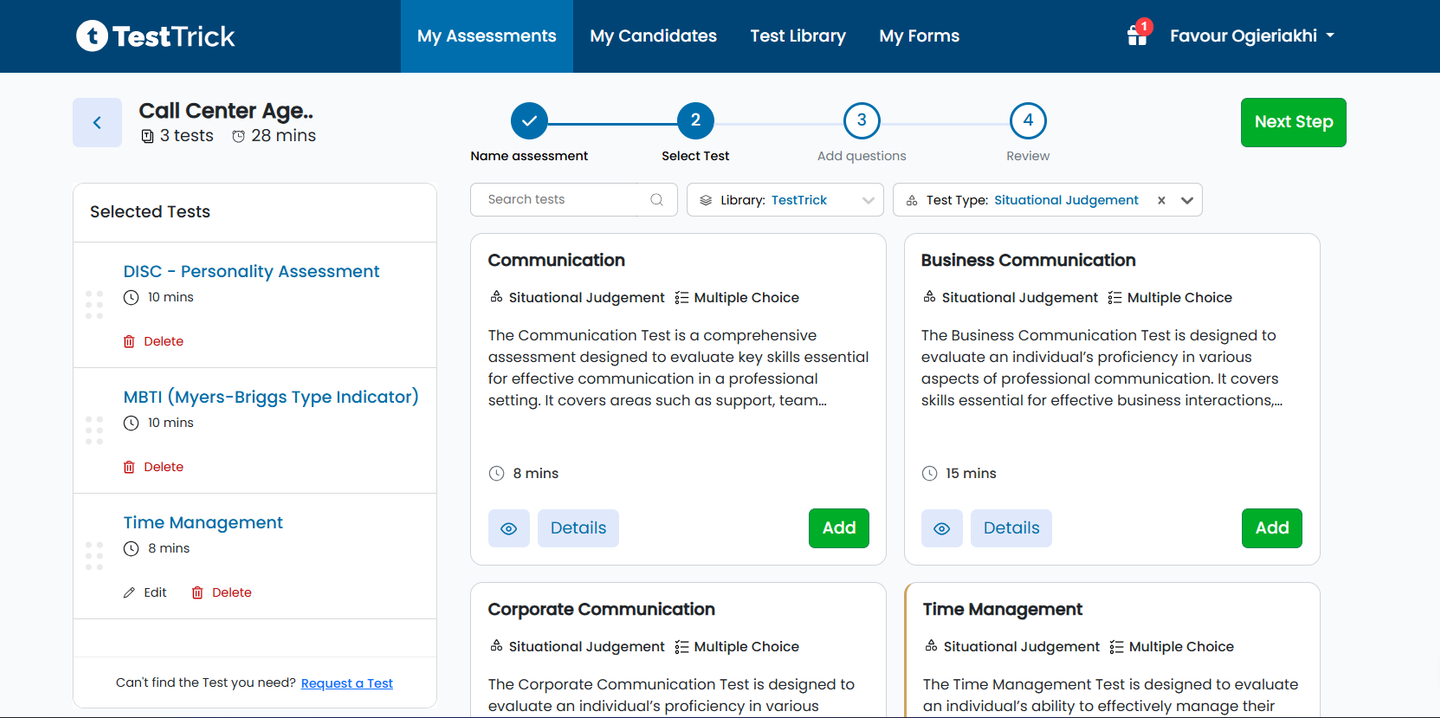
TestTrick Pschometric Tests
Combine psychometric tests with other traditional forms of pre-hiring evaluation
Another important step to remember is that psychometric tests should not be used as standalone solutions. Instead, they should be integrated into other parts of the hiring process, typically after initial screening and alongside interviews or skill-based assessments. One-on-one or asynchronous video interviews, pre-hiring screening, and skill-based evaluations are all important building blocks that make the hiring process more effective. Psychometric testing plays a valuable role, but it should not be used as a substitute for the rest.
Frequently Asked Questions
What type of questions are used in psychometric tests?
Psychometric tests use standardized questions such as personality statements, cognitive reasoning tasks, and scenario-based questions to assess how candidates think, behave, and make decisions at work.
How does psychometric testing support recruitment decisions?
Psychometric testing provides objective data on candidates’ abilities and behaviors, helping recruiters predict job performance, assess company culture fit, and make fair, evidence-based hiring decisions.
What is the role of psychometric testing in recruitment?
Psychometric testing plays a crucial role in recruitment by providing objective, data-driven insights into candidates’ personality traits, cognitive abilities, and behavioral tendencies. It helps recruiters make informed hiring decisions, match candidates to the right roles, and reduce bias, turnover, and hiring costs.
Spot the perfect fit with TestTrick’s psychometric assessments
In your search for the right hire, don’t be swayed solely by a candidate’s firm handshake, their impressive resume, or an Ivy League degree. You also need to assess cultural fit, soft skills, and how well they can thrive in your unique environment. Psychometric testing gives you the objective insights needed to make smarter hiring decisions, reduce costly turnover, and build high-performing teams.
To get started, clearly define the traits and values you need for each role, integrate psychometric tests into your existing recruitment workflow, and combine them with interviews and skill-based assessments. If you’re ready to streamline your recruitment process and find the perfect fit for your team, try TestTrick today with a free trial and see how easy it is to implement psychometric testing in your hiring.
Build a Hiring-Ready Assessment
Create role-specific, anti-cheat assessments and shortlist candidates on evidence, not guesswork.
Start for freeBy Favour Etinosa Ogie
June 16, 2026
10 min read
Build a Hiring-Ready Assessment
Create role-specific, anti-cheat assessments and shortlist candidates on evidence, not guesswork.
Start for free