How to Test Critical Thinking Skills in Candidates
You don’t need lengthy conversations to identify a critical thinker. Learn how to test critical thinking and hire smarter every single time.
By Peace Ajayi
September 2, 2026
9 min read
TL;DR – Key Takeaways!
- Critical thinking is the ability to question assumptions and evaluate information before acting on it. It’s different from problem-solving which most interviews only test.
- Standard behavioral questions let candidates recite a rehearsed story. They measure memory and confidence rather than live reasoning.
- Structured interviews, where every candidate answers the same questions against the same rubric, are about a third more predictive of job performance than free-form conversations, according to decades of hiring research (Schmidt & Hunter).
- Five methods that actually work for testing critical thinking in candidates are real past problems, structured assessments, open-ended questions, live exercises, and, for senior roles, a short paid take-home.
- Score every candidate on the same grading structure independently before comparing notes as a team.
A candidate can give a flawless interview answer and still struggle to reason through real workplace problems. That is because most interviews test confidence, memory, and storytelling more than actual critical thinking. Most recruiters simply think that by asking the same generic interview questions, they can assess candidates' ability to navigate tough scenarios.
Critical thinking can't be taught. It's developed through experience, knowledge, and a resolve to work through problems, which is exactly why organizations hire for it.
But a resume won’t show you a person’s reasoning ability, nor will a rehearsed answer do. If you really want to know whether someone can think and not just talk about thinking, you need a completely different approach.
What Critical Thinking Actually Means in a Hiring Context
Critical thinking isn’t raw intelligence or confidence. It is the habit of questioning what you are told before you act on it: either to get more background data for a well-informed response or to dissect every detail to know which one is an assumption disguised as fact.
It shows up in small, unglamorous moments on the job. A candidate with strong critical thinking notices when a request is built on a wrong premise before doing the work. They separate assumptions from fact and can tell you what would change their mind before they defend a position.
Critical thinking is different from problem-solving even though the two are used interchangeably. Critical thinking is the evaluative layer where you decide what is true, relevant, and worth acting on. Problem-solving is what happens next and where you choose what solution to execute towards a clear direction. You need the first skill to do the second one well. That is why a candidate can be a fast, confident problem-solver and still solve the wrong problem quickly.
Employers are currently feeling this gap as they struggle to find candidates with critical thinking and problem-solving skills. A separate survey of more than 1,000 U.S. hiring managers put critical thinking inside the ten most-wanted soft skills for 2026. That difficulty is an assessment problem, and it starts in the interview room.
What Normal Interviews Don’t Catch (and How to Avoid That)
Ask any recruiter with a few bad hires and you’ll hear the same story: the candidate interviewed well but could not reason through the job. That gap is a common failure in hiring.
This is typically how it happens: the interviewer asks a behavioral question like "tell me about a time you solved a difficult problem." Then the candidate narrates a story they have refined across a dozen other interviews. You think you’re watching them think but you’re actually watching them recall and perform. An interviewer who enjoys how someone talks would rate them based on their fluent, confident delivery rather than their thinking ability.
The research backs this up. Schmidt and Hunter's popular meta-analysis of hiring methods found that structured interviews (same questions, same order, same scoring rubric for every candidate) are about a third more predictive of job performance than unstructured, conversational ones. This singular difference can be why you get disappointed with some “strong” candidates who performed well in the interview.
The solution is not a cleverer interview question but changing what you measure. Instead of relying solely on a story about a problem they faced, put them in front of a problem they have not rehearsed and watch what they do with it in real time.
5 Ways To Actually Test Critical Thinking Skills In Candidates
Ditch the old, ineffective way of testing critical thinking in candidates. Instead, use one or more of these 5 methods in your next interview process:
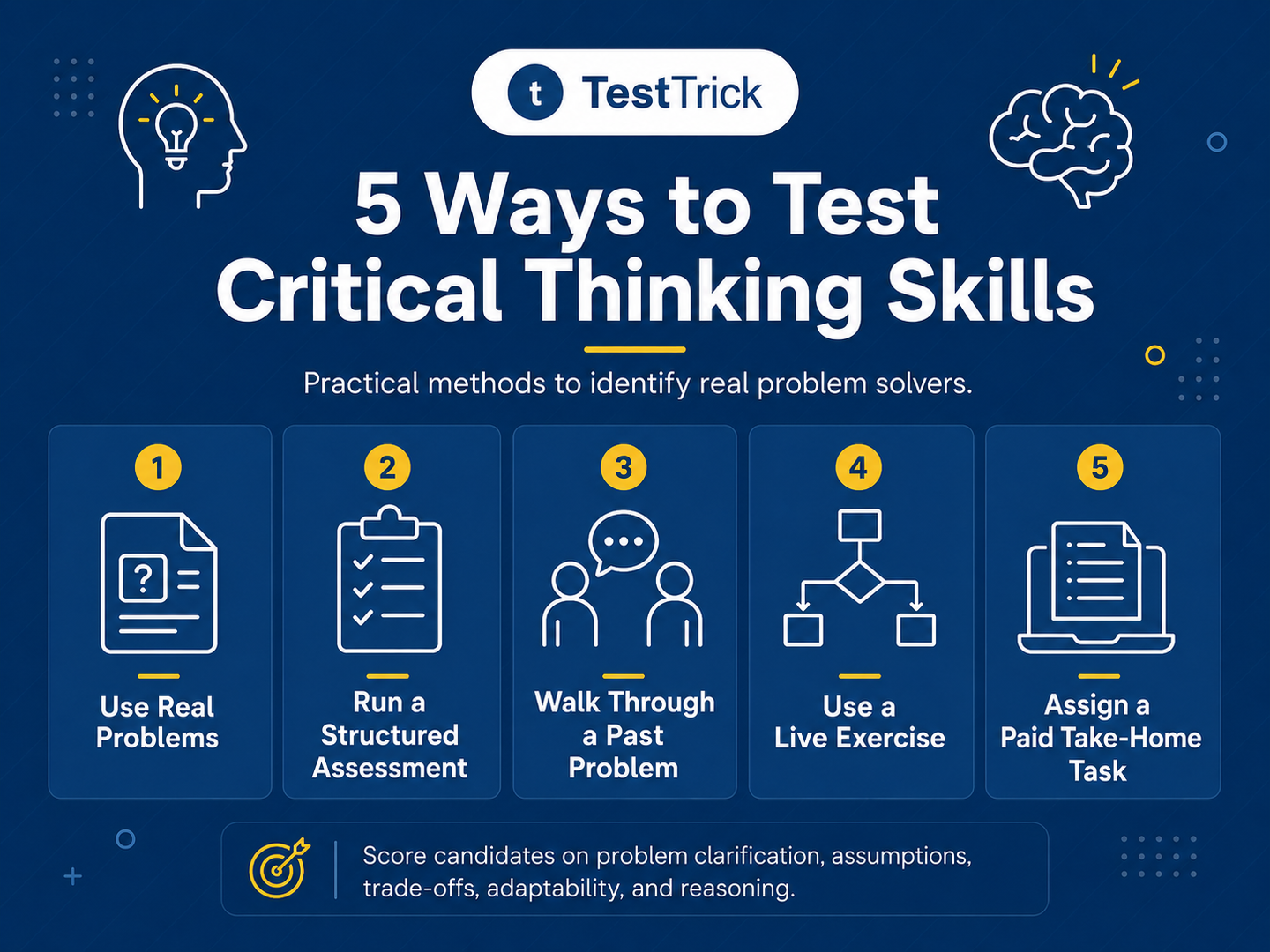
5 Ways to Test Critical Thinking Skills- TestTrick
Ask them a real problem your team already solved
Present a recent issue that your team faced and has resolved and ask them what their approach would have been. Tell them they can ask as many questions as they’d like to better grasp the situation. Then sit back and watch what their responses look like.
Who you’re looking for is a person who would ask questions to surface what they didn’t know about the situation beforehand. A strong critical thinker would probe you to understand the root cause of the issue when it was first discovered. What they’re essentially trying to get is some information to fill in the gaps to get a better context of the problem and provide the right solution to it.
Whether they assume or ask clarifying questions before committing to a direction, that’s a telltale sign of who actually thinks critically about problems. You may even see if the candidate could have handled the problem better than your team did, or made it worse. In all, a candidate who jumps straight to a confident fix without asking what data is missing is showing you exactly how they will operate on your team.
Run everyone through the same structured assessment
It is hard to compare multiple conversations against each other fairly when you rely solely on a live conversation. But you can fix that by putting every candidate through the same exercise and scoring them against a fixed benchmark.
Platforms built for this, like TestTrick, offer pre-built situational judgment and cognitive assessments with proctoring included, so you can score reasoning and not a candidate's ability to search for the answer mid-test.
To set it up on TestTrick, select the critical thinking test under the Cognitive Ability section in your dashboard. Customize it by selecting the role you’re hiring for, specifying the number of questions, and the duration of the test. You can add multiple-format questions and other skill assessments, like problem-solving or attention to detail, if the role calls for it.
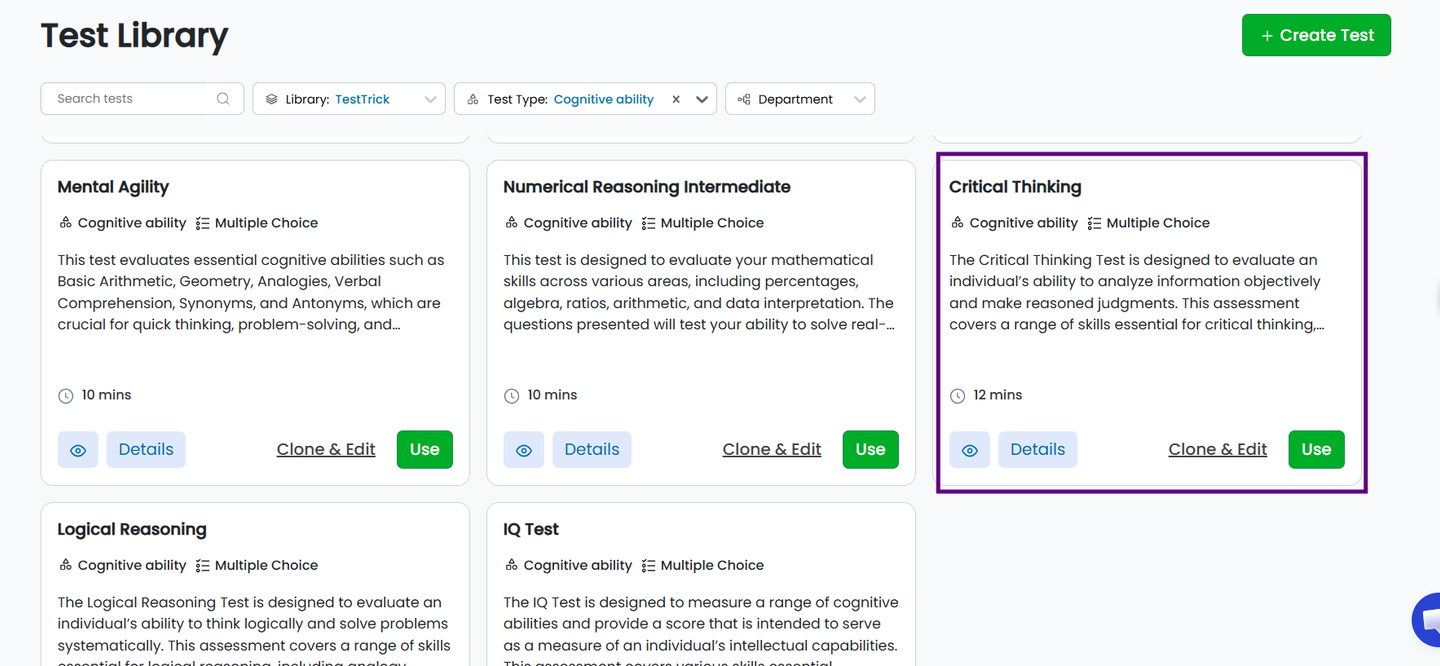
Critical Thinking Skills- TestTrick
TestTrick’s 7-day free trial gives you access to all of these features without restrictions.
A pre-employment assessment tool works perfectly for narrowing your list down to the highly qualified ones. However, it can’t tell you whether a high scorer can handle the kind of ambiguity your role entails, which is why you should pair this method with a live one.
Ask how they solved a past problem
There's a real difference between a behavioral question with a memorized answer and a genuinely open-ended one that doesn't have one.
With this tip, you’re not looking for the first answer to the first problem-scenario question you throw at them. The value is in what happens when you add a bottleneck to their solution walkthrough. A candidate who can continue reasoning even when the conditions shift is showing you the actual skill. One who repeats their original point louder is not.
Another interesting angle is to ask them what their favorite project was, in school or a past job. Critical thinkers tend to mention imperfect projects where they had to deal with real roadblocks because working through the mess is what they genuinely enjoyed. Non-critical thinkers would mention projects with little to no resistance or hitches.
Watch them think through a live exercise
This is the closest you can get to watching someone think. A scaled-down version of real work done alongside a future teammate can put the candidate in a position where silent reasoning is not an option.
Ask them to think out loud as they work. That single instruction changes everything, because a candidate who stays quiet and delivers a polished final answer gives you nothing to score except the ending. You want the middle: Do they clarify the goal before diving in? Do they name their assumptions out loud? Do they catch their own mistake without you pointing it out? A rehearsed story can never fake those parts.
Assign a paid take-home assignment for senior roles
If you're hiring for senior or highly specialized roles that are built around independent, unobserved work, a short take-home can be the closest simulation of the actual job. Keep it brief and cap it around two hours. Give a flexible deadline for submission rather than a rigid 24-hour turnaround. Also grade every submission against the same rubric.
Pay for it if it runs longer than a quick screen. Survey data on why candidates skip or resent take-home assignments consistently points to unpaid work with no guarantee of feedback or an offer at the end of it. Compensating their effort signals respect for the candidate's time and restrains your strongest applicants from dropping out of your process.
How to Score Critical Thinking Skills Fairly
Once you have chosen the right method, the next step is to score every candidate using the same structure. Without a clear rubric, interviewers may end up rewarding confidence, communication style, or quick answers instead of actual reasoning.
Use a simple 1–5 scale for each area. A score of 1 means the candidate showed little evidence of the skill, while a score of 5 means they demonstrated it clearly and consistently.
| Criteria | What to Look For | Score |
| Clarifies the problem | Asks relevant questions before answering instead of jumping to a solution | 1–5 |
| Separates facts from assumptions | Clearly identifies what is known, unknown, and assumed | 1–5 |
| Evaluates trade-offs | Explains risks, alternatives, constraints, and possible consequences | 1–5 |
| Adapts to new information | Updates their answer when new information changes the situation | 1–5 |
| Communicates reasoning | Explains their thought process clearly and logically | 1–5 |
For a more reliable result, ask each interviewer to score the candidate independently before discussing feedback as a team. This reduces group bias and keeps the evaluation focused on evidence instead of first impressions.
Green Flags vs Red Flags When Assessing Candidates
Now that you know what a bad answer sounds like, here's how to spot one before you've made the hire.
| Green Flags | Red Flags |
|---|---|
| Asks clarifying questions before answering. | Jumps straight to a confident answer with zero clarifying questions |
| Admits to not knowing instead of inventing a confident answer | Gets defensive or repeats the same point louder when you push back |
| Updates their reasoning when you add new information | Cites information or a "data point" they cannot explain the source of |
| Clearly separates what they know from what they are assuming | The answer sounds identical no matter what you actually asked. It’s a sign it is rehearsed rather than reasoned |
| Walks you through the trade-offs of their approach, not just the conclusion | Cannot walk through their own thinking |
FAQs
Can candidates fake critical thinking in an interview?
Yes, especially with generic behavioral questions they have answered a dozen times before. But you can make it harder for them by introducing a live complication mid-answer or handing them a problem they didn’t see coming. A rehearsed story would fail under real-time follow-up.
What's the difference between critical thinking and problem-solving skills?
Critical thinking evaluates information and questions assumptions before deciding what is actually true or relevant. Problem-solving chooses and executes the solution towards a clear direction. Strong problem-solvers without strong critical thinking tend to move fast toward the wrong target.
Should you pay candidates for take-home assignments?
If it takes longer than a quick 1-2 screen, treat it as the real work it is and pay them. Unpaid, lengthy assignments mostly filter for who wants the job badly enough to work for free rather than who reasons best, and they push away candidates who have other options.
How many separate methods should you actually use?
Two, at minimum: one live method (a real problem, a live exercise, or open-ended questioning) and one structured or written method (an assessment or take-home). A single interview conversation is not enough, as it is structured for fluent, rehearsed answers rather than genuine reasoning.
What's the single best interview question if you can only ask one?
There is no universal winning question, but the strongest format is usually to present a real, ambiguous situation from your team's own history, ask how they would approach it, then add a complication pathway through their answer. This tests their thinking capacity and ability to think through pressure.
Conclusion
Knowing what critical thinking looks like doesn't help you if you never apply it in your process. Out of the five methods above, pick the one that fits the seniority of the role you're hiring for and write it into your process as a required step.
Before your next interview, do three things. First, decide which one or two methods you're using and build the actual problems you'll present in advance. Second, brief every interviewer on the green and red flags from the table above, so you're not the only person on the panel who knows what a good answer sounds like. Third, agree ahead of time on what "pass" looks like for this specific role .
If you take nothing else from this, take this: stop trusting your gut on a 45-minute conversation to catch a gap that shows up nine months into the job. Build the test into the process once, and it keeps working for every candidate after this one.
Build a Hiring-Ready Assessment
Create role-specific, anti-cheat assessments and shortlist candidates on evidence, not guesswork.
Start for freeBy Peace Ajayi
September 2, 2026
9 min read
Build a Hiring-Ready Assessment
Create role-specific, anti-cheat assessments and shortlist candidates on evidence, not guesswork.
Start for free