CoderPad Pricing in 2026: Plans, Fees, and What It Actually Costs to Scale
CoderPad pricing starts at $120 a month for 5 tests or interviews, with a $25 charge for every extra one used. Here's the full cost breakdown before you buy.
By Favour Etinosa Ogie
July 29, 2026
9 min read
TL;DR – Key Takeaways!
- CoderPad's paid plans run from $120 a month for 5 tests to $400 a month for 30, with a $25 charge for each one you run past your plan's limit.
- How a test or interview gets counted against your quota depends on which plan and billing type you're on, which makes it hard to predict your real monthly spend.
- G2 reviewers rate CoderPad 4.4 out of 5 for the coding experience itself, but several point to pricing as a pain point for smaller teams.
- Features like the AI Reviewer, ATS integrations, and single sign-on (SSO) are only available on CoderPad's Custom plan, so smaller teams don't get them at all.
- TestTrick includes every feature on every plan, starting at $49 a month.
Introduction
CoderPad is a technical interview platform used to run live coding interviews and asynchronous coding tests. It comes in four plans, and each one includes a set number of tests or interviews.
How much you actually pay depends on your hiring volume, how CoderPad counts tests against your plan's quota, and what features are included at each tier.
If you're a recruiter or hiring manager who wants to know how CoderPad's pricing fits your own hiring volume, read on for the full breakdown.
We'll also look at how CoderPad's pricing compares to other tools like TestTrick, so you have everything you need to decide.
What Does CoderPad Cost in 2026?
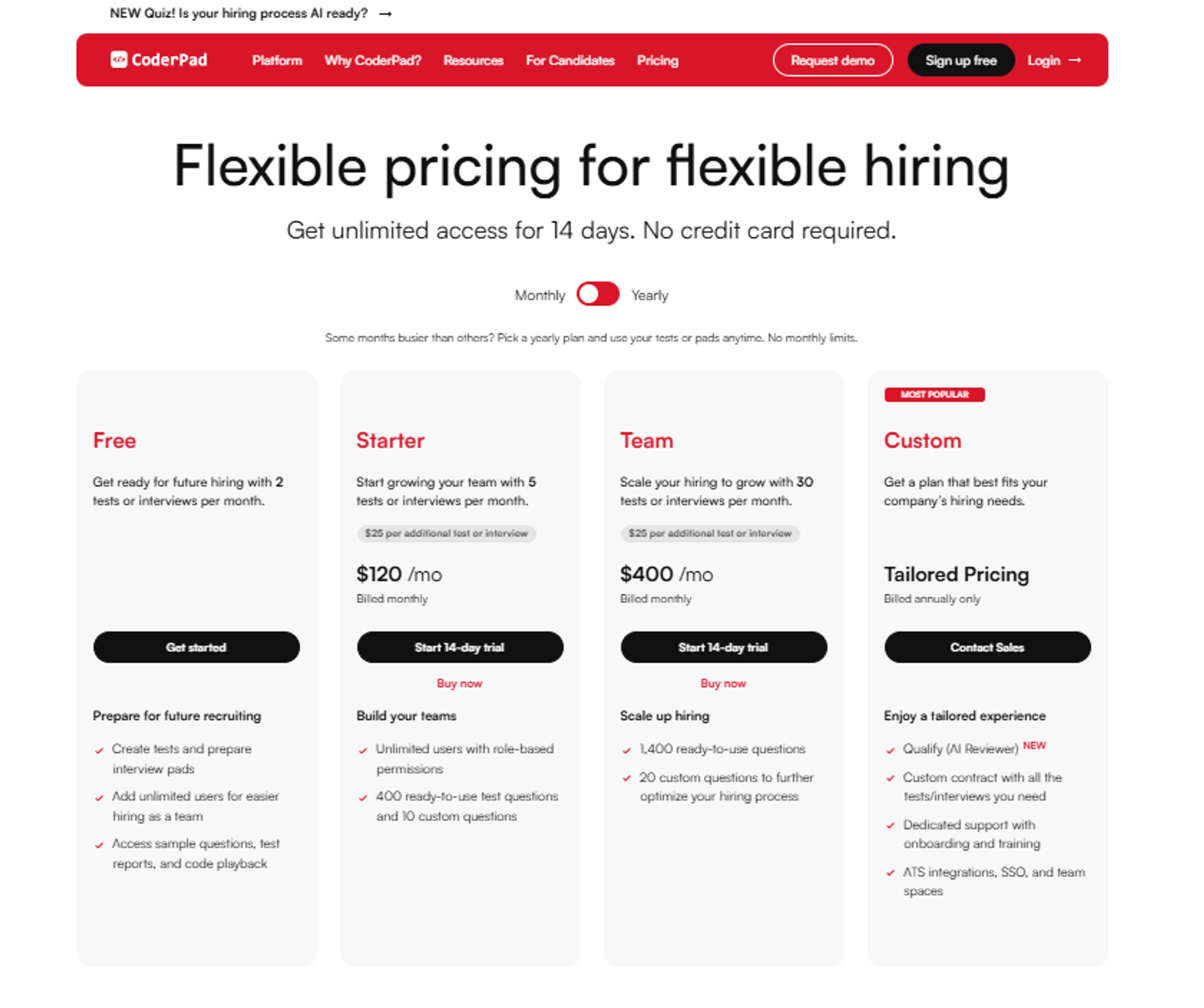
CoderPad has four plans: Free, Starter, Team, and Custom. All of them include unlimited users. What changes between tiers is the number of tests or interviews included each month and how much of the question library you get access to.
Free plan
CoderPad's free tier includes 2 tests or interviews per month. The question bank is more limited than the paid plans, and interviews expire after 4 days. This makes the free plan better suited to occasional, spontaneous screening than to a real hiring pipeline. A team hiring for a single role might get by on this tier for a month or two, but it isn't built to carry an ongoing hiring process.
Starter plan
Starter costs $120 a month, billed monthly, and includes 5 tests or interviews per month. Every test or interview run past that limit costs $25. The plan also includes 400 ready-to-use questions and lets you write up to 10 custom questions of your own. It comes with code playback, so you can watch how a candidate worked through a problem, and role-based permissions for managing what your hiring team can access.
Team plan
Team costs $400 a month and includes 30 tests or interviews per month, with the same $25 charge for anything beyond that. This tier expands the question library to 1,400 pre-built questions and 20 custom slots, which suits a team hiring across several technical roles at once.
Custom plan
Custom is CoderPad's top tier, billed annually only, with pricing set through a sales conversation rather than published on the site. This is also where CoderPad places its newer AI Reviewer tool, along with ATS integrations, single sign-on, and team spaces. None of those are available on Starter or Team, so a smaller team has no path to them without moving up to a custom contract.
Here's how the four plans line up side by side.
| Plan | Price | Tests/interviews included | Extra test charge | Users | Question library |
|---|---|---|---|---|---|
| Free | $0 | 2/month | Not Available | Unlimited | Limited Bank |
| Starter | $120/month | 5/month | $25 each | Unlimited | 400 + 10 custom |
| Team | $400/month | 30/month | $25 each | Unlimited | 1,400 + 20 custom |
| Custom | Contact sales | Set by contract | Set by contract | Unlimited | Full library + AI Reviewer, ATS, SSO |
How CoderPad Counts Tests and Interviews Against Your Quota
CoderPad's pricing page shows a number, but it doesn't tell you when a test or interview actually counts against that number. That depends on which plan you're on and how you're billed.
CoderPad runs two products under one plan. CoderPad Screen handles asynchronous tests candidates complete on their own. The live, collaborative side of the platform handles real-time interviews with an interviewer present. Both draw from the same monthly quota, but they get counted differently.
Tests are simple. A test counts against your quota the moment a candidate starts it, no matter which plan you're on.
Interview pads are more complicated, because the rule depends on how you're billed:
- On a monthly credit card plan or Enterprise Flex, a live interview pad counts once both the interviewer and candidate have joined and started coding. A Take-Home pad counts as soon as the candidate joins and starts coding, even if they don't finish.
- On an annual credit card plan or an invoiced plan, a pad counts the moment you create it, whether or not anyone ever joins.
There's one safety net either way. If a pad or test goes unused and you delete it within 28 days of creating it, it gets credited back to your quota.
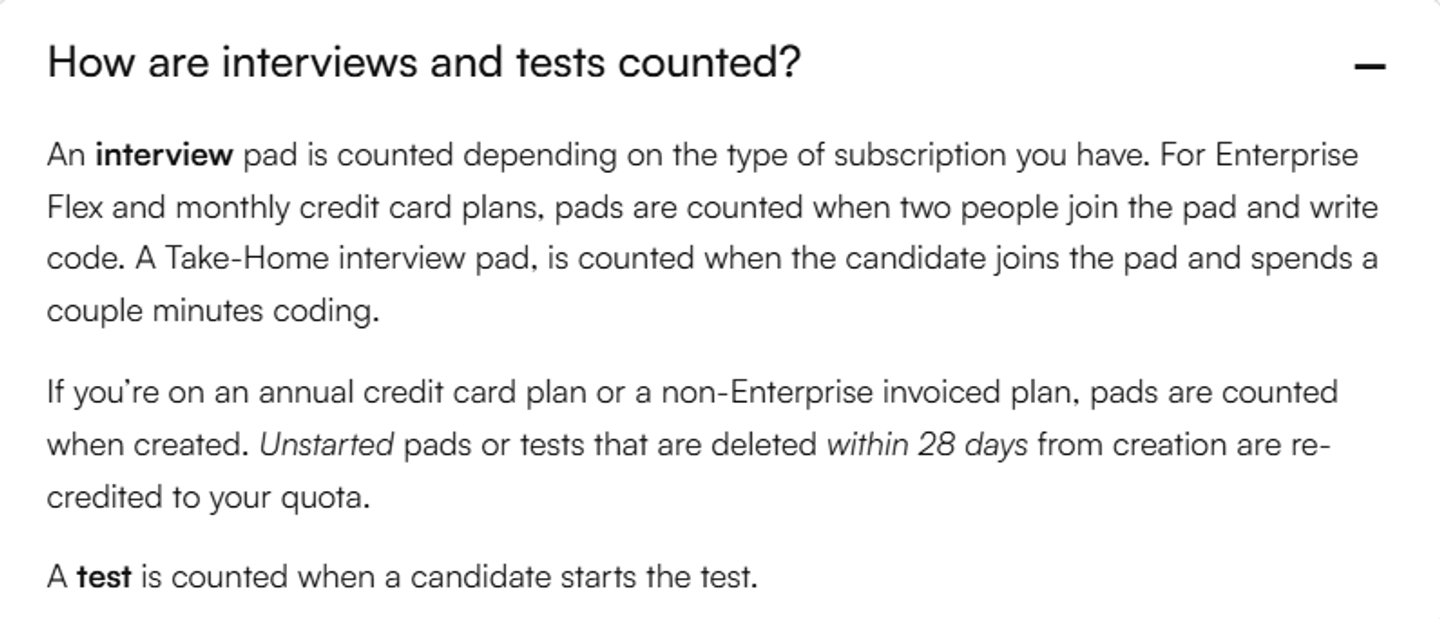
This matters most for teams on annual, invoiced plans. A recruiter who builds five interview pads for a hiring sprint, only to have two candidates reschedule past the 28-day window, has already used two of their monthly allotment before a single interview took place.
Where the Real Cost Shows Up as You Scale
The $25 charge for each additional test is the most direct place CoderPad's pricing gets more expensive than it first appears. A team on the Starter plan that regularly runs 10 interviews a month, instead of the 5 included, is paying an extra $125 on top of the base $120, which brings the real monthly cost closer to $245.
Here's where the added cost tends to build up:
- Extra tests add up fast. Once a team consistently runs more interviews than a plan includes, upgrading to Team often works out cheaper than paying per test month after month.
- Key features sit behind the Custom tier. The AI Reviewer tool, ATS connections, and single sign-on all require a custom contract, so a team on Starter or Team has to manually move candidate results into whatever applicant tracking system they already use.
- A formal security review also means a sales conversation. Companies that need invoicing or a security review before they can sign off have to go through CoderPad's sales team rather than self-serve, which usually points toward the Custom plan regardless of actual hiring needs.
- Manual work adds hidden time. For a hiring team running multiple open roles, that manual step adds real time on top of the subscription cost, even before any test volume charges come into play.
- Uneven hiring months cost more. A quiet month followed by three open requisitions at once is common, and CoderPad's per-test structure means that second month costs noticeably more than the first, even though the plan itself hasn't changed.
Teams considering CoderPad for developer assessment tools should map out their expected monthly interview volume before choosing a tier, since the gap between what a plan includes and what a team actually needs is where most of the unplanned cost sits.
What Users Say About Using CoderPad Day to Day
CoderPad holds an average rating of 4.4 out of 5 across its G2 reviews. Most of the published feedback comes from candidates and engineers who were tested on the platform, so the reviews say more about the coding experience than about day-to-day admin work.
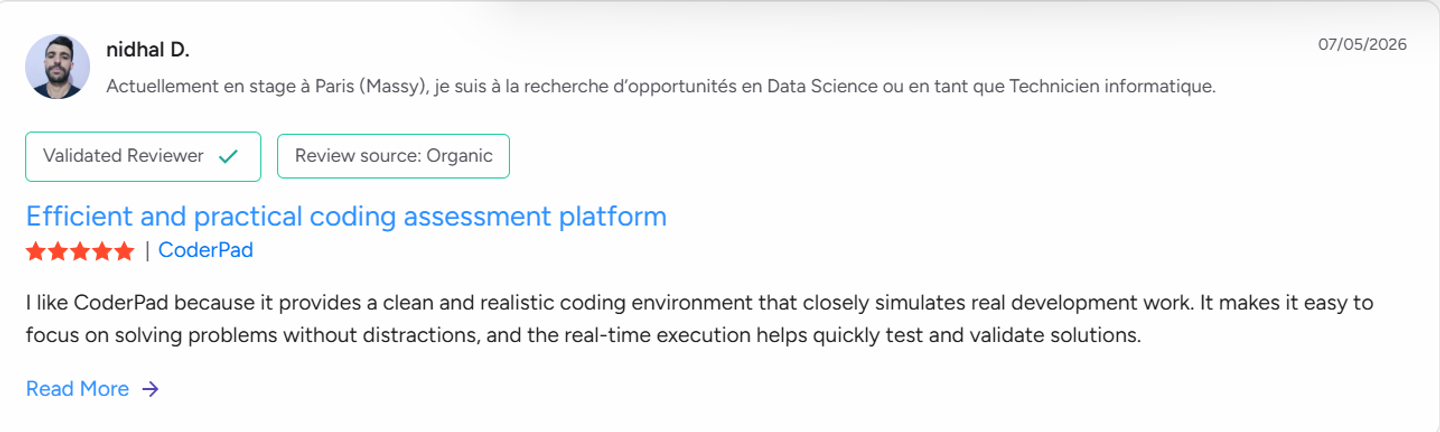
The praise is consistent across reviewers. Nidhal D., a data science student, pointed to the clean, realistic coding environment that keeps candidates focused on solving the problem, with real-time execution that lets them test and validate a solution right away.
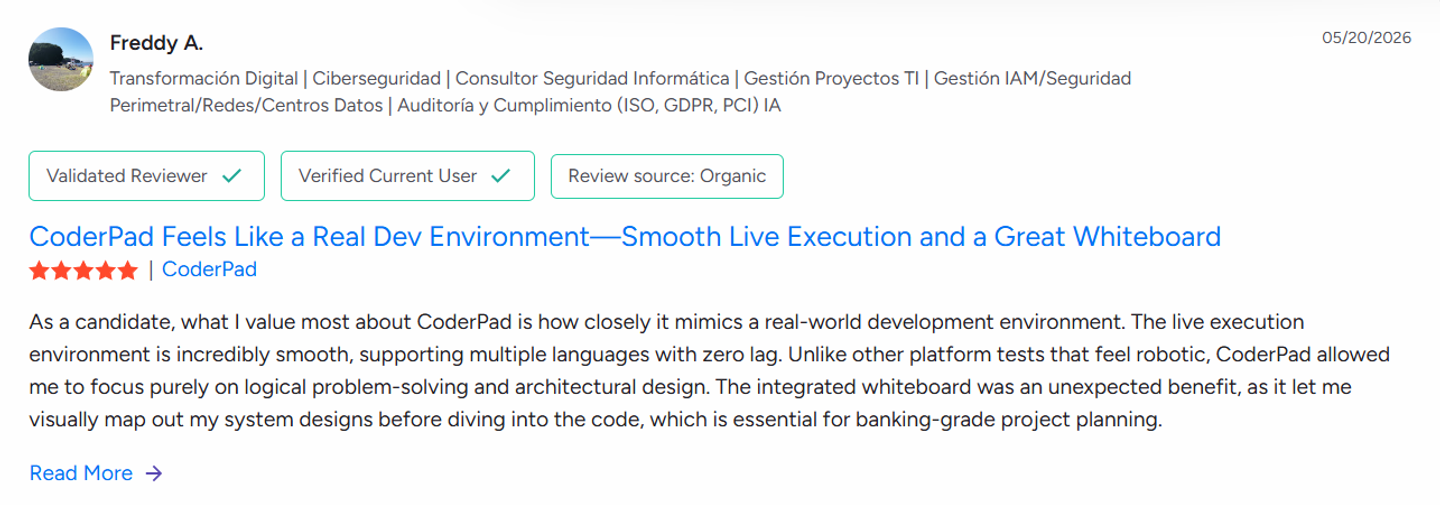
Freddy A., an IT project manager, said the real-time collaboration felt close to a real technical interview platform, with smooth support across multiple programming languages and a built-in whiteboard for sketching out system designs before writing any code.
Sanket P., a software engineer, said CoderPad was easy to set up. Candidates could open a link and start a collaborative coding interview instantly, which kept the process focused on problem-solving instead of fighting with an editor, and made for a smoother candidate experience overall.
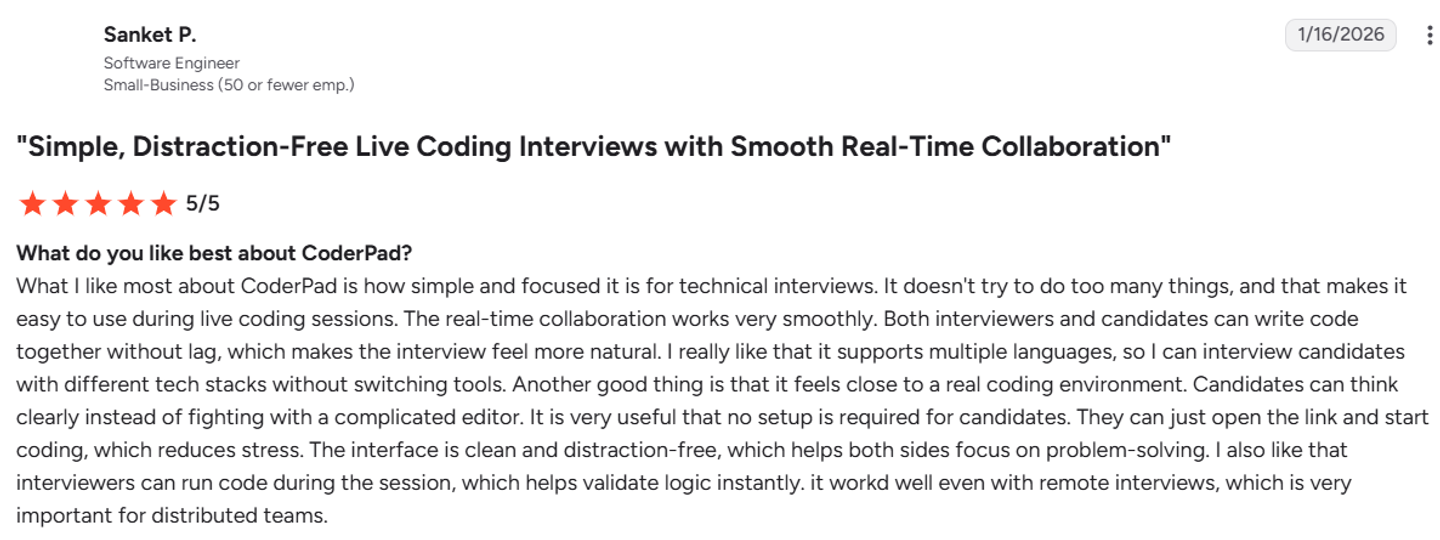
The complaints point somewhere different. Sanket P. also mentioned that pricing can feel expensive for small teams running only a handful of interviews a month, alongside limited debugging tools and thin reporting once the session ends.

Daniel Fernando S., a fullstack developer, rated the platform 4.5 out of 5 but flagged that pricing tends to sit on the higher side for smaller companies, along with a few missing advanced IDE features.

Taken together, the reviews describe a platform that does the coding assessment experience well. The catch is that a small team's actual hiring volume runs into pricing friction long before it runs into any limit on the coding side of things.
Is CoderPad's Pricing Model Right for Your Hiring Volume?
CoderPad's pricing fits some hiring situations more comfortably than others. A team with a steady, predictable pace of technical interviews can plan around a fixed monthly quota without much trouble. The model works less well once volume becomes harder to predict.
It tends to work well when:
- Your hiring process runs a consistent number of technical interviews each month, so a fixed quota is easy to plan around.
- You don't need ATS integration, single sign-on, or a formal security review, since those all sit behind a custom sales conversation.
- Your team values a focused, distraction-free coding assessment experience over broader hiring features.
It tends to get expensive or restrictive when:
- Hiring volume swings month to month, since every test past your quota adds a flat charge regardless of your base plan.
- Your talent acquisition team needs ATS integration or SSO without committing to an annual, custom-priced contract.
- You're assessing more than coding skills, since CoderPad's plans are built around technical interviews and don't cover broader hiring needs like psychometric testing or video interviewing.
For a small team running one or two technical hires a quarter, CoderPad's Starter plan is a reasonable way to get a working technical interview platform without a large upfront cost. For a team scaling across multiple technical roles at once, or running a broader mix of coding challenges alongside live interviews, the combination of per-test charges and gated features tends to push the real cost of technical hiring well past what the Starter or Team plan price suggests.
A Simpler Alternative: TestTrick vs. CoderPad Pricing
CoderPad's pricing model ties cost to test volume and holds back key features until you reach its highest tier. TestTrick takes a different approach, and the difference shows up in both what each plan includes and what it costs to get started.
What TestTrick Includes on Every Plan
Every TestTrick plan, from the smallest to the largest, includes the full platform: coding skills assessment tools for technical coding assessments, video interviews, anti-cheating software with AI proctoring built in, ATS integrations, and candidate assessment reports. The only thing that changes between plans is how many candidate credits and user seats you get. A credit is only used when a candidate completes an assessment, not when you create one or send an invite. TestTrick lays out this model in full on its own skill assessment platform pricing page.
TestTrick's Plans at a Glance
- Starter: $49 a month, 50 credits, 3 users. Built for small teams filling one to five roles a month.
- Basic: $75 a month, 100 credits, 5 users. Meant for growing companies hiring across several departments at once.
- Business: $99 a month, 150 credits, 7 users. Aimed at mid-size teams and recruitment agencies handling higher volume.
- Enterprise: custom-priced, with credit and user limits set to match organizations hiring 500 or more people a year, plus a dedicated account manager and priority support.
| Plan | CoderPad | TestTrick |
|---|---|---|
| Entry Price | $120/month (Starter) | $49/month (Starter) |
| Included volume | 5 tests/interviews | 50 credits |
| Feature access | Full library only at Custom tier | Every feature on every plan |
| ATS integration | Custom plan only | Included from Starter |
| Free trial | 14 days, no card required | 7 days, no card required |
Where the Gap Matters Most
The gap becomes clearest at the entry level. CoderPad's Starter plan costs $120 a month for 5 tests or interviews, and any extra one costs $25. TestTrick's Starter plan costs $49 a month for 50 completed candidate assessments, and a credit is only used when a candidate finishes, not when you create the assessment or send the invite.
TestTrick's CoderPad alternative page walks through that comparison in more detail, including how credits map to the tests and interviews a team is already running.
Frequently Asked Questions
With TestTrick, you only pay for completed candidate assessments rather than per test. And every plan includes the full platform from day one, including ATS integration and proctoring. Start a 7-day free trial to see how the numbers compare against your own hiring plans.
Build a Hiring-Ready Assessment
Create role-specific, anti-cheat assessments and shortlist candidates on evidence, not guesswork.
Start for freeBy Favour Etinosa Ogie
July 29, 2026
9 min read
Build a Hiring-Ready Assessment
Create role-specific, anti-cheat assessments and shortlist candidates on evidence, not guesswork.
Start for free