7 Best Cultural Assessment Tools for Hiring in 2026
Discover the 7 best cultural assessment tools for 2026 to hire for fit, align teams, and boost employee engagement and workplace performance.
By Favour Etinosa Ogie
June 3, 2026
10 min read
You hired someone with a great resume and a strong interview. Six months later, they're gone. The skills were there. The fit wasn't.
Cultural assessment tools and culture assessment tests fix that. They give you a structured, repeatable way to approach cultural fit hiring, so you can assess candidates on values, work style, and personality traits that fit how your team operates.
In this article, we’ll explore the 7 best cultural assessment tools that can help you hire for fit, align teams, and boost workplace performance.
Quick answer: The best cultural fit hiring tools are TestTrick, Culture Amp, Predictive Index, Leapsome, Hogan, Typeform, and Bryq.
What to Look for Before You Choose a Cultural Assessment Tool
Not all assessment tools are equal. Some sound rigorous and are closer to a personality quiz. Four things actually matter.
- Scientific validity: A good tool is built on psychometric tests and validated frameworks like the Big Five personality test or the Organizational Culture Inventory. If a vendor can't point you to peer-reviewed research, move on.
- Candidate experience: The best tools are under 20 minutes, mobile-friendly, and feel fair to the person taking them.
- ATS integration: If results don't flow into your existing system, the assessment becomes a manual step that gets skipped under pressure.
- Pricing transparency: Where it's public, it's included below. Where it's custom, we've said so.
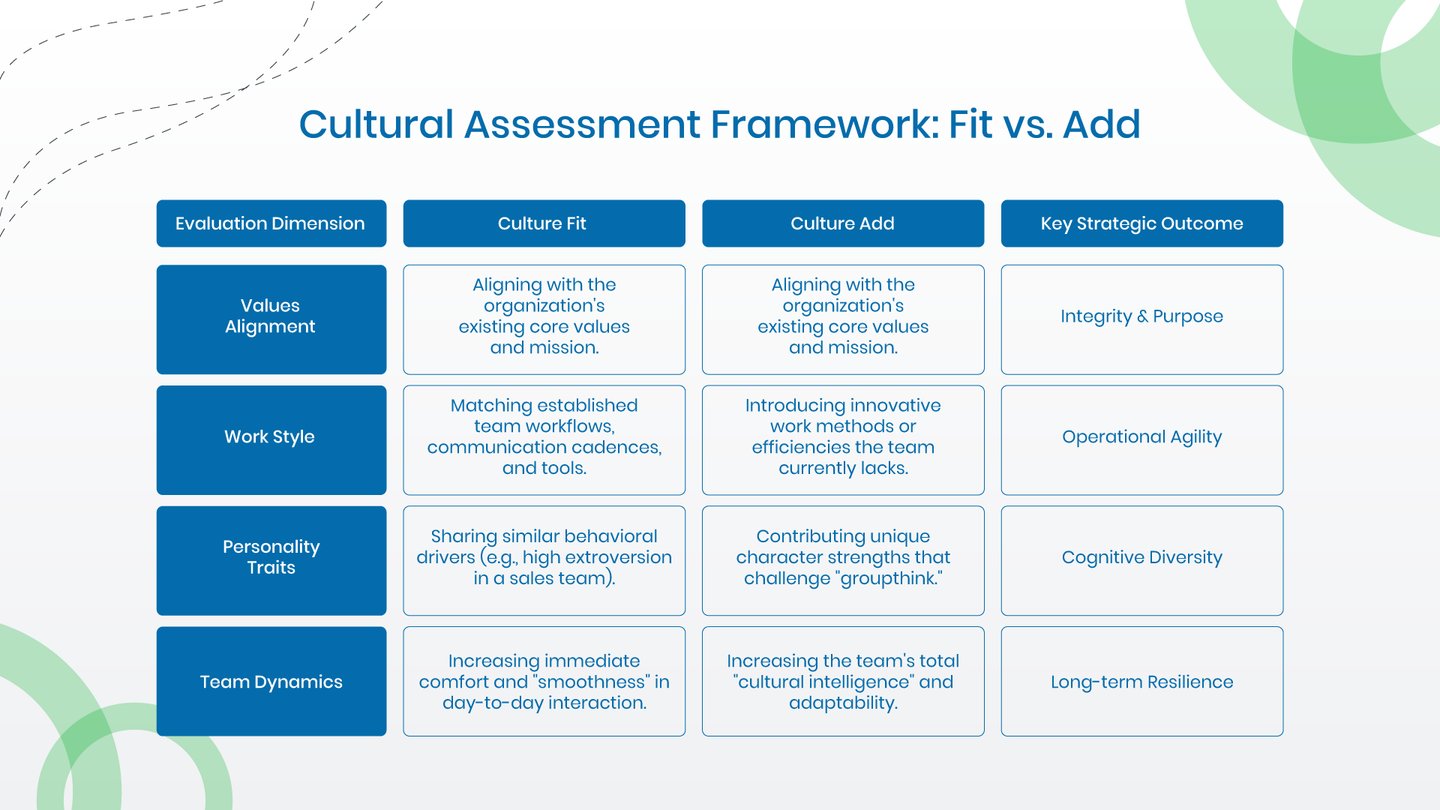
cultural fit
One distinction worth understanding: culture fit asks whether a candidate matches your company culture. Culture add asks whether they bring something that makes it stronger. The best tools measure both, part of a broader cultural competence evaluation aligned to your guiding principles.
Best Cultural Assessment Tools at a Glance
| Tool | Best for | Pricing | Standout Feature |
|---|---|---|---|
| TestTrick | Skills + culture screening combined | From $49/month | Skills and cultural fit combined |
| Culture Amp | Ongoing culture measurement | Custom | Industry benchmarking data |
| Predictive Index | Behavioral fit for team dynamics | Custom | Behavioral drive mapping |
| Leapsome | Culture tied to performance management | Custom | Connects hiring to reviews and goals |
| Hogan Assessments | Senior and executive hires | Custom | Academically rigorous, widely validated |
| Typeform | DIY culture screening, small teams | From free | Flexible, low barrier to start |
| Bryq | Science-backed pre-hire culture fit | From $69/month | Cognitive and cultural fit combined |
The 7 Best Cultural Assessment Tools for Hiring
1. TestTrick
TestTrick
Best for: Teams who want culture fit and skills screening in one platform
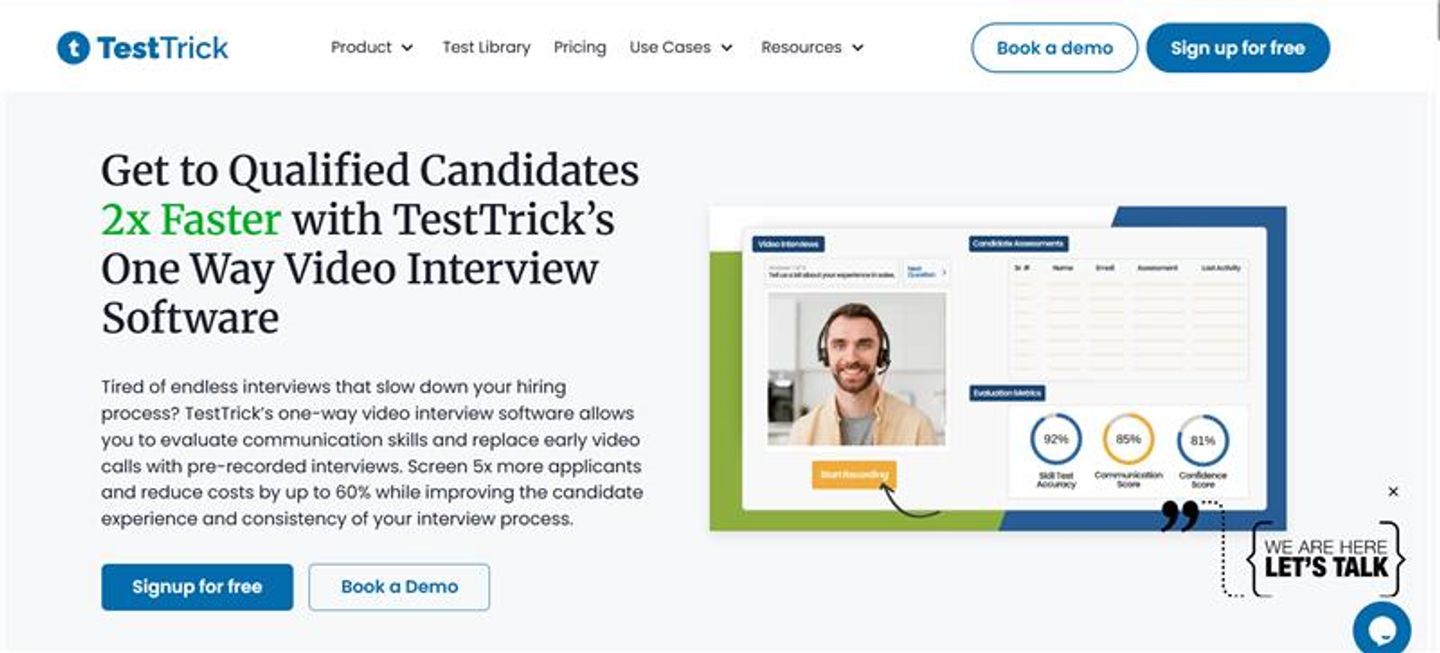
Most skills-based hiring processes treat culture fit, behavioral screening, and skills assessments as separate steps. TestTrick solves the culture fit challenge by combining pre-employment assessment tools with culture fit indicators in a single platform.
The platform lets you assess candidates on cognitive aptitude, personality traits, and role-specific skills. Its psychometric tests follow validated frameworks. The reporting dashboard lets you share candidate reports with hiring managers, and automated ranking filters out candidates below your thresholds.
Key features:
- Skills assessments for technical and non-technical roles
- Cognitive aptitude and personality testing
- Automated candidate ranking
- One-way video interviews with structured prompts
- ATS integrations
Pros:
- Transparent tiered pricing
- One platform replaces two tools
- Consistent criteria for every candidate, which builds cultural competence in hiring.
Cons
- Limited AI analysis feature as of now
Pricing: Starter at $49/month for 50 candidates, Basic at $75/month for 100 candidates, Business at $99/month for 150 candidates, and Enterprise custom.
2. Culture Amp
Culture Amp
Best for: Mid-to-large teams that want to measure and track culture continuously, not just at hire
Culture Amp is less a hiring tool and more an organizational culture intelligence platform. Its primary value isn't pre-hire screening. It's giving HR teams ongoing visibility into their organizational culture and employee satisfaction levels, and which teams are disengaging, and where gaps in organizational culture between stated and lived values are widest.
The data is still useful for hiring. If organizational culture data shows your sales team scores low on psychological safety, adjust your assessment criteria to prioritize trust-builders. Its AI sentiment analysis surfaces themes from open-ended responses automatically.
Key features:
- Engagement surveys
- Benchmarking
- Action planning
- DEI analytics.
Pros:
- Best-in-class benchmarking
- Strong DEI reporting
Cons:
- Not a pre-hire tool
- Expensive for smaller teams and only useful if leadership acts.
Pricing: Custom. Requires a sales conversation. Positioned for mid-market and enterprise.
3. Predictive Index
Predictive Index
Best for: Teams hiring for roles where behavioral dynamics and team chemistry are critical
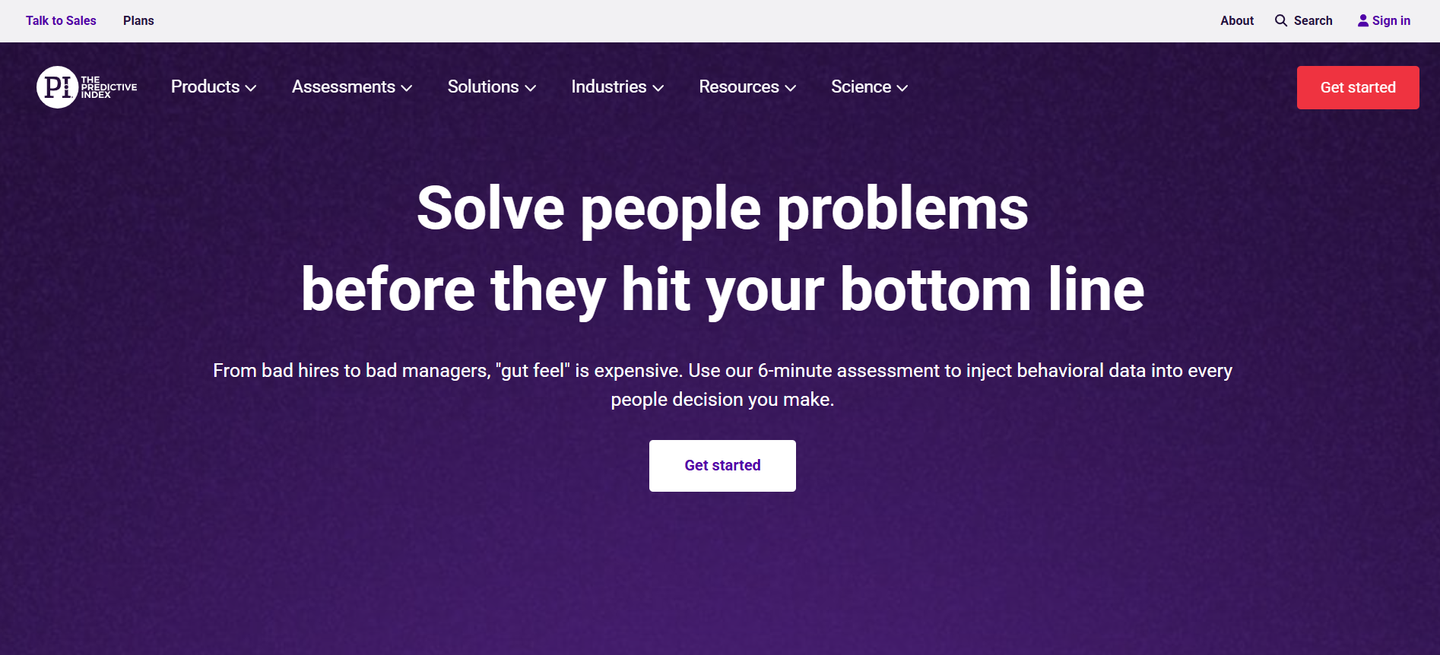
The Predictive Index assessment platform maps candidates against four behavioral drives: dominance, extraversion, patience, and formality. The result predicts someone's communication style, key behavioral traits, and team dynamic.
It lets you assess candidates by comparing their profile against the existing team to spot friction before it happens. PI's cognitive assessment adds a second data point on processing speed.
Key features:
- Behavioral tests
- Cognitive ability testing
- Team dynamics mapping
- The Predictive Index assessment platform also includes role-fit benchmarking.
Pros:
- Strong at predicting team fit
- Good inter-rater reliability
- Integrates with major ATS platforms
Cons:
- Proprietary framework
- Licensing costs add up at volume.
Pricing: Custom. Typically mid-to-enterprise pricing. Contact PI directly for a quote.
4. Leapsome
leap home
Best for: HR teams building a full-cycle people strategy where hiring connects directly to development
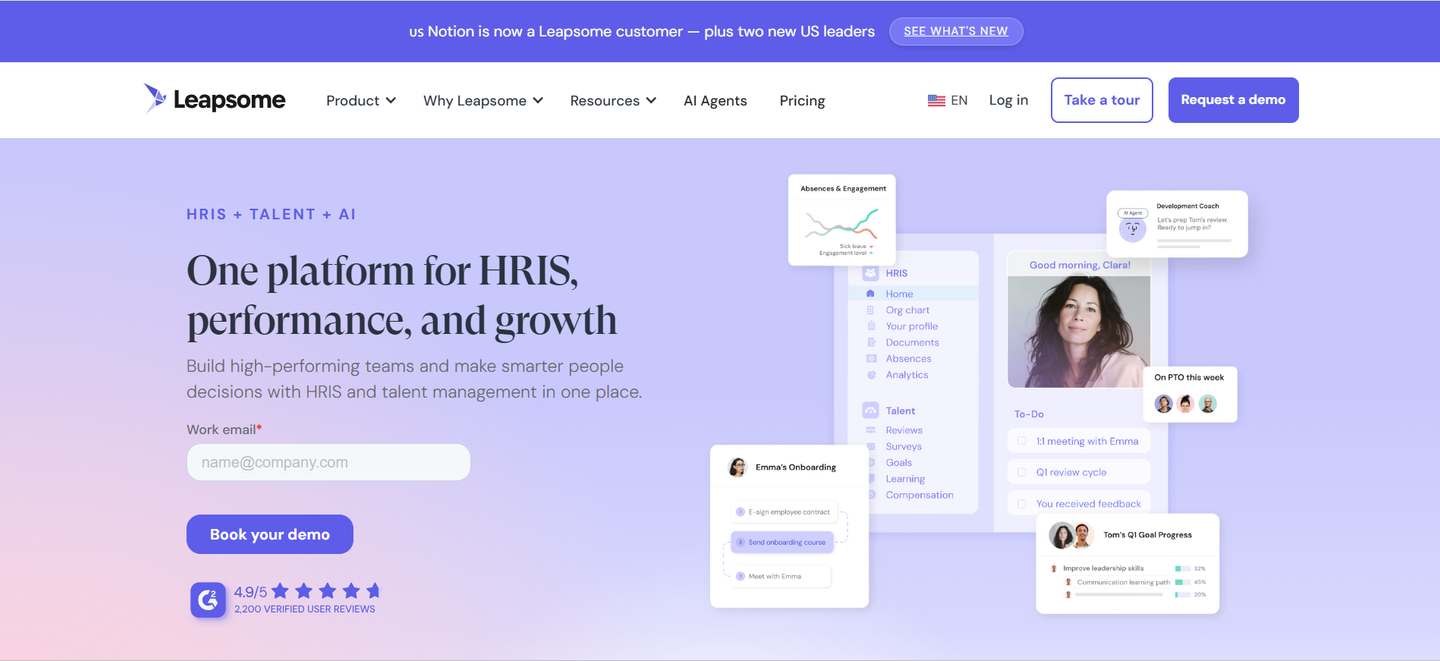
Leapsome sits at the intersection of hiring, performance management, and learning. Its workplace culture assessment capabilities connect what you assessed at hire to how you set goals, track performance, and develop people.
For HR managers focused on employee retention, not just filling seats, Leapsome makes sense. You assess candidates for company values alignment at hire, tie it to a 90-day plan, then track whether that fit shows up in reviews.
Key features:
- Culture assessments
- OKR tracking
- Performance reviews
- 360-degree feedback
Pros:
- Culture data connects to performance
Cons:
- Overkill for pre-hire screening only
- Requires organizational buy-in.
Pricing: Custom. Better suited for teams of 50 or more. Contact Leapsome for a quote.
5. Hogan Assessments
hogan
Best for: Senior, executive, and high-stakes hires where deep personality profiling is worth the investment
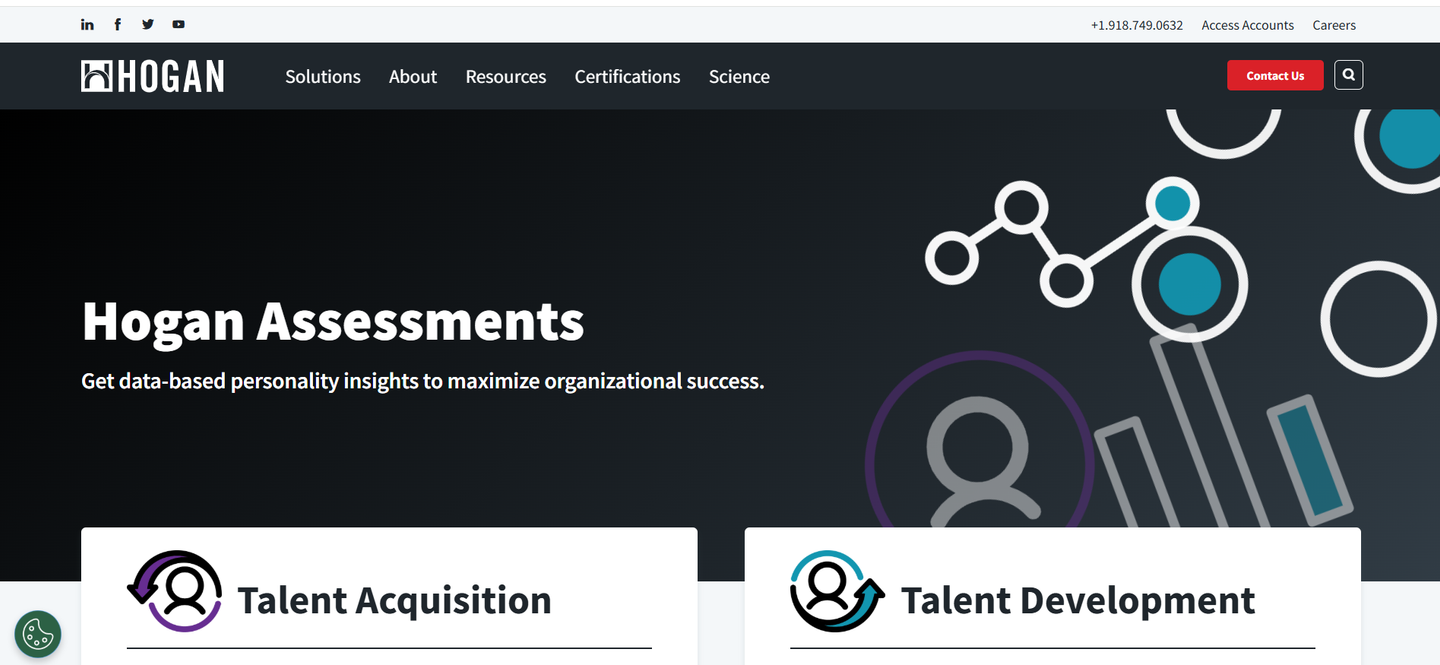
Hogan is the most academically rigorous tool on this list. For a VP of Sales or CFO hire, Hogan is the standard.
It covers three dimensions based on deep psychometric assessments: the bright side (day-to-day personality), the dark side (how you behave under stress, the stuff that derails careers), and core values and motivators. That dark side assessment is what separates Hogan from most competitors. It's the only tool that gives you structured insight into cultural competence gaps and how a candidate might fail, not just how they might succeed.
Hogan is not built for high-volume hiring. At entry-level volumes, the depth is unnecessary and the price becomes prohibitive.
Key features:
- HPI (personality psychometric tests)
- HDS (derailers under stress)
- MVPI (values and culture)
Pros:
- Highest predictive validity on this list
- Covers risk factors others ignore
Cons:
- Requires certified administrators
- Expensive for anything outside senior hiring
- 45 to 60 minutes (unlike short video interviews, video interview platforms, or quick skills tests).
Pricing: Custom. Expect to pay per assessment plus certification costs. Contact Hogan directly.
6. Typeform (and custom survey tools)
Typeform
Best for: Small teams or early-stage companies that need a low-cost starting point for cultural screening
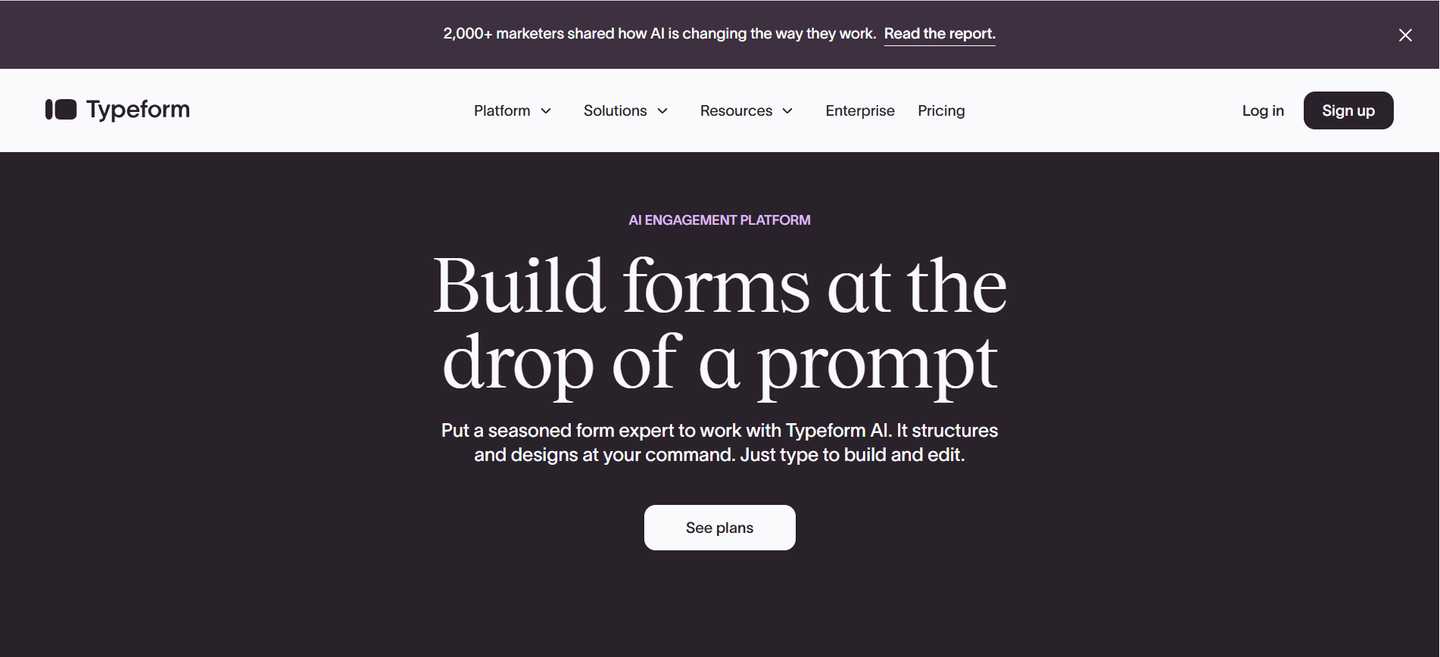
Typeform isn't a cultural assessment platform. It's a survey tool. But used thoughtfully, it helps small teams gather cultural signals before investing in a dedicated platform.
Build a short company values survey using structured prompts (5 to 8 questions) and send it after initial application review to identify obvious mismatches. A few questions alongside situational judgement tests: "How do you prefer feedback?" "High direction or high autonomy?" "What does a bad week look like?"
Survey responses are self-reported and easier to game than situational judgement tests. So pair with reference checks.
Key features:
- Custom survey builder
- Conditional logic
- Keyword-based scoring
- ATS integrations via Zapier.
Pros:
- Free tier
- Fast to set up
- Fully customizable.
Cons:
- Not validated
- No benchmarking data.
Pricing: Free tier available. Paid plans start at around $39/month.
7. Bryq
Bryq
Best for: HR teams that want a scientifically validated pre-hire culture and cognitive fit assessment without the enterprise price tag
Bryq combines cognitive ability testing with values and skills alignment, letting you assess candidates on cultural and cognitive fit in a single pre-hire tool. It leans into cultural alignment, mapping the culture fit between candidate values and your organization's defined culture profile.
The setup requires you to define your company values first, what your values statements say versus what actually drives decisions. That's a useful forcing function for teams who haven't formalized their cultural fit criteria. Assessments take around 15 minutes.
Key features:
- Cognitive ability assessment
- Culture fit scoring
- Candidate comparison dashboard
- Assessment center-style reporting
- ATS integrations.
Pros:
- Scientifically validated
Cons:
- Fit scores depend on your culture definition
- Limited benchmarking data.
Pricing:
- Free Trial: $0/month – 14 days, no credit card required
- Pro: $69/month billed annually ($828/year) – 1–15 employees
- Enterprise: Custom pricing
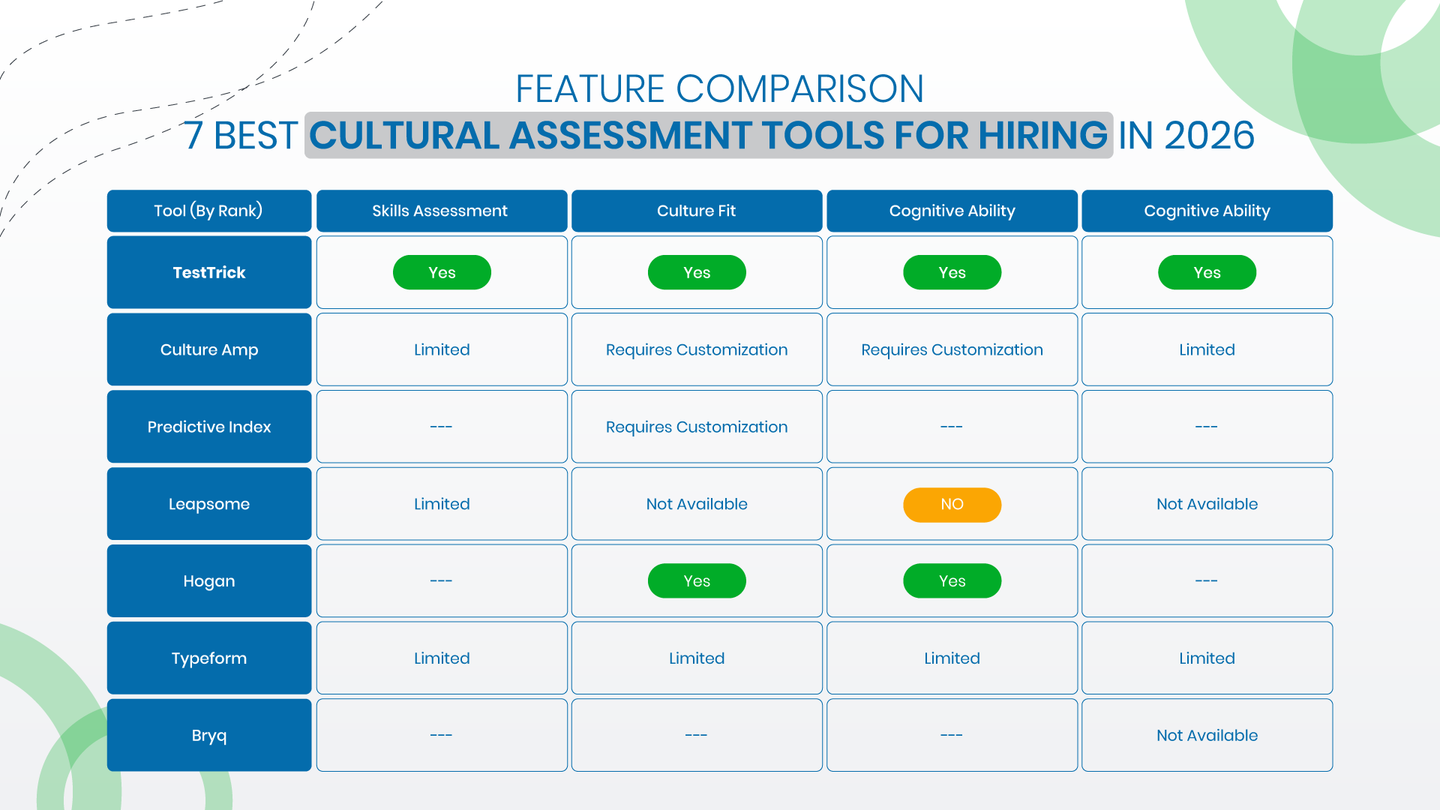
feature-wise comparison
How to Add Cultural Assessment to Your Hiring Process Without Slowing It Down
Cultural Assessment
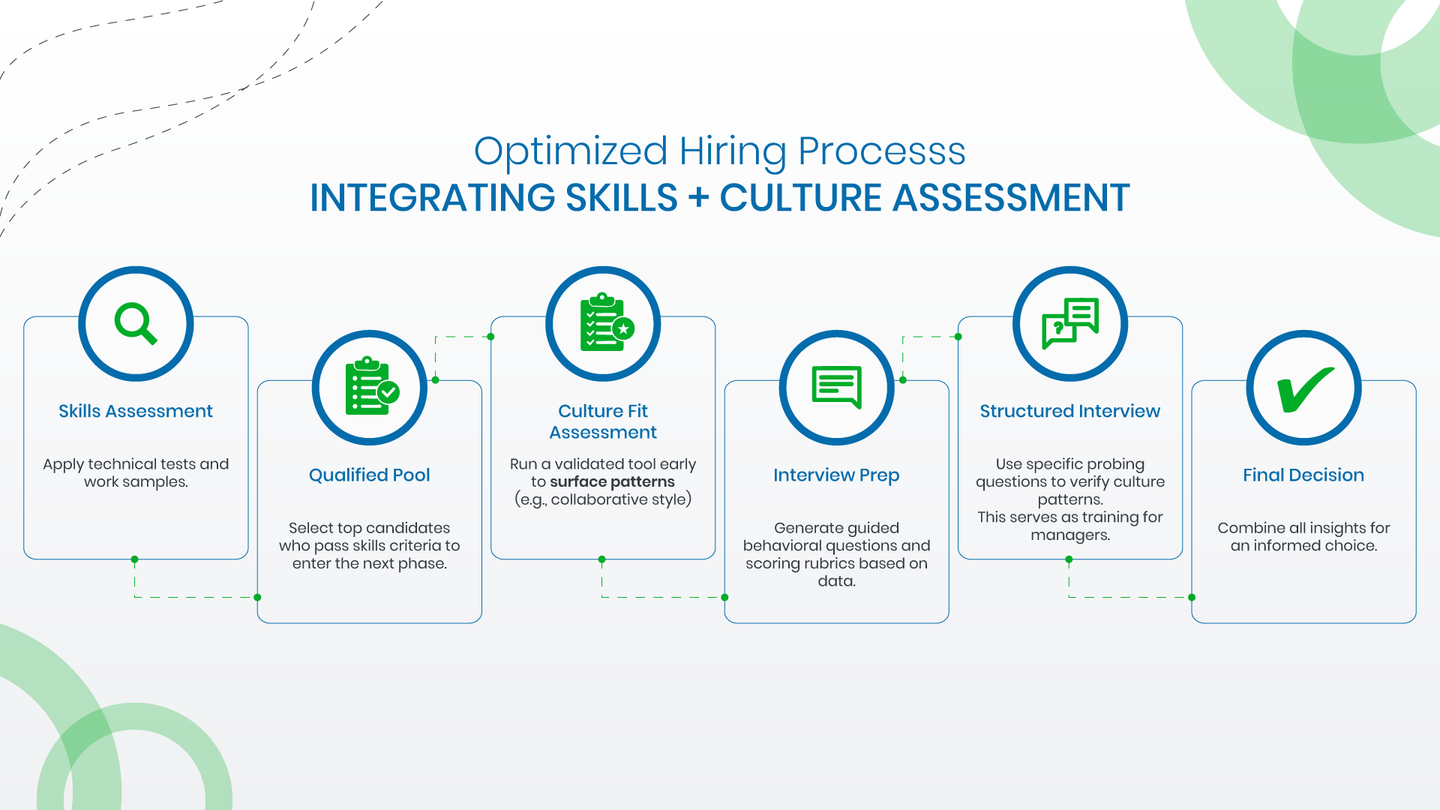
The most common recruitment strategy mistake is bolting cultural assessment into an existing process without thinking about sequencing.
- Run your skills assessment tools first. Then run cultural fit assessments on the qualified pool, earlier in the hiring process than most teams expect.
- Use structured prompts to guide interview questions and serve as training for hiring managers on what to probe, not to make hiring decisions. If cultural fit assessments flag a low "collaborative working style" score, that's a prompt to probe in the interview with a scoring rubric for consistency, not an automatic disqualification. Cultural fit assessments surface patterns. Behavioral interviews verify them.
- Share results with hiring managers before video interviews or in-person conversations, not after. Most will adapt their questions naturally when they can see the gaps. For consistency, some teams use blind scoring before sharing profiles. Waiting until debrief is less effective because everyone's already leaning toward a decision, which hurts inter-rater reliability.
- Don't use cultural fit assessments to screen for sameness. The recruitment and selection process works best when cultural tools protect workplace culture while avoiding homogeneity. Using validated assessments with blind scoring reduces unconscious bias. If you're combining pre-employment screening with cultural fit assessments for the first time, start with one role type and one tool before rolling it out broadly.
What Cultural Assessment Tools Won't Tell You
Assessments measure tendencies, not certainties. A candidate who scores well on every culture dimension and workplace adaptability test can still leave in three months if their manager is poor, the role isn't what was described, or the team shifts after a reorg. A weak cultural fit score on paper can turn out to be exactly the perspective your team needed.
They work best as one input among several, alongside behavioral interviews, reference checks, and onboarding that reinforces alignment from day one. For context, see skills assessment software and other assessment solutions that complement cultural tools. The teams that get the most from these tools treat them as a conversation starter, not a decision-maker.
Frequently Asked Questions
What is a cultural assessment tool?
A cultural assessment tool is an assessment instrument that measures how well a candidate's values, work style, and personality align with your organization and team. Unlike skills tests or traditional assessment center exercises, cultural fit hiring tools measure how someone prefers to work and whether that fits your environment. Most use validated psychological frameworks to measure behavioral traits and generate comparable scores for consistent candidate evaluation.
Are cultural assessments legally compliant?
Yes, when used correctly. Apply the same assessment to every candidate and don't use cultural fit as the sole basis for rejection. The EEOC requires selection tools don't create adverse impact against protected groups.
How long does a cultural assessment take?
Most cultural fit hiring assessments take 10 to 20 minutes, long enough to generate reliable data and short enough to keep completion rates high. Assessments above 30 minutes see meaningful dropout in high-volume hiring.
Can I use cultural assessments for internal hiring or promotions?
Yes, and this is one of the most underused applications. When someone is being considered for a lateral move or promotion, a cultural assessment surfaces whether their working style and team collaboration approach fits the new environment. It's particularly useful as a cultural fit hiring decision when promoting someone into management for the first time, where fit with the team they'll be leading matters as much as their individual track record.
What's the difference between culture fit and culture add?
Culture fit asks whether a candidate matches your company culture. Culture add asks whether they bring something that makes it better. The best soft skills assessment tools measure both. Too much fit creates homogeneous teams with shared blind spots. Too much add creates teams with no common ground. The goal is baseline alignment on values and working style, supporting diversity and inclusion in perspective and approach.
Choose the Right Cultural Assessment Tool for Your Team
Most HR teams make the same mistake: they focus heavily on skills screening but overlook cultural fit. This creates teams that can technically do the job but struggle to collaborate, communicate, or stick around past six months.
The tools on this list tackle these challenges in different ways. TestTrick is a practical starting point for pre-hire cultural fit. It combines skills assessments with culture screening all in one platform. Culture Amp is ideal if you want to measure and improve your organizational culture over time, not just screen for fit. Hogan is worth the investment for senior or executive hires, where a mis-hire can be costly.
The key is to start where your hiring process is breaking. Losing candidates to poor cultural fit? Begin with assessments. Lacking reliable culture data? Begin with measurement. Choose one tool, use it consistently, and let the insights guide your next steps.
TestTrick lets you screen for both skills and cultural fit before interviews, starting at just $49/month, with a 7-day free trial to get you started.
Build a Hiring-Ready Assessment
Create role-specific, anti-cheat assessments and shortlist candidates on evidence, not guesswork.
Start for freeBy Favour Etinosa Ogie
June 3, 2026
10 min read
Build a Hiring-Ready Assessment
Create role-specific, anti-cheat assessments and shortlist candidates on evidence, not guesswork.
Start for free